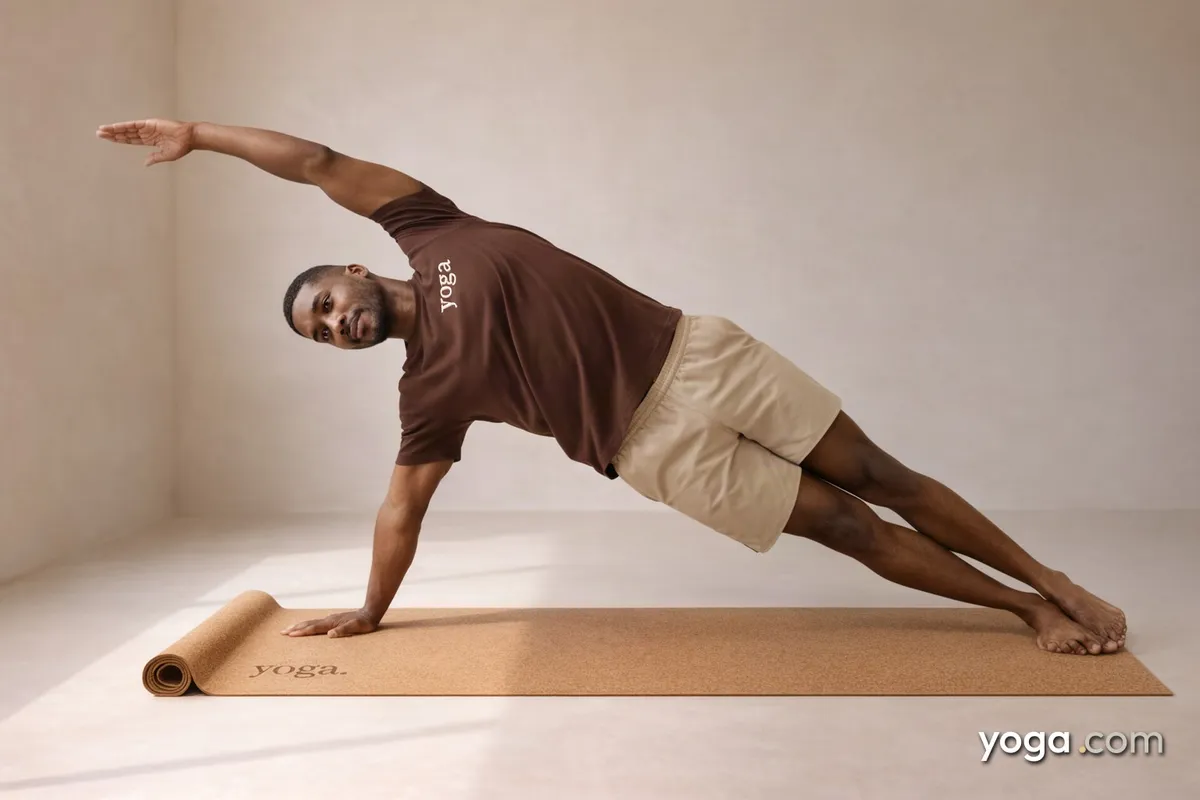
Side Plank with Overhead Arc, Right Arm Down - Vasiṣṭhāsana ("pose of the sage Vasiṣṭha") - is a side-plank arm balance that asks your right hand and forearm to bear your full body weight while your torso arcs upward and to the right, shortening the right waist and lengthening the left side of the body from hip to fingertips.
At a Glance
- Level: Intermediate
- Type: Arm Balance
- Targets: Right wrist and forearm muscles, right shoulder stabilizers, obliques, lateral hip muscles
- Good for: Wrist and forearm strength, lateral core control, shoulder stability, full-body alignment awareness
How to Do Side Plank with Overhead Arc, Right Arm Down
- Begin in Plank Pose. Stack your shoulders over your wrists, press all ten fingers evenly into the mat, and draw your core in and up so your hips are level with your shoulders.
- Shift onto your right hand. Roll to the outer edge of your right foot, stacking your left foot on top of your right. Your right wrist, elbow, and shoulder form one vertical line. Ground through the base of your index finger and thumb to protect the wrist joint.
- Press your hips up. Drive your right hip toward the ceiling so your body forms a straight diagonal line from right heel to crown. This hip lift is the foundation - let it happen fully before you attempt the bend.
- Raise your left arm overhead. Extend it toward the top of the mat, bicep near your left ear, palm facing down. Feel the left side of your body lengthen from left hip to left fingertips.
- Initiate the right bend. Keeping the hips lifted, arc your left arm up and over to the right, reaching it beyond your right hand. Simultaneously allow the right waist to shorten - the right lateral muscles work concentrically, drawing the right hip and right shoulder closer together like the inner arc of a bow.
- Breathe and hold. The right side of your torso is the compressed, active arc; the left side is the long, passive arc stretched overhead. Your hips remain high throughout - they should never sag toward the floor.
- Stack and check. Confirm that your right shoulder is not collapsing toward your ear. Keep it externally rotated, pressing the floor away, so the glenohumeral joint is stable under load.
- Exit with control. Bring your left arm back directly overhead, re-stack the hips to neutral side plank, then lower through Plank Pose and rest in a neutral position before switching sides.
Benefits
- Strengthens the wrist and forearm muscles. Holding the full body load on one hand under a lateral bend intensifies demand on the wrist flexors, extensors, and pronator-supinator group beyond standard side plank.
- Builds lateral core strength. The right obliques and quadratus lumborum contract concentrically to create and hold the rightward arc of the torso.
- Develops shoulder-girdle stability. The rotator cuff and serratus anterior on the right side must work continuously to keep the shoulder packed and the chest open under full body weight.
- Lengthens the left lateral line. With the left arm extended overhead and the torso bending away, the left intercostals, obliques, and latissimus dorsi receive a sustained stretch.
- Improves proprioceptive awareness. Balancing on one arm while managing a lateral arc trains fine motor control and real-time body-position sensing.
Common Mistakes and Alignment Cues
- Mistake: Hips sag toward the mat. Cue: Press the floor away with your right hand and drive your right hip ceiling-ward. A dropped hip collapses the shoulder and defeats the lateral arc.
- Mistake: Right shoulder creeps toward the ear. Cue: Actively draw the right shoulder blade down your back and broaden across the right collarbone to keep the joint stable.
- Mistake: Bending from the neck instead of the whole side. Cue: The arc should be visible from your right hip all the way through your left fingertips - initiate the curve at the waist, not the cervical spine.
- Mistake: Weight dumped into the heel of the right hand. Cue: Spread the fingers wide and press through the pads of all four fingers and the base of the thumb to distribute load across the entire wrist and forearm.
- Mistake: Left arm drops in front of the face instead of reaching long overhead. Cue: Chase length first - extend your left arm until the left side of your body is fully open before deepening the rightward arc.
Modifications and Props
If full side balance is not yet available, place your right knee down with the shin at a 45-degree angle behind you, reducing the load on the wrist and forearm while you practice the lateral arc. A folded blanket or wedge under the right wrist can reduce wrist extension for anyone building wrist and forearm tolerance. To deepen the challenge, try lifting the top leg a few inches once the arc is stable.
Cautions
Approach this pose carefully if you have wrist, elbow, or shoulder discomfort, as the right arm bears substantial load throughout. Those with lateral neck or rib injuries should skip the bend and practice standard side plank while tissue heals. If you're working with an injury or a medical condition, check with a qualified professional before practicing.