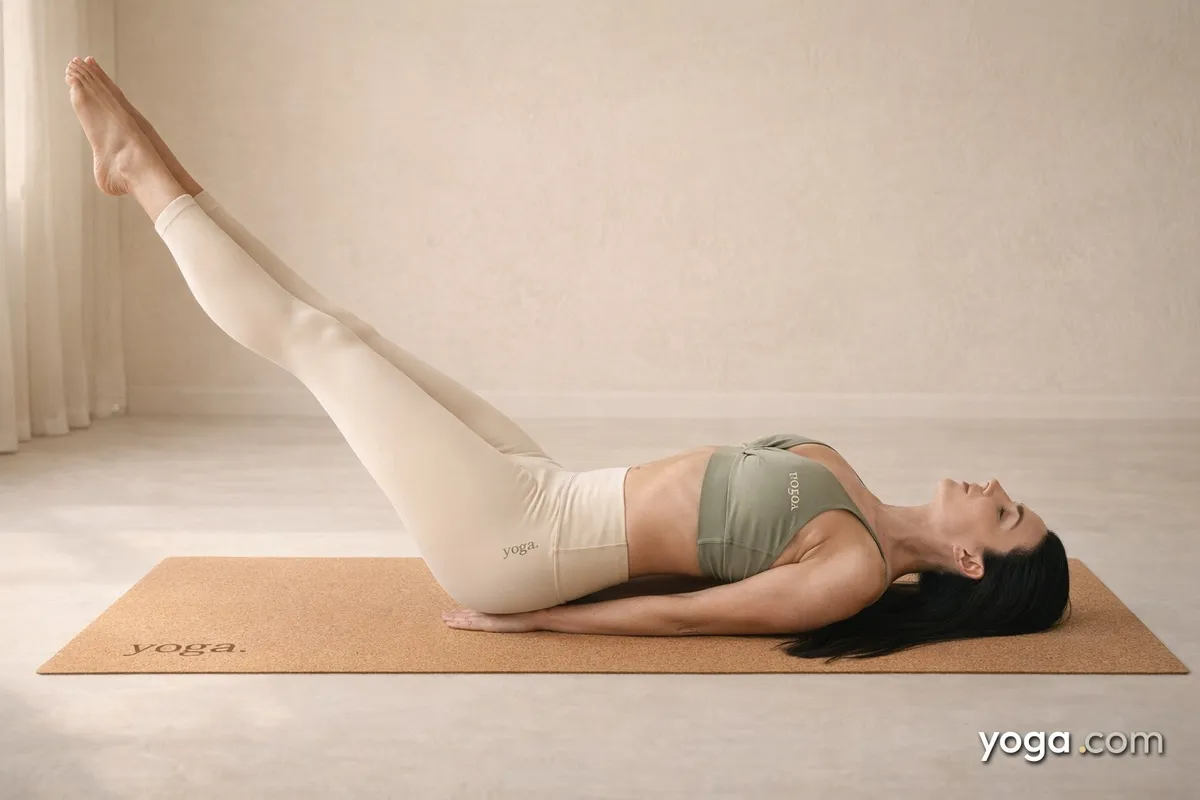
Fish Pose with Straight Legs Up is a supine backbend that combines the classic chest-opening arch of Matsyāsana (legs raised) - literally "fish pose" from the Sanskrit matsya (fish) and āsana (seat or posture) - with both legs extended vertically toward the ceiling. The addition of straight legs increases the demand on the core, hip flexors, and lower back, making this a more energizing and challenging variation than the traditional bent-knee form. It works well as a peak backbend in a moderate sequence or as a counter-pose after forward folds.
At a Glance
- Level: Intermediate
- Type: Backbend
- Targets: Chest and anterior shoulders, thoracic spine, hip flexors, core
- Good for: Building upper-back extension strength, lengthening the front body, improving postural awareness
How to Do Fish Pose with Straight Legs Up
- Lie flat on your back with your legs together and arms alongside your body, palms facing down.
- Slide your hands under your hips, palms pressing into the floor, with your elbows drawing toward each other beneath you.
- On an inhale, press firmly through your forearms and elbows to lift your chest. Arch your upper and mid-back off the mat, drawing your shoulder blades together and down.
- Carefully lower the crown of your head toward the floor - or rest it lightly there - so the throat opens and the cervical spine extends gently. Do not bear significant weight on the head.
- Engage your core and, on your next inhale, lift both straight legs to a 45-90-degree angle from the floor. Keep your feet flexed or pointed, inner thighs pressing together.
- Hold for 3-6 breaths, maintaining the chest lift and steady engagement through the abdomen. Gaze softly toward the ceiling or slightly behind you.
- To come out: lower your legs slowly to the mat on an exhale, keeping the core engaged throughout the descent.
- Press through your forearms to lift the head gently, then release the arch and lower your back to the floor. Rest in Corpse Pose for several breaths.
Benefits
- Stretches the intercostal muscles, anterior chest, and front of the shoulders.
- Strengthens the thoracic erector spinae and rhomboids through active extension.
- Builds isometric endurance in the hip flexors and lower abdominals as they support the raised legs.
- Increases mobility in the thoracic spine and sternocostal joints.
- Lengthens the anterior hip and psoas when the legs are held at a lower angle.
- Develops coordination between spinal extension and lower-body stability.
Common Mistakes and Alignment Cues
- Collapsing weight onto the head: The crown of the head rests lightly - the real support comes from your forearms and elbows. If your neck feels compressed, reduce your backbend until the head can float free.
- Letting the lower back over-arch: Keep your tailbone lengthening toward your heels and your lower abdominals gently drawn in; the arc should live in the mid-to-upper back, not the lumbar spine.
- Legs drifting apart: Press the inner thighs together and imagine the legs as one unit; this also stabilizes the pelvis and protects the lower back.
- Dropping the chest as the legs rise: The chest lift must come first and hold throughout. If the upper-back arch collapses when you raise the legs, lower the legs a few degrees or work the two actions separately before combining them.
- Holding the breath: Keep your breath full and even; a cramped exhale is a signal to soften or back off the height of the legs.
Modifications and Props
- Block under the thoracic spine: Place a block at its lowest height between the shoulder blades to support the backbend passively and let you focus on learning the leg-raise component.
- Legs at 45 degrees: If holding the legs vertical is too demanding on the hip flexors or lower back, keep them at a 45-degree angle. This reduces the load significantly while preserving the shape.
- Strap around the feet: Loop a strap around the soles and hold the ends in your hands to help keep the legs together and give the arms something to work against, which also reinforces the chest lift.
- Head supported: If you have neck sensitivity, skip the cervical extension entirely and rest the back of the head on a folded blanket, maintaining the thoracic arch with the chest still lifted.
Cautions
- Avoid this pose if you have a recent or acute neck injury; the cervical extension, even when lightly loaded, can aggravate the area.
- Approach with care if you have low-back sensitivity - focus on thoracic extension and reduce leg height to minimize lumbar compression.
- Those with high blood pressure should avoid prolonged holds with the throat open and chest lifted; come out sooner than you think you need to.
- Pregnancy: consult your midwife or OB before practicing any supine backbend past the first trimester.
If you're working with an injury or a medical condition, check with a qualified professional before practicing.
Related Poses
- Bridge Pose - a gentle preparation that opens the chest and strengthens the spinal extensors before the full fish arch.
- Cobra Pose - a prone backbend that builds familiarity with thoracic extension and shoulder-blade engagement.
- Upward-Facing Dog Pose - deepens the chest opening and anterior shoulder stretch as a natural next step.
- Corpse Pose - the ideal counter-pose to neutralize the spine and integrate after any backbend sequence.
For practice ideas, see A Gentle Yoga Routine for Tired, Low-Energy Days and A 10-Move Chair Yoga Sequence for a Midday Reset.