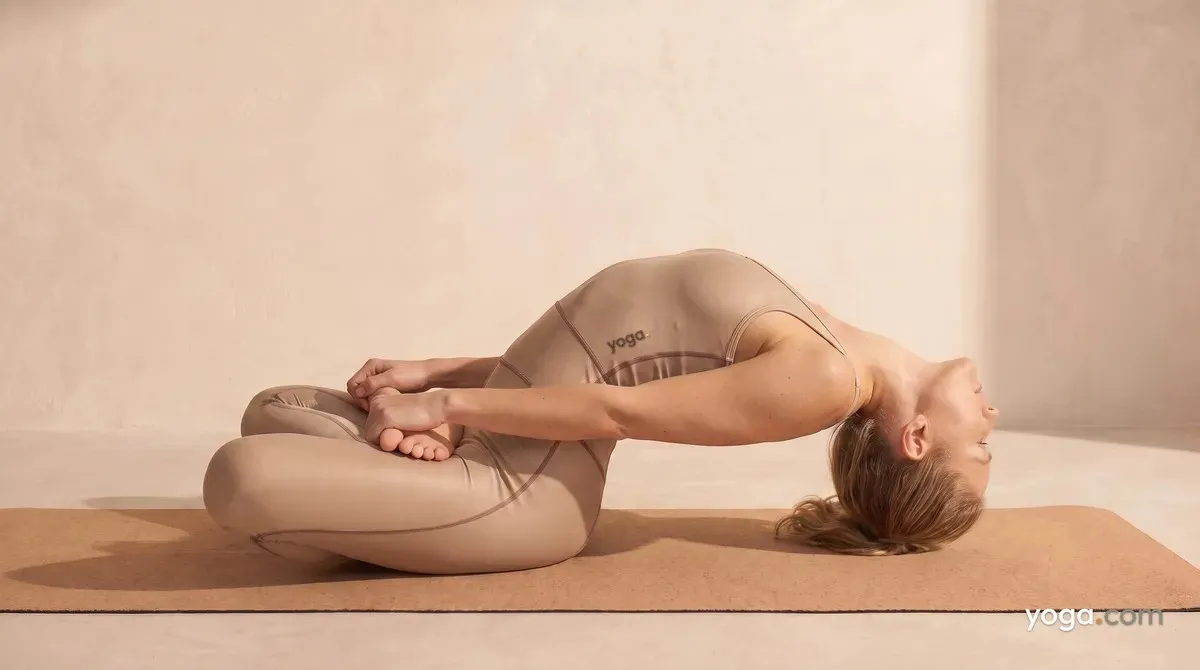
Fish Pose in Lotus Pose (Padma Matsyāsana - literally "lotus fish posture") combines the deep hip-opening of full Lotus with a supported thoracic backbend, creating an intense interplay between the lower and upper body. The shape lands naturally near the end of a seated or floor sequence, after the hips are thoroughly warmed and the spine is ready for extension.
At a Glance
- Level: Advanced
- Type: Backbend
- Targets: Thoracic spine, hip flexors, chest and anterior shoulders, quadriceps
- Good for: Expanding the anterior chest, mobilising the mid-back, deepening hip-flexor length in a static hold
How to Do Fish Pose in Lotus Pose
- Establish full Lotus. Sit upright on the floor and cross your legs into Padmāsana - right foot on the left thigh, left foot on the right thigh (or your preferred leg-order). Press both knees gently toward the floor and sit evenly on both sitting bones.
- Place your hands. Bring your palms flat to the floor just behind your hips, fingers pointing toward or slightly away from you. Press down to lengthen the spine before you begin to lower.
- Open through the chest. On an inhale, draw your shoulder blades together and down, lift the sternum, and begin to lean back onto your forearms. Let the elbows land on the floor, upper arms roughly parallel.
- Release the crown of the head. Continue arching the mid-back until the crown - not the back of the skull - rests lightly on the floor. The weight should be shared between your forearms and the crown; avoid dumping all load onto your neck.
- Take hold of the feet. Once you find the backbend, reach both hands forward and grasp the outer edges of your crossed feet - left hand to left foot, right hand to right foot. This is the classic expression of the pose. Keep the elbows lifted slightly off the floor or allow them to rest, whichever maintains spinal integrity.
- Breathe and hold. Direct your breath into the upper chest. Keep the throat soft, the jaw relaxed, and the gaze either straight up at the ceiling or softly toward the wall behind you. Hold for 5-10 slow breaths.
- Come out with control. Release the feet and return your hands to the floor beside the hips. Press into the palms and forearms, tuck the chin, and use your core to lift your head and torso back to upright - do not roll out by collapsing the neck.
- Counter and reset. Release Lotus, extend both legs, and take a seated forward fold or Corpse Pose for several breaths before repeating on the opposite leg-cross.
Benefits
- Stretches the anterior chest muscles (pectoralis major and minor) and the anterior deltoids.
- Mobilises the thoracic vertebrae into extension, counteracting prolonged flexion.
- Lengthens the hip flexors (psoas and iliacus) while the legs are held in the Lotus position.
- Strengthens the deep spinal extensors that control the backbend.
- Builds end-range hip external rotation and adductor flexibility through the sustained Lotus hold.
- Encourages full three-dimensional breathing by expanding the rib cage in all directions.
Common Mistakes and Alignment Cues
- Compressing the cervical spine: If most of your weight lands on the back of the skull or neck, walk your elbows closer together and lift the chest higher so the crown barely grazes the floor.
- Collapsing the lumbar into a crunch: The backbend should arc through the mid-back, not hinge at the lower back. Engage your core lightly and think of lengthening the tailbone toward the knees.
- Letting the knees fly up: If both knees lift off the floor when you recline, the hips aren't ready for this combination. Work on Lotus independently before adding the backbend.
- Jerking the head up to exit: Always return your hands to the floor first, press through the palms, and use abdominal strength to float the torso up with the chin leading - not the forehead.
- Forcing the feet-grip prematurely: Only reach for the feet once the backbend is stable. Rushing that step causes the chest to collapse and the neck to over-extend.
Modifications and Props
- Block under the upper back: Place a block (medium height) horizontally between the shoulder blades. This supports the thoracic backbend so you can focus on opening the chest without bearing weight on the crown.
- Half Lotus variation: If full Lotus is not yet available, take Half Lotus (one foot on the opposite thigh, the other leg crossed below) and recline into Fish. Alternate the leg that is on top each time you practice.
- Arms alongside the body: Instead of gripping the feet, slide the hands under the hips, palms down, and press the forearms into the floor to support the arch - a more accessible hand position that still builds the shape.
- Blanket under the head: If the crown doesn't reach the floor comfortably, fold a blanket to the exact height needed so the neck is not strained in the gap between the floor and the skull.
Cautions
- Neck or cervical spine issues: Any weight-bearing through the crown of the head is contraindicated if you have cervical disc problems or acute neck pain. Use the block modification instead.
- Knee injury or limited external rotation: Do not force the legs into Lotus if you feel pain in the knee joint. Lotus requires hip rotation, not knee torque; practice preparatory hip openers before attempting this combination.
- Lower-back sensitivity: Keep a mild engagement of the abdominal muscles throughout to avoid over-compressing the lumbar vertebrae in the backbend.
- Recent abdominal surgery or pregnancy: Avoid deep backbends that stretch the abdominal wall until cleared by your care provider.
If you're working with an injury or a medical condition, check with a qualified professional before practicing.
Related Poses
- Bridge Pose - an accessible backbend that warms the spine before deeper extensions.
- Upward-Facing Dog Pose - builds thoracic extension strength and anterior chest opening.
- Upward Bow Pose - a natural next progression once Padma Matsyāsana is steady.
- Corpse Pose - the ideal counter-pose to neutralise the spine after exiting.
For a quieter practice context, see A Gentle Yoga Routine for Tired, Low-Energy Days or A 10-Move Chair Yoga Sequence for a Midday Reset.