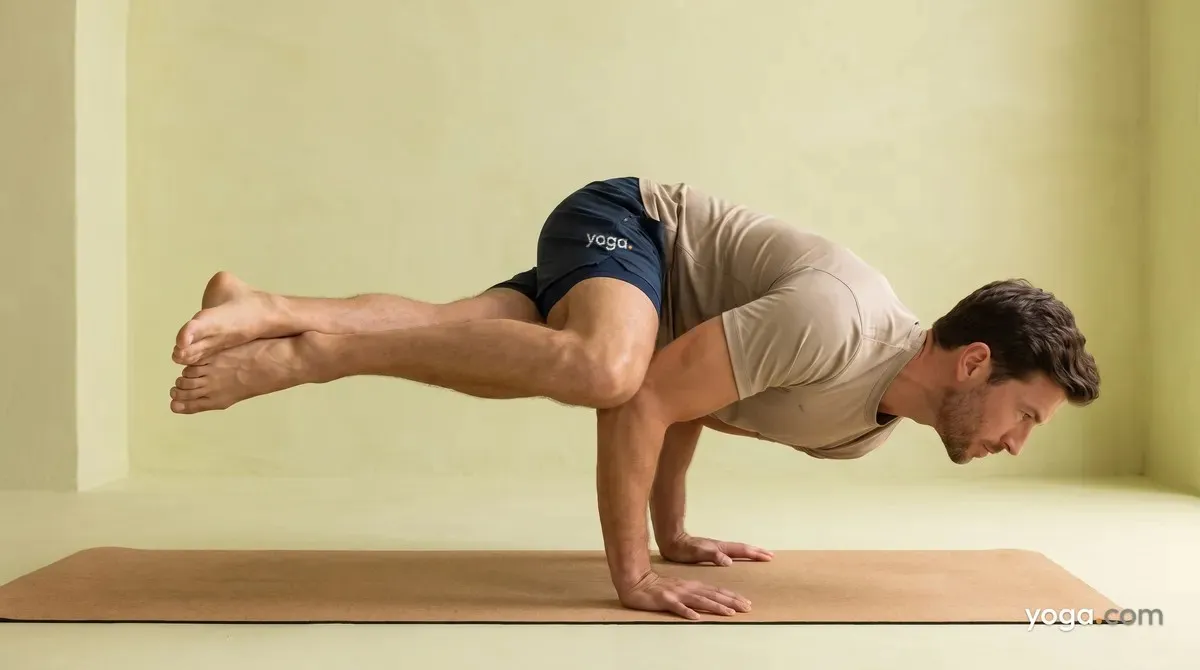
Eight Angle Pose - Aṣṭavakrāsana in Sanskrit, meaning "eight-angle" or "eight-crooked" - is a side-extending arm balance that asks your whole body to work as one interconnected unit. The pose is named for the sage Ashtavakra, whose body was bent in eight places. Here you create those angles deliberately: two hands, two elbows, two inner thighs, and two feet all press and hook against each other to keep you airborne. It is demanding, playful, and deeply satisfying once it clicks.
At a Glance
- Level: Advanced
- Type: Arm Balance
- Targets: Wrists, forearms, triceps, core (obliques and transverse abdominis), hip flexors, inner thighs, hamstrings
- Good for: Building upper-body pressing strength, developing core integration, improving proprioception and lateral stability
How to Do Eight Angle Pose
These instructions bring the left leg on top. To practice the right-side variation, swap every left and right cue.
- Start in a low squat. Come into a deep squat with your feet hip-width apart. Place both palms flat on the mat, shoulder-width apart, fingers spread wide. Shift your weight slightly forward so your arms begin to engage.
- Thread the left arm under the left leg. Lift your left foot and thread your left upper arm as high under your left thigh as possible - aim to get the thigh resting on the back of the left upper arm, just above the elbow. Press the thigh down onto the arm to lock it in place.
- Hook and cross the ankles - left ankle on top of right. Straighten both legs out to the left side as much as you can. Flex both feet strongly and hook the left ankle on top of the right ankle, squeezing the feet together. This grip is your foundation: the more actively you press the feet against each other, the more stable the whole pose becomes.
- Bend your elbows to Chaturanga depth. Begin to lean your torso forward and slightly left, transferring your weight into your hands. Bend both elbows to roughly 90 degrees - active arms with elbows bent and hugging the ribs - exactly as you would in Four-Limbed Staff Pose. Do not straighten the arms; maintaining this bend keeps the shoulders stable and the chest lifted as you shift your weight forward.
- Float the feet off the mat. Continue pressing your palms firmly into the floor and squeezing your inner thighs. As your center of gravity moves over your hands, your hips and legs will begin to rise. Let the legs extend out to the left, parallel to the floor. Keep pressing the left ankle down onto the right to prevent the feet from sliding apart.
- Find your horizontal line. Extend through the heels, firm the core, and lift the chest slightly so your spine stays long rather than rounding excessively. Gaze forward and slightly down. Breathe - hold for three to five steady breaths, maintaining that Chaturanga-depth elbow bend throughout.
- Come out with control. Bend the knees gently, lower the feet back to the floor, unhook the ankles, and slide your left leg free. Return to a squat, shake out the wrists, and rest in Malasana before switching sides.
Benefits
- Upper-body pressing strength: Sustained isometric load through the wrists, forearms, and triceps builds functional pressing endurance.
- Oblique and lateral core strength: Holding the legs parallel to the floor demands continuous engagement of the obliques and transverse abdominis on both sides.
- Hip flexor and adductor activation: Squeezing the ankles together and lifting the legs recruits the hip flexors and inner-thigh muscles in a uniquely loaded position.
- Proprioceptive refinement: Balancing on two hands while the body extends laterally trains spatial awareness and fine motor control through the shoulders and wrists.
- Shoulder stability: Protraction and depression of the scapulae under load develop the serratus anterior and lower trapezius in a functionally useful range.
Common Mistakes and Alignment Cues
- Mistake: Straightening the elbows to "lock in" the pose. Cue: Keep elbows bent at roughly 90 degrees and hugging the ribs throughout. Straightening shifts load dangerously into the passive structures of the elbow joint.
- Mistake: Letting the ankle grip go slack. Cue: Actively press the left ankle down onto the right and squeeze the feet toward each other. The ankle lock is what keeps the legs lifted - release it and the legs drop.
- Mistake: Collapsing the chest toward the floor. Cue: Spread the collarbones wide and lift the sternum slightly. Think of the chest moving forward and away from the thighs, not sinking between the arms.
- Mistake: Placing the thigh too low on the arm (near the wrist). Cue: Hook the thigh as high as possible on the back of the upper arm - above the elbow. A higher shelf gives the leg leverage to stay lifted.
- Mistake: Holding the breath while searching for balance. Cue: Exhale fully as you shift your weight forward. A steady exhale activates the deep core and makes the transition into the balance far smoother.
Modifications and Props
If the full expression feels out of reach, build the pose in layers. Place a folded blanket or block under each hand to add height, which reduces the range of motion required at the wrists and hips. Practice the ankle hook - left ankle on top of right, feet flexed and squeezing - while still standing or seated to ingrain the grip before adding the balance. Strengthen the arm and core components by holding Four-Limbed Staff Pose for extended counts and practicing Crane Pose regularly. If your thigh slides down the arm, rub a small amount of sweat into the skin or practice in a fitted top so the fabric creates traction.
Cautions
Avoid this pose if you are experiencing acute wrist, elbow, or shoulder pain, or if you have a recent injury to any of these joints. The sustained load on the wrists is significant; warm up thoroughly with wrist circles and tabletop wrist stretches before attempting the pose. Those with lower-back sensitivity should build adequate core strength first and enter the pose gradually rather than forcing the weight shift. If you're working with an injury or a medical condition, check with a qualified professional before practicing.
Related Poses
- Four-Limbed Staff Pose - develops the Chaturanga arm position and pressing strength that Eight Angle Pose depends on.
- Crane Pose - builds the core compression and hand-balance confidence that transfers directly into arm balances.
- Side Plank Pose on Left Hand, Legs Together - trains lateral core strength and the side-body integration required to hold the legs extended.
- Plank Pose - establishes the foundational shoulder stability and full-body tension needed for any arm balance.