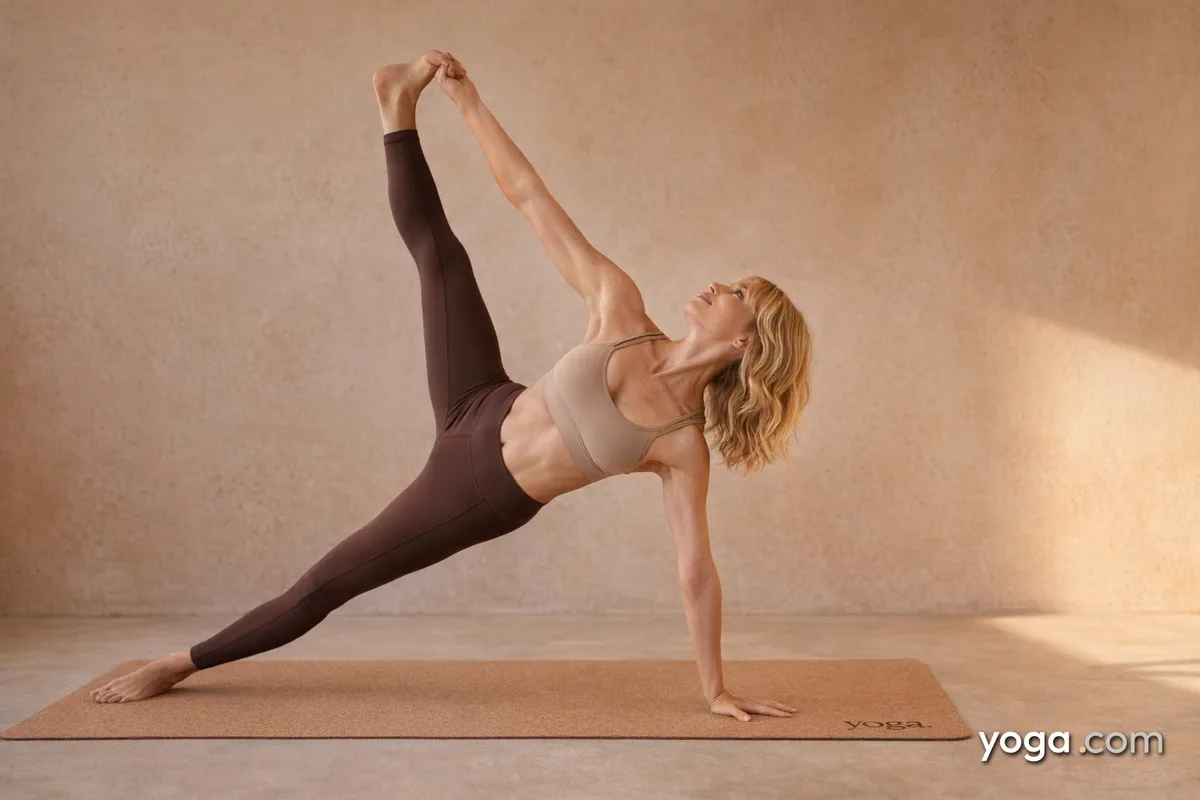
Side Plank Pose with Right Hand Grab is a demanding arm balance that builds on the foundation of Vasiṣṭhāsana (right hand grab) - named for the Vedic sage Vasiṣṭha, whose name translates roughly as "most excellent" or "best." In this variant, the right hand supports the entire body while the top hand reaches down to hold the outer edge of the raised foot, creating a full lateral arc from heel to crown. It fits naturally toward the peak of a strength-focused sequence, after the wrists, shoulders, and hips are thoroughly warmed.
At a Glance
- Level: Intermediate
- Type: Arm Balance
- Targets: Lateral core (obliques and quadratus lumborum), shoulder girdle, hip abductors, hamstrings of the raised leg
- Good for: Building wrist and shoulder stability under load; strengthening the obliques through a long lateral line; improving single-leg hip control
How to Do Side Plank Pose with Right Hand Grab
- Start in Plank Pose. Place your hands shoulder-width apart, fingers spread wide, index fingers pointing forward. Engage your core and press the floor away so the space between your shoulder blades is full.
- Shift onto the right hand. Roll onto the outer edge of your right foot, stacking your left foot directly on top of the right or placing it slightly in front for more stability. Your right arm extends straight, wrist below shoulder.
- Lift your hips. Press through the right hand and outer edge of the right foot to raise your hips until your body forms one straight diagonal line. Firm your right glute and engage the right oblique to keep the hip from sagging.
- Raise the left leg. With control, lift the left leg to hip height or higher, keeping the left hip stacked directly above the right. Flex the left foot strongly.
- Reach for the left foot. Extend your left arm upward first to open the chest, then hinge at the left hip and reach the left hand toward the outer edge (pinky-toe side) of the left foot. If the foot is out of reach, hold the left shin or ankle instead.
- Find your gaze. Look straight ahead or, if the neck is comfortable, gaze upward past the left shoulder. Breathe steadily for 3-5 full cycles.
- Come out with control. Release the left foot, re-extend the left arm overhead, then lower the left leg back to meet the right. Roll back to full Plank Pose on an exhale.
- Rest and repeat. Lower to the mat or move through a vinyasa before practicing the left-side equivalent.
Benefits
- Strengthens the obliques, transverse abdominis, and quadratus lumborum through an active lateral load
- Builds shoulder-joint stability and serratus anterior engagement in a weight-bearing position
- Stretches the hamstrings and hip flexors of the raised leg under active control
- Develops unilateral hip-abductor strength as the top leg works against gravity
- Improves balance and proprioception through a reduced base of support
Common Mistakes and Alignment Cues
- Mistake: Hip sinks toward the floor. Cue: Drive the right outer hip up and imagine pressing your right foot through a wall beside you - the lateral force lifts the hips.
- Mistake: Supporting wrist collapses inward. Cue: Spread all five fingers, press evenly through the heel of the hand, and micro-rotate the right elbow crease forward to protect the joint.
- Mistake: Chest rotates toward the floor when grabbing the foot. Cue: Keep the left shoulder rolling open toward the ceiling; think of the grab as a secondary action, not the main event.
- Mistake: Top leg drops below hip height. Cue: Flex the left foot hard and imagine kicking the left heel away from you - that muscular effort keeps the leg elevated.
- Mistake: Neck cranes upward with tension. Cue: Lengthen through the crown first; your gaze follows only as far as the neck allows without strain.
Modifications and Props
- Lower the supporting knee: Place the right knee on the mat (shin angled back) to reduce the load on the wrist and shoulder while you work on the foot grab.
- Use a strap: Loop a strap around the left foot and hold the strap with the left hand so you can straighten the arm and open the chest without forcing hamstring flexibility.
- Hold the shin or ankle: If the foot is out of reach with a straight arm, grip the shin or ankle instead - the lateral line is still fully engaged.
- Place the right hand on a block: Setting a block under the right palm raises the floor and reduces the wrist angle, easing strain for tighter wrists.
Cautions
- Wrist sensitivity: Avoid this pose if you have an acute wrist injury or carpal tunnel flare; the full body weight bears on a single palm.
- Shoulder instability: If the supporting shoulder feels unstable or impinged, build more strength in standard Side Plank before adding the foot grab.
- Tight hamstrings or hip flexors: Forcing the top leg upward can strain the hip or lower back - use a strap and work within your available range.
- Neck issues: Keep the gaze neutral (forward) rather than looking up if you have cervical disc concerns.
If you're working with an injury or a medical condition, check with a qualified professional before practicing.
Related Poses
- Plank Pose - the essential preparation for building the wrist and core strength this pose demands
- Side Plank Pose on Left Hand, Legs Together - the complementary side and a direct prerequisite for the foot-grab variation
- Downward-Facing Dog Pose - a useful counter-pose to decompress the wrists and re-lengthen the spine after the lateral hold
- Upward-Facing Dog Pose - opens the front body and reinforces shoulder extension, balancing the intense lateral work
Looking for ways to work these poses into a fuller practice? See A Gentle Yoga Routine for Tired, Low-Energy Days and A 10-Move Chair Yoga Sequence for a Midday Reset.