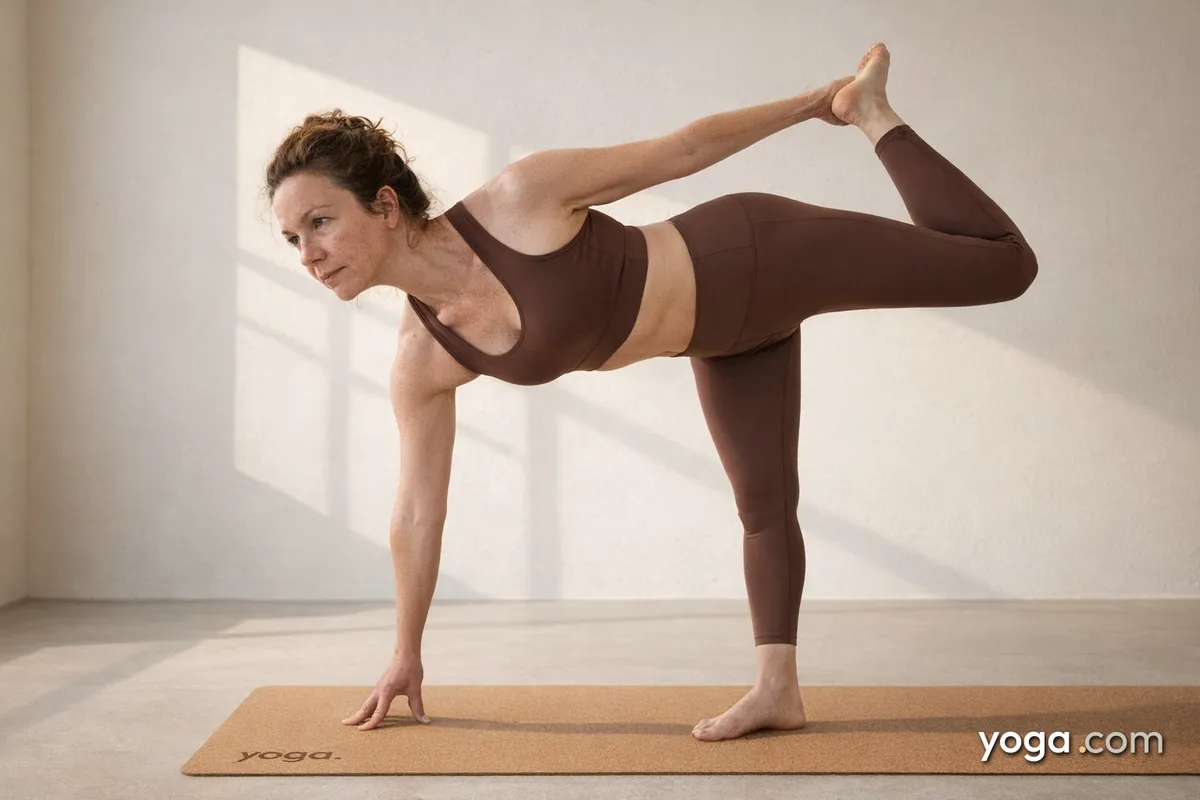
Half Moon Pose with Stretch is a demanding standing balance that adds an active quad stretch to the classic one-legged lateral extension. In Sanskrit it is called Ardha Candrāsana (with stretch) - ardha meaning "half," candra meaning "moon" - and the "stretch" refers to the lifted leg's knee bending so the top hand can catch that foot, deepening the front-line stretch through the quads and hip flexors. It typically appears in the peak or heat of a standing sequence, once the hips and spine are well warmed.
At a Glance
- Level: Intermediate
- Type: Balance
- Targets: Standing-leg hip stabilizers, quadriceps, thoracic spine, shoulder girdle
- Good for: Building single-leg stability, lengthening the hip flexors and quads of the lifted leg, developing rotational awareness in the torso
How to Do Half Moon Pose with Stretch
- Set your foundation. Begin in Warrior II with your right foot forward. Place a block (or the floor) about 12 inches ahead of your right pinky toe. Straighten your right leg, shift your weight forward, and lift your left foot off the mat, coming into standard Half Moon Pose - right hand on the block, left arm extending toward the ceiling, left leg parallel to the floor.
- Stabilize the standing leg. Press evenly through all four corners of your right foot. Firm the right thigh without locking the knee; engage the outer right hip to keep the pelvis level.
- Open the torso. Stack the left hip directly over the right, and rotate the chest open to the left. Gaze forward or, if your neck is comfortable, toward your top hand.
- Bend the lifted knee. On an exhale, bend your left knee and draw the left foot toward your left buttock. Keep the left thigh roughly parallel to the floor - resist the urge to let it drop.
- Catch the foot with the top hand. Reach your left hand back and take hold of the top of your left foot or ankle. If the foot is not accessible yet, loop a strap around the ankle.
- Press foot into hand, hand into foot. Create isometric resistance: press the foot away from your body while the hand holds firm. This action lifts the chest, draws the shoulder blades together, and deepens the quad stretch without compressing the lower back.
- Hold and breathe. Stay for 5-8 full breaths, keeping the gaze steady and the bottom hand lightly on the block for balance support.
- Come out with control. Release the foot, extend the left arm back toward the ceiling, then bend the right knee and lower the left foot to the mat. Return through Warrior II or step back to Mountain Pose. Repeat on the left side.
Benefits
- Strengthens the gluteus medius and hip abductors of the standing leg, building lateral hip stability.
- Stretches the quadriceps and hip flexors of the lifted leg through an active, loaded position.
- Challenges proprioception and fine motor control of the ankle and foot.
- Builds shoulder stability as the top arm works to hold the foot against resistance.
- Encourages thoracic rotation and extension, counteracting rounded-upper-back posture.
- Develops concentration and breath control under muscular demand.
Common Mistakes and Alignment Cues
- Mistake: The lifted thigh drops toward the floor when the knee bends. Cue: Before catching the foot, deliberately lift the left thigh higher so there is "room" for the knee to flex without the leg sinking.
- Mistake: The standing knee collapses inward. Cue: Micro-bend the right knee and press the inner right thigh outward; think of screwing the right foot into the floor without actually moving it.
- Mistake: The torso collapses forward, losing the chest opening. Cue: Draw the left shoulder back strongly - imagine threading the top arm through the space behind you - to maintain the open-stack rotation.
- Mistake: Gripping the foot pulls the lower back into compression. Cue: Ease the grip and rely on the isometric press of foot against hand; keep the tailbone long rather than arching sharply.
- Mistake: The gaze wanders, destabilizing balance. Cue: Fix the eyes on one unmoving point at floor level or straight ahead; a wandering drishti is usually the first signal the core has softened.
Modifications and Props
- Block under the bottom hand: Use the block at its tallest height if your hamstrings or hip flexors are tight; this raises the floor so you can keep the torso upright without collapsing.
- Strap around the lifted foot: If your hand cannot reach the foot, loop a strap around the top of the ankle and hold both ends. This lets you work the press-and-resist action without forcing the shoulder or rounding the back.
- Wall at your back: Practice with your back near a wall. If you lose balance, the wall catches you. You can also lightly press the lifted foot into the wall to create resistance instead of using the hand.
- Skip the foot catch: Keep the lifted leg straight in classic Half Moon Pose until the standing-leg balance is rock-solid before adding the quad stretch variation.
Cautions
- Knee concerns: Deep knee flexion of the lifted leg may be uncomfortable with certain knee conditions; skip the foot catch and keep the lifted leg extended.
- Hip or sacroiliac instability: The one-legged lateral position places significant demand on the hip and SI joint; move slowly and avoid forcing the pelvis into a deep stack if you feel strain there.
- Wrist or shoulder issues: If bearing weight on the lower wrist is uncomfortable, use a fist or fingertips on the block, or practice against the wall without the bottom hand on the floor.
- Vertigo or inner-ear conditions: The strong balance demand and gaze changes can be disorienting; work close to a wall and keep the gaze at floor level.
If you're working with an injury or a medical condition, check with a qualified professional before practicing.
Related Poses
- Warrior Pose on Left Foot - an essential preparation that warms the hips and grounds the standing-leg mechanics.
- Tree Pose on Right Foot - a gentler single-leg balance to build the hip stability this pose demands.
- Lord of the Dance Pose (Left) - a natural progression that deepens the quad stretch and backbend component explored here.
- Advanced Extended Left Hand to Big Toe Pose - a counter-balancing challenge that works the opposite hip and hamstring line.
Looking for sequences that build toward standing balances? See A Gentle Yoga Routine for Tired, Low-Energy Days for a foundation-first approach, or try A 10-Move Chair Yoga Sequence for a Midday Reset to practice hip and balance work accessibly.