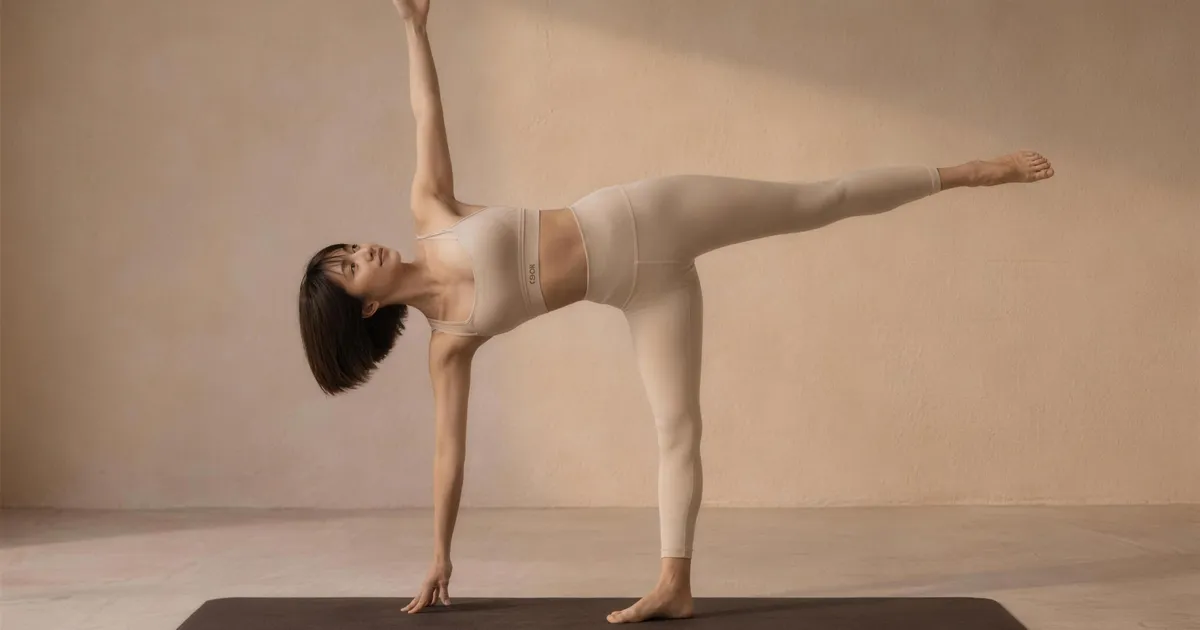
Half Moon Pose (Ardha Candrāsana - literally "half moon posture") is a standing balance that demands equal parts strength and openness. You stand on one leg, extend the other parallel to the floor, and open the entire front body to the side wall, embodying the luminous arc of a half moon. It typically appears mid-sequence after Triangle Pose or Warrior II, where the hip and hamstring have already warmed up.
At a Glance
- Level: Intermediate
- Type: Balance
- Targets: Standing leg and glutes, hip abductors, obliques, shoulders
- Good for: Building single-leg stability, strengthening the lateral chain, improving spatial awareness
How to Do Half Moon Pose
- Start in Triangle Pose on your right side, right foot forward, left hand on your left hip, right fingertips resting lightly on the floor or a block outside your right foot.
- Bend your right knee and walk your right hand (or block) about 12 inches forward along the floor, directly below your right shoulder. Shift your weight onto the right foot.
- Lift your left leg as you straighten the right leg. Raise the left leg until it is roughly parallel to the floor, foot flexed and toes pointing toward the left wall.
- Stack your hips by rotating the left hip open toward the ceiling. The pelvis, chest, and shoulders all face the left wall, not the floor.
- Extend your left arm straight up toward the ceiling, palm facing left. Draw the left shoulder blade toward your spine to keep the shoulder open rather than rounding forward.
- Gaze can be downward for stability, forward at the horizon, or upward toward your top hand - choose the option that lets you breathe evenly and keep the standing hip firm.
- Hold for 5-8 breaths. Press actively through both feet - the standing foot into the mat and the lifted heel away from the hip - to engage the full lateral line.
- To exit, bend the right knee, lower the left foot back to the mat, and return to Triangle Pose. Repeat on the left side.
Benefits
- Strengthens the quadriceps, glutes, and hip abductors of the standing leg
- Stretches the hamstrings of the standing leg and the inner groin; engages the hamstrings of the lifted leg as the heel reaches actively away from the hip
- Lengthens the lateral trunk - obliques and intercostals - on both sides
- Builds shoulder stability and thoracic rotation as the top arm reaches overhead
- Trains proprioception and single-leg balance coordination
- Engages the deep core muscles to stabilize the spine against gravity
Common Mistakes and Alignment Cues
- Collapsing the standing hip inward: Press the standing hip firmly out to the side so the pelvis stays level and the outer glute stays active.
- Letting the top hip roll forward: Draw the top hip crease back and up to keep both hips stacked on the same vertical plane as the side wall.
- Dumping weight into the floor hand: Use the block or fingertips only for orientation - the standing leg should carry your weight. Try hovering the hand briefly to check.
- Shortening the lifted leg: Reach the raised heel away from the hip as if pushing a wall; this activates the hamstring and keeps the leg from sagging.
- Gripping the neck to look up: If gazing upward strains the neck, return the gaze to the floor - the shape of the pose is unchanged.
Modifications and Props
- Block under the hand: Place a block on its highest, medium, or lowest height beneath the standing-side hand. This lifts the floor to meet you and makes the rotation much more accessible.
- Wall behind the back: Stand with your back a few inches from a wall. Rest the back of the lifted leg and the back of the top arm lightly against the wall for proprioceptive feedback and greater confidence.
- Foot on the wall: Press the lifted foot flat against a wall at hip height. This gives the raised leg a stable reference point so you can focus on rotating the torso open.
- Top hand on the hip: Keep the top hand on the hip instead of reaching overhead to reduce the balance demand and make the hip stacking easier to feel.
Cautions
- Ankle or knee instability: Move slowly into and out of the pose, and use a block to reduce the lateral lean on the standing joint.
- Neck issues: Keep the gaze neutral (toward the floor or straight ahead) rather than rotating the head upward.
- Hip replacement or recent hip surgery: The degree of hip rotation in this pose may not be appropriate; work within your surgeon's movement guidelines.
- Low blood pressure or dizziness: Use the wall variation and avoid shifting the gaze upward, which can increase disorientation.
If you're working with an injury or a medical condition, check with a qualified professional before practicing.
Related Poses
- Tree Pose on Right Foot - foundational single-leg balance that builds the hip stability Half Moon requires
- Warrior Pose on Left Foot - strengthens the standing leg and opens the hip in preparation
- Eagle Pose (Right) - complementary standing balance that challenges proprioception from a different plane
- Advanced Extended Left Hand to Big Toe Pose - a natural progression once Half Moon feels steady
Looking for sequences that include standing balances? See A Gentle Yoga Routine for Tired, Low-Energy Days and A 10-Move Chair Yoga Sequence for a Midday Reset.