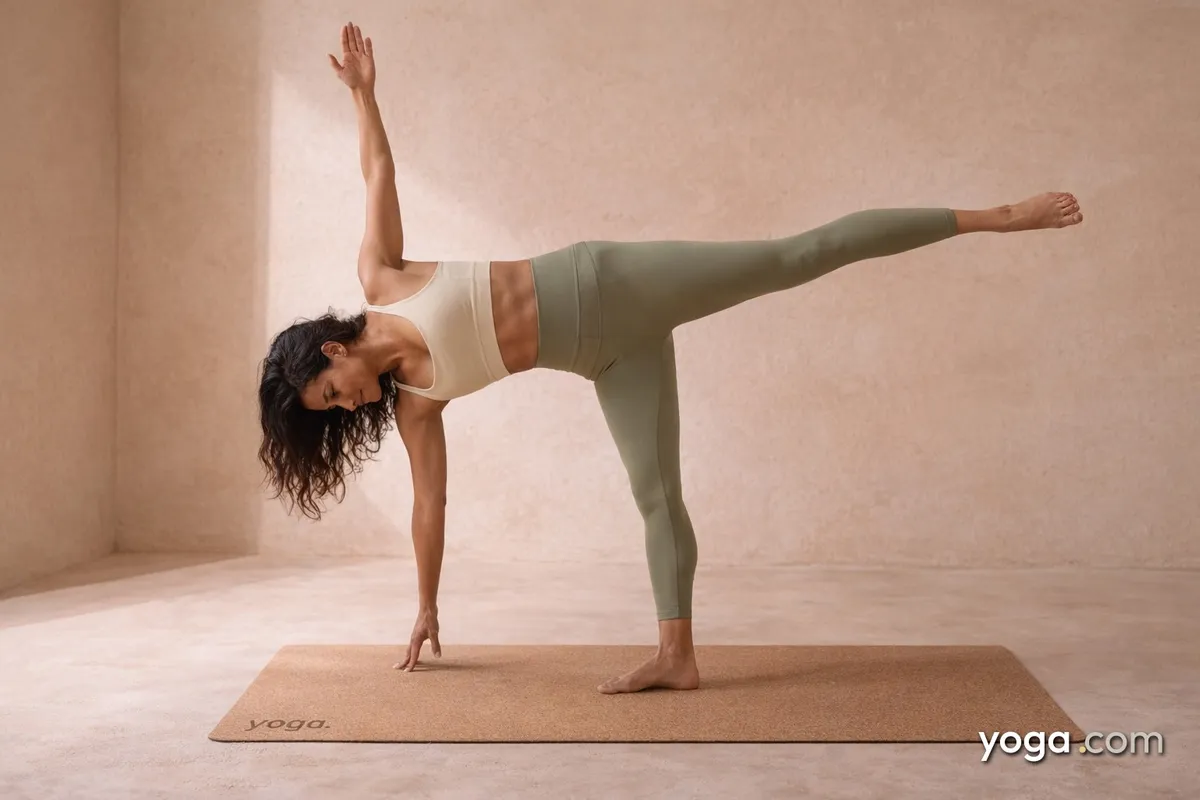
Half Moon Pose (Ardha Candrāsana (right side) - literally "half moon pose") is a standing balance that opens the body into a single lateral plane, with the right leg grounded and the left leg lifted parallel to the floor. It appears naturally after Warrior II or Triangle Pose on the right side, asking you to shift your weight onto one foot and find steadiness as you expand in four directions at once.
At a Glance
- Level: Intermediate
- Type: Balance
- Targets: Standing hip and glute (right side), hip abductors (left side), obliques and lateral trunk, shoulders
- Good for: Building single-leg stability, lengthening the lateral body, developing proprioception and coordination
How to Do Half Moon Pose (Right)
- Start in Triangle Pose (right side). Stand with your feet wide apart, right foot turned out 90°, left foot slightly in. Extend your right hand toward the floor and your left arm overhead.
- Bend the right knee and walk your right fingertips forward about 12 inches - roughly one foot's length in front of your right pinky toe. Place a block under your right hand if the floor feels far away.
- Shift your weight entirely onto the right foot. Press firmly through the right heel and the ball of the foot as you begin to float the left foot off the floor.
- Straighten the right leg (a soft micro-bend at the knee is fine) and lift the left leg until it is roughly parallel to the floor. Flex the left foot strongly, spreading through the toes as if pressing against a wall behind you.
- Stack the hips. Rotate the left hip open toward the ceiling, so both hip points face the left wall. The pelvis is in the same plane as the torso - avoid pitching forward.
- Extend the left arm straight up, fingers reaching toward the ceiling so both arms form one long vertical line. Keep the right shoulder drawing back; avoid collapsing into it.
- Set your gaze (drishti). Look down at the floor for stability, straight ahead for moderate challenge, or up at the left thumb for the fullest version.
- To exit, bend the right knee, step the left foot back to its wide Triangle stance position, then rise into Triangle or Warrior II. Pause for two breaths before moving to the left side.
Benefits
- Strengthens the quadriceps, hamstrings, and glutes of the standing (right) leg
- Activates the hip abductors and external rotators of the lifted (left) leg
- Stretches the inner thighs, groins, and the lateral trunk on both sides
- Builds shoulder stability and trains the scapular stabilizers under an open-chain load
- Challenges proprioception and single-leg balance, training ankle and knee stability over time
- Lengthens the spine laterally and engages the obliques to resist lateral collapse
Common Mistakes and Alignment Cues
- Collapsing into the supporting shoulder: Draw the right shoulder blade toward the spine so the chest stays broad - imagine the floor pushing your hand away rather than bearing your weight.
- Hip rotating forward (closing): Actively externally rotate the left thigh so the left hip stacks directly above the right. Think "left hip to the ceiling."
- Lifted foot drooping or turning inward: Flex the left foot with the toes pointing toward the left wall; this activates the hip abductors and keeps the pelvis level.
- Locking the standing knee into hyperextension: Maintain a slight, intelligent bend in the right knee - engage the quadriceps rather than jamming the joint.
- Gaze causing neck strain: If looking up compresses the neck, keep the gaze neutral and forward until the pose feels stable from the core outward.
Modifications and Props
- Block under the right hand: Place a block at its tallest height just outside the right pinky toe. This shortens the distance to the floor and allows the torso to stay long rather than crunching sideways.
- Wall at the back: Stand a few inches in front of a wall and rest the left heel against it. The wall gives instant feedback on hip rotation and lets you focus on the upper body and gaze.
- Half Moon at the wall (full support): Practice with your back body against the wall - right hand on a block, left leg lifted, everything pressing lightly into the wall - to feel the correct alignment without the balance demand.
- Lower the lifted leg: If the hip abductors fatigue quickly, lift the left leg to only 45° rather than parallel. Height is far less important than a level pelvis and open hip.
Cautions
- Ankle or knee instability: Approach this pose gradually; sudden balance demands on an unstable joint can lead to a fall. Use a block and the wall until single-leg strength is consistent.
- Hip or sacroiliac sensitivity: Avoid forcing the lifted hip to open if you feel pinching or sharp sensation at the hip socket or SI joint. Keep the lifted leg lower and the rotation modest.
- Neck issues: Skip the upward gaze; keep the head in line with the spine and look straight ahead.
- Inner ear or vestibular conditions: Balance poses can trigger dizziness; fix the gaze on a single point close to the floor and have a wall or chair within reach.
- If you're working with an injury or a medical condition, check with a qualified professional before practicing.
Related Poses
- Tree Pose on Right Foot - a gentler single-leg balance to build the foundational stability this pose requires
- Warrior Pose on Left Foot - shares the same wide-leg stance family; useful preparation for the hip and leg strength needed here
- Advanced Extended Left Hand to Big Toe Pose - a natural progression that deepens single-leg balance with an active hamstring stretch
- Downward-Facing Dog Pose - a grounding counter-pose to reset the spine and hamstrings after the lateral demand of Half Moon
Looking for sequences that build toward standing balance? See A Gentle Yoga Routine for Tired, Low-Energy Days and A 10-Move Chair Yoga Sequence for a Midday Reset.