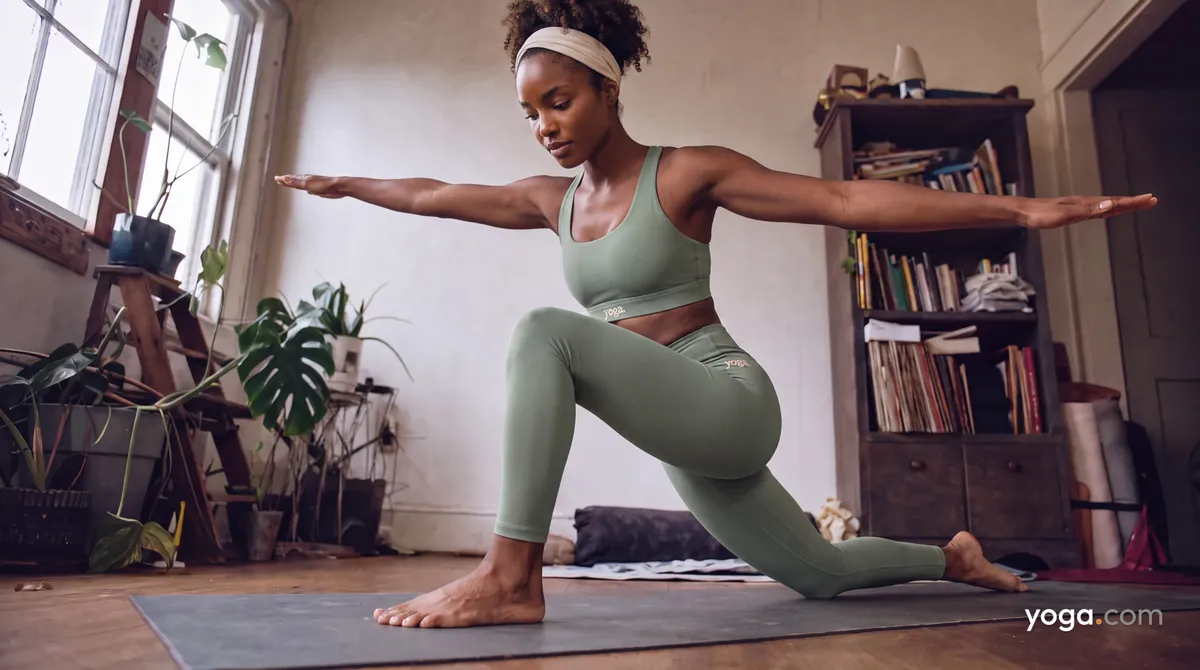
You came to yoga to feel better - and your knees have other ideas. That dull ache after Warrior Two, the twinge in a deep squat, the tightness that creeps in during seated poses: these are signals worth listening to. The good news is that most yoga-related knee trouble is preventable, and understanding a few key alignment principles makes all the difference.
Your Knee Is Not the Real Problem (Usually)
The knee is mostly a hinge joint and it bends and straightens very well, but the knee was never built for significant rotation or side-to-side forces. When the hip above it or the ankle below it is stiff, restricted, or misaligned, the knee quietly absorbs the excess stress. You feel the pain in your knee, but the real source of that pain is often somewhere else entirely. Keep in mind that the knee itself is not always the body part that needs your attention first.
Think of it this way: tight hip flexors in Warrior One (Virabhadrasana I) can tip the pelvis forward and push the front knee inward, and so the knee ends up taking on forces that were never meant for it. That inward collapse - called a valgus position - loads the inner knee with forces it was not designed to handle, especially over dozens of repetitions per class. On top of that, your knee keeps absorbing those forces class after class because the real problem in your hip goes unaddressed.
What the Research Says About Yoga Knee Injuries
A 2025 medical big data analysis of 89 yoga practitioners with knee injuries identified five independent risk factors:
- High body mass index
- Low self-protection awareness - not knowing what misalignment feels like
- Frequent forward-bending postures
- Insufficient sports medicine knowledge among instructors
- Incomplete curriculum design
That second point really matters and you should not overlook it. Not knowing where your knee is in space is a documented risk factor, which means that your body awareness is not just a soft skill here because it actively protects your knee from harm. Keep in mind that awareness of misalignment is a real, researched part of staying safe in yoga practice.
There is also promising evidence on the other side of the ledger. A 2025 prospective study of adolescents with anterior knee pain found that an 8-week yoga protocol produced a 23.82-point improvement in knee function scores (Pedi-IKDC) and this was a meaningful, statistically significant result. On top of that, this finding shows that yoga, when yoga is practiced with care, can support your knee health rather than undermine your knee health.
The Poses That Demand the Most From Your Knees
Triangle Pose (Trikonasana)
Triangle Pose looks like a simple stretch and not a load-bearing challenge - but the data says otherwise. A 2021 biomechanical study of 13 experienced female yoga practitioners found that Triangle Pose produced the largest range of motion at the hip (90.5°), knee (68.8°), and ankle (46.4°) of the poses tested. The knee moved into slight extension and adduction while generating the largest knee joint adduction moments - a loading pattern associated with increased osteoarthritis risk. Triangle Pose places real mechanical demand on your knee joint, even though it may not feel that way from the inside.
Stance width matters here too. A 2022 study found that increasing stance width in Trikonasana increased leading-limb loading and decreased trailing-limb loading - meaning the distance between your feet directly changes how force is distributed through each leg and so your stance width is something you should pay close attention to.
The fix: Experiment with a slightly narrower stance if you feel strain in the front knee. Keep a micro-bend in the front knee rather than locking the front knee into full extension. Let your torso come up higher if needed - depth is not the goal, joint integrity is.
Warrior Two (Virabhadrasana II)
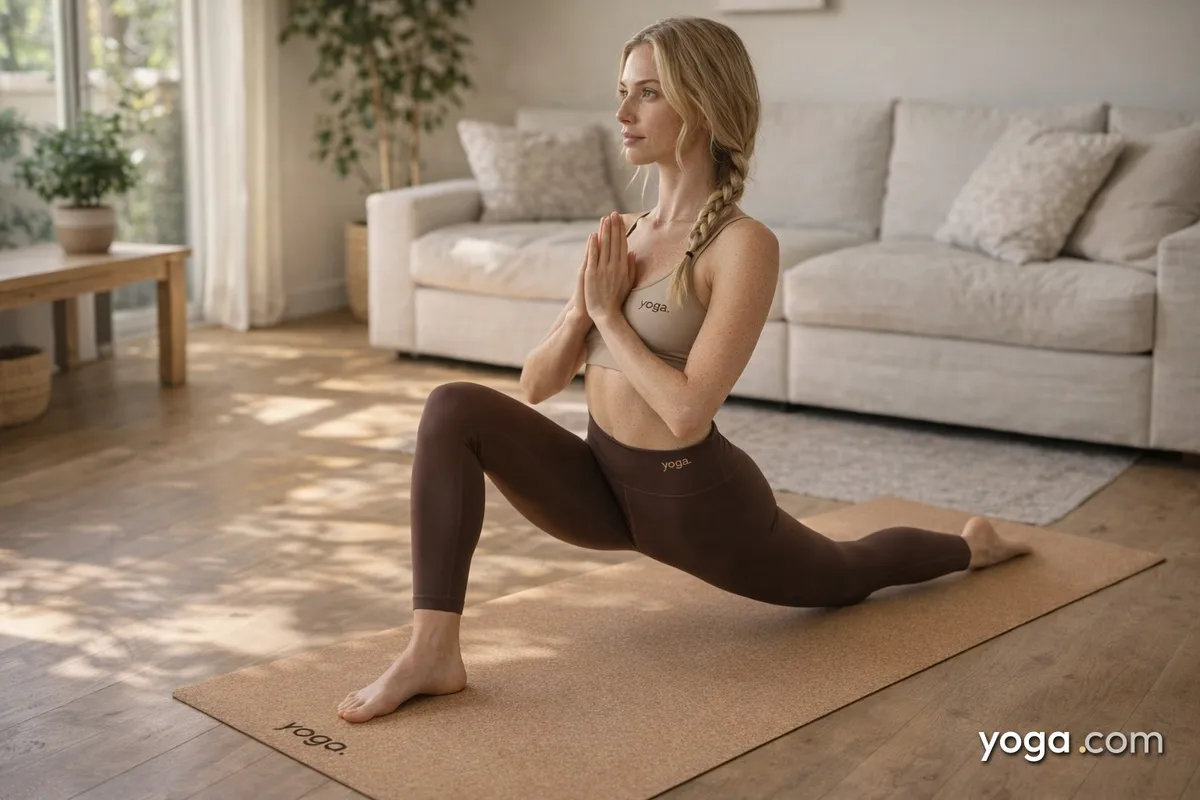
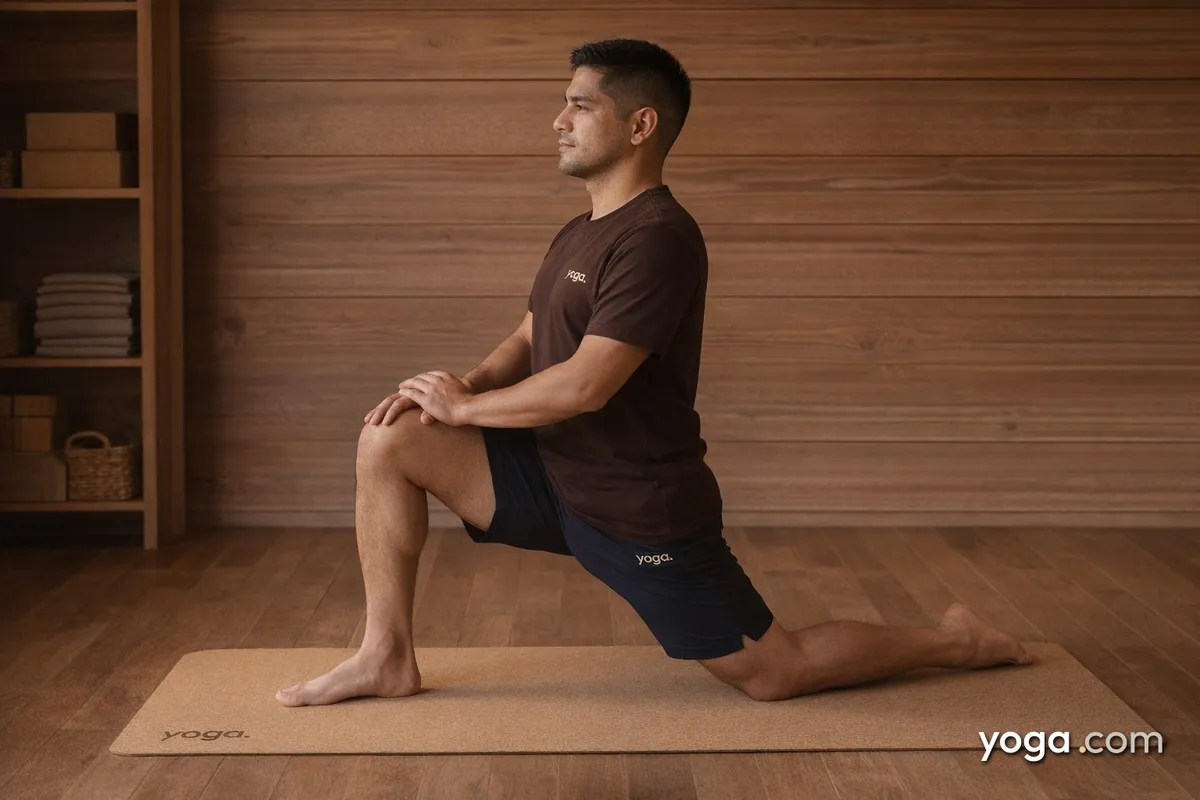
The front knee is under load in Warrior Two, and the most common mistake is letting the front knee drift inward as you sink deeper.
The fix:
- Stack the front knee directly over the ankle - not past it.
- Draw the kneecap toward the second toe.
- Press evenly through the back foot so the front arch doesn't collapse.
- If the knee won't stay aligned, come up higher. There is no prize for a deeper lunge with a wobbling knee.
Modify if: You have a medial collateral ligament issue. Work in a high lunge with the front knee at 90° or less until alignment holds easily.
Hero Pose (Virasana)
The patellofemoral joint - the front of the knee where the kneecap sits - takes significant compression when the knee folds fully and so forcing your seat to the floor before your body is ready is a fast route to pain. Keep in mind that the patellofemoral joint is not designed to handle that kind of forced compression.
The fix:
- Place a block or firm bolster under your seat to lift the hips and reduce the knee angle.
- Try tucking a small rolled towel into the back of the knee to decompress the joint space.
- Work progressively: block on its tallest setting first, then medium, then flat.
Skip it if: You feel any sharp pinching at the front of the knee. A supported cross-legged seat is a perfectly valid alternative.
Garland Pose / Deep Squat (Malasana)
At the bottom of a full squat, the meniscus and posterior joint capsule are under load and heels lifting off the floor and knees caving inward compound the stress on these structures considerably. On top of that, most people do not realize how much extra strain the knees take when the heels are not fully grounded.
The fix:
- Place a folded blanket under your heels if your heels lift - keeping heels grounded is non-negotiable.
- Actively push the knees out over the second and third toes.
- Try a wall-supported squat: lower only as far as your heels stay flat and your knees stay aligned.
Skip the full depth if: You have a history of meniscus injury. A high squat with knees at roughly 90° is a safer entry point - consult your physiotherapist before going deeper.
Lotus and Half-Lotus (Padmasana)
The rotation in Lotus is meant to come entirely from the hip. When the hip does not have enough range of motion, that rotation gets pushed down into the knee - and the knee, as a hinge joint, is not equipped to handle that kind of rotation because the knee is simply not built for it. The lateral ligaments pay the price when your knee is forced to compensate for what the hip cannot do.
The fix:
- Never use arm strength to force the top leg into position.
- If your hip stops rotating, stop there. The knee will not compensate safely.
- Work on hip openers - like Reclined Pigeon (Supta Kapotasana) - as preparation, not a shortcut.
Skip it if: You have any existing knee ligament or cartilage issues. Half-Lotus carries the same risks in a milder form and so Half-Lotus should not be treated as a safe substitute without guidance. Seated cross-legged (Sukhasana) with a blanket under the hips is a wise long-term alternative while your hip mobility develops.
Five Alignment Habits Worth Building Right Now
- Track the knee over the second toe in every standing pose with a bent knee. Glance down - it takes two seconds and tells you everything.
- Never lock the standing knee. A soft micro-bend keeps the joint muscles active and reduces sudden compressive load.
- Let the hip do the rotating. In external-rotation poses, if the hip stops, the pose stops. The knee is not a backup rotator.
- Use props without apology. Blocks, blankets, and bolsters are precision tools, not signs of limitation.
- Tell your teacher about any knee history before class begins. A good instructor will offer modifications; instructor knowledge is a documented protective factor.
When to Step Back and See a Professional
Mild muscle fatigue after class is normal. Sharp pain, clicking with pain, swelling, or any sensation that lingers more than 24 hours is not. If you experience any of these, stop the practice that provoked it and consult a physiotherapist or sports medicine physician before returning to those poses. Yoga is a long game - protecting the joint now keeps you on the mat for years.
Protect the Knees You Have
Your knees do not have to be a liability in yoga; they can genuinely get stronger and more mobile with the right approach. The practice works when you treat alignment as useful information and not as an inconvenience, so keep in mind that you need to track the knee, respect the hip's limits, use your props, and speak up in class. On top of that, small adjustments made consistently add up over time and those small adjustments build a practice that supports your body rather than slowly wearing your body down. Keep in mind that this is exactly what you came here for, and your knees deserve that kind of honest, steady attention.
Sources
- PMC / Medicine - Risk factors for knee injury in yoga practitioners (2025)
- PubMed - Stance width effects on lower extremity loading in Trikonasana (2022)
- PMC - Biomechanical analysis of triangle pose in experienced female yoga practitioners (2021)
- PMC - Yoga protocol for anterior knee pain in adolescents (2025)