A standing yoga sequence is exactly what it sounds like: a series of poses practiced on your feet, one flowing into the next, that strengthens your legs while steadying your attention. It builds real strength from the ground up and anchors you in the present moment. Whether you're brand new to yoga or looking to deepen a regular practice, this guide gives you a safe, effective sequence you can start today.
Before you begin: If you have a knee condition, hip injury, or chronic back pain, please check with a healthcare provider or physical therapist before starting this or any new exercise sequence. This article is educational and isn't a substitute for individual medical advice.
Why Standing Poses Build Both Strength and Stability
Standing poses demand something from almost every major muscle group at once. Your quadriceps, glutes, and calves are holding you up. Your core is steadying your spine. Your hips are working to keep everything aligned. That layered effort is exactly what makes this style of practice so efficient.
The American College of Sports Medicine recommends that every adult perform activities that maintain or increase muscular strength and endurance for a minimum of two days per week. A consistent standing yoga practice can meaningfully contribute to that goal.
Different poses also target different parts of the leg. You'll typically feel Warrior I (Virabhadrasana I) in the front thigh and the back-leg hip flexors, and Warrior II (Virabhadrasana II) along the outer front thigh. Chair Pose (Utkatasana) hammers the front of the thigh hard. Moving through a full sequence means you're working all those muscles, not just one.
The Sequence: Pose by Pose
Work through these poses in order. Hold each one for three to five full breaths - long enough for the muscles to actually do something. Repeat the standing poses on both sides before moving on.
1. Mountain Pose (Tadasana)
Stand with feet hip-width apart, arms relaxed at your sides. Feel all four corners of each foot pressing into the floor. Grounding starts here - not as a metaphor, but as a physical sensation of weight and stability.
- Common mistake: Locking the knees and thrusting the ribs forward.
- Fix: Keep a soft micro-bend in the knees and let the lower ribs gently drop.
2. Warrior I (Virabhadrasana I)
Step one foot back, turn the back foot out about 45 degrees, and bend the front knee deeply over the second toe. Square your hips toward the front of your mat and lift your arms overhead. Front knee position in this pose matters directly for your safety.
- Common mistake: The front knee drifting inward toward the big toe.
- Fix: Actively press the front knee out so it tracks over the second and third toes. If you have a knee condition, keep the bend shallow.
3. Warrior II (Virabhadrasana II)
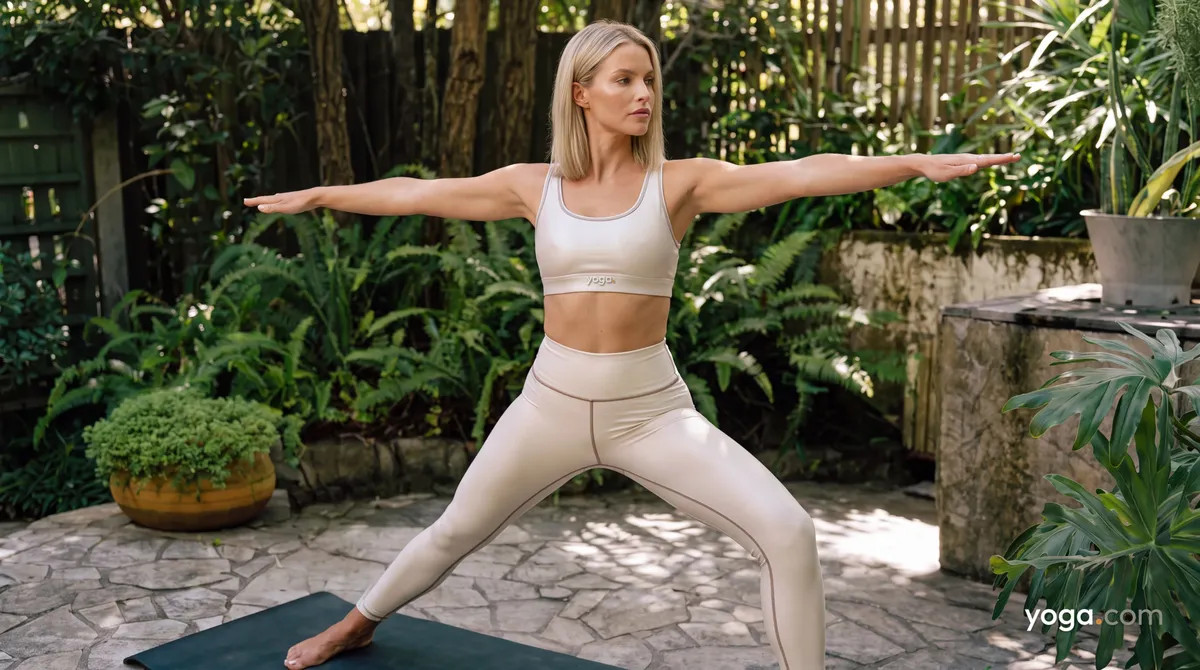
From Warrior I, open your hips and arms wide so your torso faces the long side of the mat. The front knee stays bent, the back leg stays strong and straight. Gaze over your front fingertips. Your torso should stay upright - not leaning forward - throughout the pose.
- Common mistake: Letting the front knee collapse inward or the torso lean forward.
- Fix: Stack the front knee directly over the ankle and keep your torso upright between both arms.
4. Extended Triangle Pose (Utthita Trikonasana)
Straighten both legs, then reach your front hand down toward your shin or a block while your top arm extends toward the ceiling. This pose stretches the hamstrings of the front leg and the side body while keeping the legs engaged. A long spine here is more important than reaching your hand lower.
- Common mistake: Rounding the spine to reach lower.
- Fix: Prioritize a long spine over depth - rest your bottom hand on a block if needed. If you have a hamstring strain, bend the front knee slightly.
5. Chair Pose (Utkatasana)
Stand with feet together or hip-width apart, then sit your hips back and down as if lowering onto a chair behind you. Arms reach forward or overhead. This is the most demanding pose in the sequence for the thighs and lower back - keep weight in your heels throughout.
- Common mistake: Weight rolling onto the toes, lower back over-arching.
- Fix: Keep weight in your heels and draw your lower ribs in. If your lower back feels strained, reduce the depth of your squat.
How to Breathe Through Hard Moments
When a pose gets intense, the temptation is to hold your breath. Don't. Your breath is your clearest signal about whether you're working productively or pushing past your edge.
Keep your inhales and exhales long and steady. If your breathing becomes ragged or stops, ease up - try straightening the front knee a little, narrowing your stance, or coming out of the pose entirely. Easing up when your breath breaks down is smart training, and smart training is what helps you improve over time.
Real Risks Worth Knowing
Standing poses are safe for most people, but a few alignment details matter a lot for your joints.
The single most protective habit in any deep lunge or Warrior pose is tracking your front knee over your second and third toes. When the knee caves inward, more stress is placed on the inner structures of the knee - stress it was never designed to absorb. This one alignment habit protects your knee more than almost anything else you can do in these poses.
A few other sensible guidelines:
- Dull muscle burn during a pose = normal, healthy effort.
- Sharp or pinching joint pain = come out immediately.
- Mild muscle soreness the next day = common after unaccustomed effort and usually nothing to worry about.
- Persistent joint pain after practice = consult a doctor or physical therapist before continuing.
Research evaluated by the Agency for Healthcare Research and Quality found that yoga improved pain and function in people with low-back pain in both the short and intermediate term, but individual circumstances vary and professional guidance protects you.
How to Modify for Your Level
You do not have to earn the "full" version of a pose before the pose is worth doing. Every modified version still works your muscles and builds your strength.
- Narrow your stance to reduce the load on your knees and hips.
- Reduce your bend in any Warrior - a shallower knee angle still works the muscles.
- Use a wall for balance in single-leg poses like Warrior III (Virabhadrasana III). Place one hand on the wall and remove it when you feel ready.
- Use a block under your bottom hand in Triangle to keep your spine long without straining.
- Progress slowly - widening your stance or deepening your bend a little more each week adds up quickly over a month.
Working with a Teacher
If you are new to standing poses, even two or three sessions with a qualified teacher can make a real difference. A good teacher spots alignment issues - especially knee and hip tracking - that you simply cannot see in yourself. Look for a Registered Yoga Teacher (RYT) credential through Yoga Alliance as a baseline signal of training hours.
A yoga credential is not a medical qualification. Your teacher can guide your alignment but cannot diagnose or treat injuries. If you are returning from an injury, loop in your doctor or a physical therapist to confirm your practice is safe for your specific situation.
Before You Go
Building a standing yoga sequence for strength and grounding is one of the most accessible ways to develop genuine lower-body power, improve balance, and feel more at home in your body - all at once. Start with Mountain Pose, move through the Warriors and Triangle, finish with Chair, and breathe through all of it. Keep your knees tracking over your toes, listen to your body's signals, and build gradually. The strength and steadiness you're looking for show up one held pose at a time.