Joint-friendly yoga is exactly what it sounds like: a way of practicing that protects your knees, wrists, and shoulders instead of quietly stressing them. You came to yoga to feel better - more mobile, less stiff, more at home in your body - and without a little know-how, the same poses that promise relief can work against you. The good news: a few targeted adjustments make an enormous difference.
Before you begin: If you're managing osteoarthritis, a meniscus injury, patellofemoral syndrome, a joint replacement, or any other joint condition, check with your healthcare provider or physical therapist before starting or intensifying a yoga practice. This article is educational and isn't a substitute for individual medical advice.
Real Risks, Real Numbers
Practiced thoughtfully, yoga is widely used to support mobility and joint comfort - but it carries real risks when approached carelessly. 21.4% of yoga practitioners in one study reported acute adverse effects, typically after years of practice, and 10.2% reported chronic adverse effects that lingered over time.
That's not a reason to avoid the mat. It's a reason to get smart about how you use it.
Which Poses Carry the Most Joint Risk?
Hand-, shoulder-, and headstands were the most commonly reported practices associated with acute adverse effects, accounting for 29.4% of acute cases. These inversions place intense demand on the wrists, shoulders, and cervical spine - especially when alignment isn't dialed in.
Pace matters too. Power yoga users reported the highest injury rate at 1.50 injuries per 1,000 hours of practice, compared to an average of 0.60 across all styles. A faster practice gives your joints less time to signal discomfort before something goes wrong. If you're newer to yoga - or managing any joint sensitivity - a slower, alignment-focused class is almost always the safer starting point.
Your Knees: The Joint That Needs the Most Attention
The knee is a hinge joint asked to do heavy rotational work in yoga, which it wasn't designed for. Deep flexion, weight-bearing twists, and poses that pull the knee out of neutral alignment are the most common culprits.
Sharp or pinpoint pain in the knee during a pose is a signal to stop - not breathe through. A healthy stretch feels like a broad, dull pull across a wide area. A warning sign feels pointed and specific.
Modify These Common Poses to Protect Your Joints
Props aren't a sign of weakness - they're how experienced practitioners stay injury-free for decades. Here's how to adapt four frequently problematic poses.
Child's Pose (Balasana)
- The risk: Forcing the hips all the way to the heels compresses the back of the knee joint.
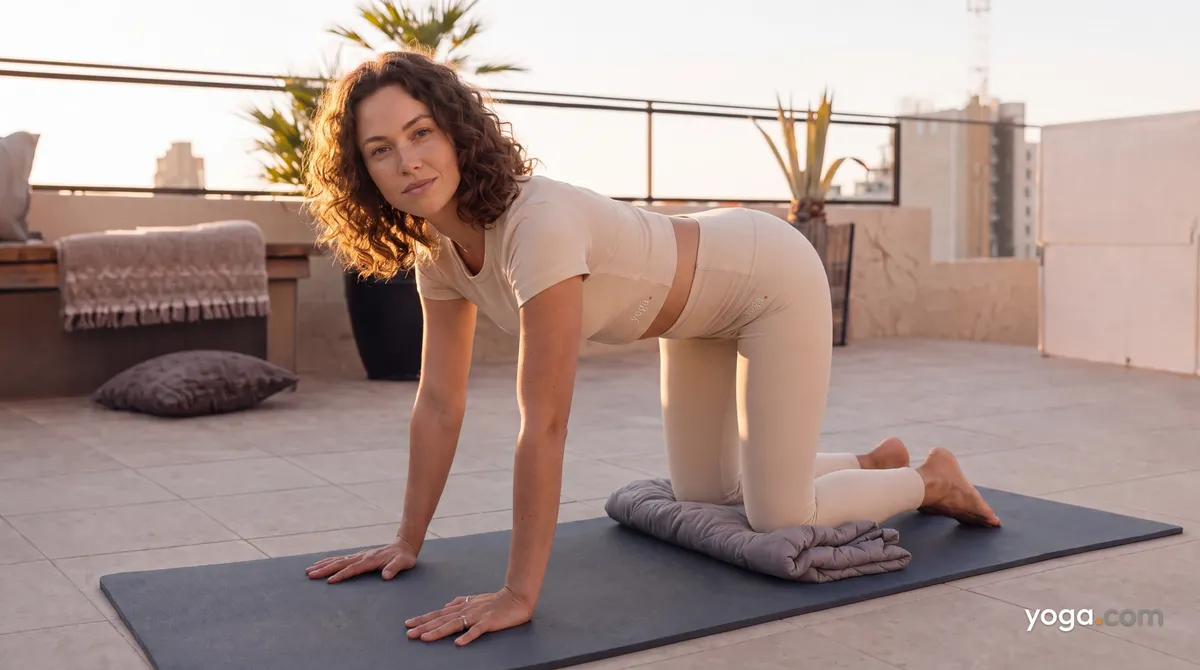
- The fix: Place a folded blanket or block between your thighs and calves to reduce knee flexion. Your hips don't need to reach your heels to get the benefit.
- Skip if: You have an acute knee injury or recent knee surgery.
Hero Pose (Virasana)
- The risk: Sitting directly on the floor demands deep knee flexion that strains the patellofemoral joint.
- The fix: Sit on a block, bolster, or stacked blankets between your feet. Even a few inches of height dramatically reduces compressive load.
- Skip if: You have a meniscus tear, MCL injury, or recent knee replacement.
Pigeon Pose (Eka Pada Rajakapotasana)
- The risk: When the hip isn't open enough, the knee absorbs the rotation, stressing the medial knee structures (MCL and medial meniscus).
- The fix: Do Reclined Pigeon instead. Lie on your back, cross one ankle over the opposite thigh, and flex that foot. You get the same hip-opening stretch with zero weight bearing through the knee.
- Skip the floor version if: You have any medial (inner) knee pain, a meniscus injury, or MCL history.
Yogi Squat (Malasana)
- The risk: Heels lifting off the floor shifts weight forward and increases shear force at the knee.
- The fix: Place a rolled blanket under your heels, or sit on a low block. This keeps the joint from closing fully at the end range where compression is highest.
- Skip if: You have patellofemoral syndrome - use a chair-supported version instead.
Protecting Your Wrists
Weight-bearing on the hands - Plank, Downward-Facing Dog (Adho Mukha Svanasana), and Crow Pose (Bakasana) - compresses the wrist joint. Without proper form, that load adds up.
- Spread your fingers wide and press actively through every knuckle, not just the heel of the hand. This distributes load across the whole palm.
- Keep your wrist crease parallel to the front of your mat in Dog and Plank. Turned-in hands dump weight onto the outer wrist.
- Use wedges or fists if you have wrist pain - these reduce the angle of extension that strains the joint.
- Build up gradually. Forearm-based alternatives (Dolphin Pose / Ardha Pincha Mayurasana instead of full inversions) let you develop shoulder strength before adding wrist load.
Protecting Your Shoulders
The shoulder is the most mobile joint in the body - which also makes it easy to misuse. Handstands and shoulder stands were among the top contributors to acute yoga injuries, but subtler strain builds up in everyday poses too.
- In Downward Dog: Externally rotate your upper arms (roll your biceps toward each other) to create space in the shoulder socket rather than jamming into it.
- In Chaturanga Dandasana: Keep your elbows hugging your ribs and your shoulders level with - or above - your elbows. Many teachers cue stopping at elbow height to reduce load on the front of the shoulder.
- In Warrior I and II (Virabhadrasana I and II): Relax your shoulder blades down your back rather than letting them ride up toward your ears.
- If you have existing shoulder issues, skip full Shoulder Stand (Salamba Sarvangasana) and Plow (Halasana) until you've spoken with a physical therapist or sports medicine doctor.
Pain Versus Sensation
Every teacher worth their training will tell you this: sensation is expected, pain is not. A productive stretch feels broad, diffuse, and eases with breath. Stop immediately if you feel anything sharp, pinching, or joint-specific. Soldiering through joint pain in yoga is one of the most reliable ways to turn a minor issue into a chronic one.
If you're working with a specific joint condition, your doctor or physical therapist can help you identify which modifications are right for your situation.
How to Choose the Right Class
Your instructor's knowledge of joint mechanics matters. Look for teachers who:
- Ask about injuries before class begins
- Offer modifications proactively - not just when someone complains
- Have training in therapeutic yoga, anatomy, or adaptive teaching
- Slow down to explain alignment rather than just cuing the next transition
Styles like Iyengar yoga, Viniyoga, and Restorative yoga tend to build in the most structural support for joints and naturally embody joint-friendly yoga throughout every session. If you're managing sensitivity in any joint, these are excellent places to start.
One Last Thing
Protecting your joints doesn't mean doing less - it means choosing props without apology, reading your body's signals accurately, and finding a teacher who understands how poses affect joint mechanics. Move with that care consistently, and your practice can last a lifetime.