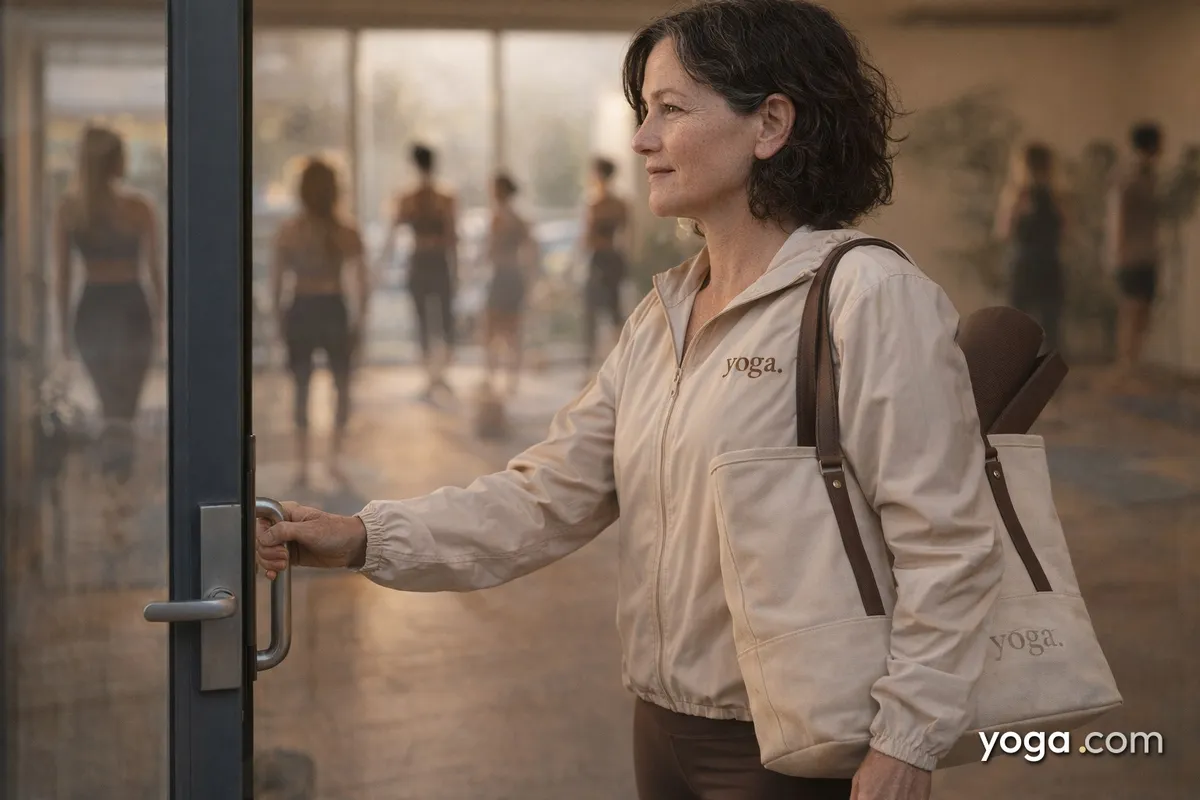
You're standing at the studio door with your mat tucked under one arm, and everyone inside already seems to know exactly where to put their feet. That feeling - half excitement, half dread - is one of the most universal first-class experiences there is. This guide won't just tell you what to do; it'll tell you why each thing works, because the reason is usually what makes it stick.
Why Following a Flow Feels So Hard at First
You are not bad at movement. You are simply brand new to it and those are not the same thing, so please do not confuse the two.
When a teacher moves from one pose to the next in a flowing sequence, you are being asked to watch, copy, remember the order, and keep breathing - all simultaneously. It's many separate jobs for a first-time brain. Dropping one or two of them and falling a half-step behind is completely normal and it happens to almost every beginner because the brain is still learning how to handle so many tasks at once.
The people around you who look effortlessly smooth have done this exact sequence many times before. Keep in mind that what you are seeing is accumulated practice, not natural talent. On top of that, every person in that room had a clumsy, half-a-step-behind first class too, just like you are having right now.
Start with the Breath, Not the Feet
Here is one of the most practical shifts you can make as a new student: stop chasing the teacher's feet and follow the breath instead. The breath is a much better guide than watching fast-moving limbs.
In a flowing class, each movement is tied to either an inhale or an exhale. The breath is the metronome the whole sequence is built on and it is slow and it is audible, so the breath is far easier to track than the teacher's feet or hands moving quickly through each shape.
When you get lost - and you will get lost more than once - come back to the breath first. Let your body find the shape of the pose afterward. Keep in mind that returning to the breath works much better than staring at the floor in a panic, because the breath keeps moving and your body can follow the breath one step at a time.
Props are tools, not training wheels
A block under your hand or a strap around your foot is not a crutch. A prop is what lets you hold a pose with a long, safe spine instead of straining for depth you are not ready for yet. On top of that, experienced practitioners use props all the time, so using props does not mean you are doing something wrong.
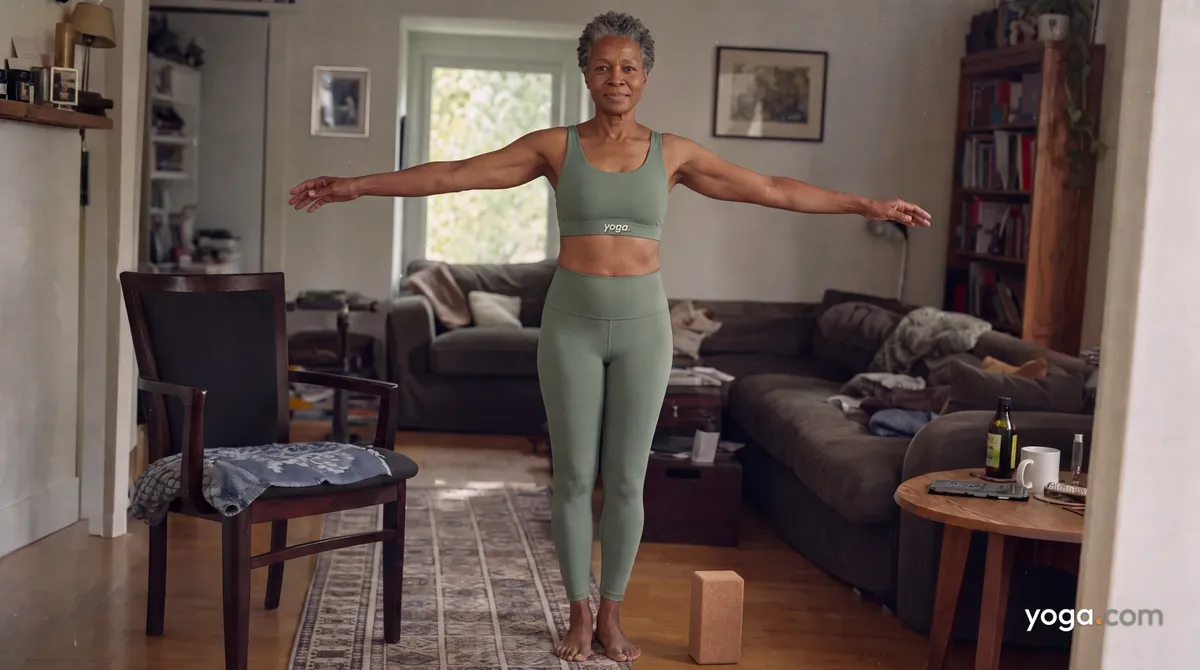
One small thing worth knowing: a foam block has three different heights depending on which side you stand the block on. If the tall side feels like too much, simply turn the block onto its flat side. The pose suddenly works.
Where to Place Your Mat
New students often head straight for the back corner because they are thinking it is the safest place to hide. The back corner is actually where the long-time regulars set up, because those long-time regulars already know the sequence and do not need visual cues at all.
As a beginner, you are better off placing your mat two rows back and slightly to one side and this position is helpful because it keeps you close enough to see the teacher clearly, so you also have a steady neighbor nearby that you can glance at when you lose the thread of the flow. Keep in mind that your mat placement can make a real difference in how much you get out of the class.
Forgetting the Sequence Is Part of Learning It
Blanking on what comes next is not a memory problem. This is just how the body learns any new physical skill - through repetition, with shaky early attempts full of small stops and restarts. Forgetting the sequence is a normal part of the process, and you should expect it to happen.
The sequence starts to feel automatic only after you have moved through the sequence many times. That smoothness you are chasing is built one repeated class at a time, and so you need to be patient because the body takes time to absorb new movement patterns. Which leads to one of the most effective beginner strategies:
- Go to the same class, with the same teacher, several times in a row. Most flowing classes repeat a core set of poses. When the same shapes keep appearing again and again, your body begins to recognize those shapes before your brain even catches up. Keep in mind that this repetition is exactly what your body needs.
- Your third class will almost always feel easier than your first - not because you have changed, but because your body has started to remember. On top of that, your brain will feel less overwhelmed because the sequence is becoming more familiar to you.
Tell the Teacher You're New
Before class begins, take thirty seconds to introduce yourself as a beginner. A good teacher will keep half an eye on you once they know you are new, offer easier variations of challenging poses, and steer you away from anything not appropriate for a first-timer. Keep in mind that this small introduction can make a big difference in how safe and comfortable your first class feels.
If you have an existing injury - a tricky shoulder, tight lower back, sensitive knees - mention it quietly and privately in those early minutes, not out loud to the room. A teacher who knows about your injury ahead of time can offer a safer modification before you even need to ask, and that means you are less likely to push too hard in a pose that is wrong for your body.
It also helps to know who is teaching you. Look for a teacher registered with Yoga Alliance at the RYT-200 or RYT-500 level - those designations reflect documented training hours and supervised teaching experience, and so those designations give you a basic measure of whether your teacher has gone through real, structured preparation. On top of that, if you want to know a teacher's background, simply ask. A confident instructor will be happy to share that information with you.
The Mistakes Most Beginners Make
Forcing depth before your body is ready
A good stretch feels like a broad, dull pull across a wide area. A sharp or pinching sensation - especially in a joint like a knee or shoulder - is a warning signal, not something to breathe through. You should back off the moment it goes sharp. Backing off costs you nothing and backing off protects you from the kind of strain that keeps you off the mat for weeks and sets your progress back significantly.
If you have any ongoing pain or a medical condition, check with your healthcare provider before starting a new movement practice.
Comparing yourself to the most flexible person in the room
The person folding all the way to the floor next to you may have ten years of daily practice behind that person. Trying to match their depth in week one is exactly how beginners pull a hamstring and end up frustrated because your body simply has not had time to adapt. Keep in mind that you should move at the pace of your own breath. The deeper version of a pose will come for you - on your own timeline, not someone else's.
Quitting after one or two awkward classes
Awkward is the early stage. Awkward is not a sign you are doing it wrong; awkward is a sign you are doing it at all. Give yourself at least four or five classes before you decide how you feel about yoga. On top of that, the discomfort of not knowing what you are doing has a short shelf life, so staying patient really does pay off for you.
One Thing That Makes Physical Activity Worth Starting
If you need a nudge to keep coming back, consider this: evidence from a systematic review of 168 studies shows a positive inverse relationship between stress and exercise in 72.8% of reviewed studies. Moving your body consistently is one of the most well-supported tools you have for managing everyday stress. Keep in mind that this is not a small finding - this is a large body of research telling you that regular physical activity and lower stress tend to go together, and so if you are looking for a reason to start moving, this evidence is a very good one.
Current guidelines from both the CDC and the American Heart Association recommend at least 150 minutes of moderate-intensity activity per week for adults, and that recommendation can absolutely include a flowing yoga or movement class because these classes count as moderate-intensity activity. That works out to five 30-minute sessions per week. On top of that, five sessions of 30 minutes is a realistic target for most adults, and so the guidelines are not asking you to do anything extreme. The target is entirely doable for your schedule.
Own Your Place Here
Walking into your first movement class takes real courage, and that is something you should recognize about yourself. The confusion you feel at the front end of that experience is temporary, and the strength, ease, and sense of belonging you build are not temporary at all. Keep in mind that following the breath is one of the simplest things you can do when you feel lost. Use props without apology, because props are there for you and there is no reason to avoid them. Tell your teacher you are new, so your teacher can give you the right guidance from the start. Showing up again next week matters more than doing everything perfectly on your first visit. Show up again next week and then the week after that, because the mat rewards consistency above everything else and consistent effort is what produces real results for you over time.