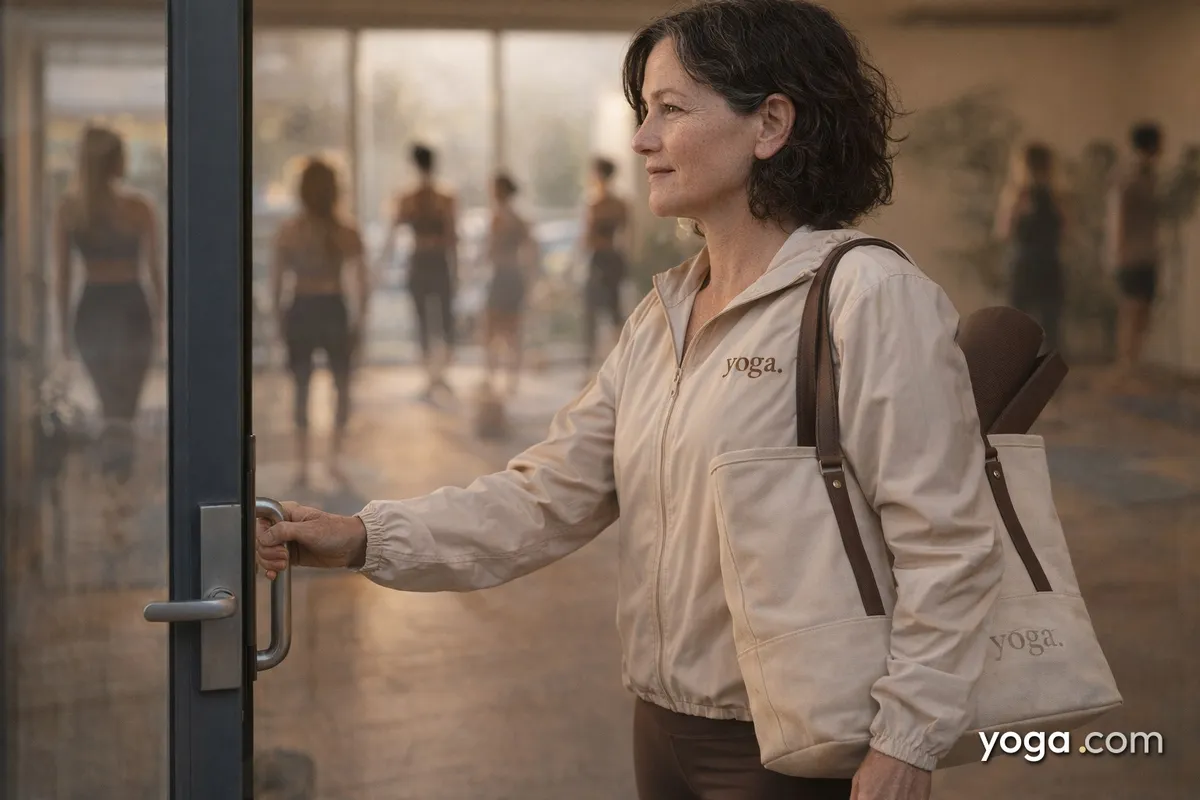

You came for the stretching. Maybe the stress relief. But somewhere around week three or four, you noticed something else - the familiar face on the next mat, the easy chat after class, the feeling of belonging to something. The social side of yoga sneaks up on you, and for many practitioners, it ends up being just as nourishing as the poses themselves.
You're Already in Good Company
Walking into a studio means joining a genuinely large community. Women make up the heart of that community - 23.3% of adult women in the U.S. practiced yoga in 2022, compared to 10.3% of men, according to the National Health Interview Survey. That's a wide, diverse pool of people showing up for very similar reasons.
And their reasons go beyond flexibility. 80% of adults who practiced yoga in 2022 said they did so to restore or improve their overall health - which, it turns out, includes their relationships.
How Connection Actually Builds in a Class
Here's something experienced teachers know that no study quite captures: the real social work happens at the edges of class. During the poses, everyone is facing forward, breathing, following cues. Connection lives in the quiet minutes before class starts and the few minutes after it ends.
If you roll in at the last second and bolt the moment Savasana (Corpse Pose) is over, you're skipping the most social window of the whole hour. Staying just a few minutes longer is often all it takes.
Regularity matters too. A weekly class puts you in the same room with the same people, over and over. That repetition turns strangers into familiar faces - and familiar faces into genuine connections.
What the Research Says About Group Exercise and Women
The social pull of group movement isn't just anecdotal. A study of 506 participants found that for women, belonging to an exercise group was significantly associated with building an exercise identity - and that identity, in turn, was significantly associated with higher physical activity levels.
The same study found that women perceived group exercise membership as a source of emotional, validation, informational, instrumental, and companionship support. That's not a small thing. It means the group itself becomes a kind of care structure - one that keeps you showing up and feeling held.
Yoga Practitioners Report Real Shifts in Their Relationships
In a national survey of over 1,000 Iyengar yoga practitioners, the social benefits were striking. 67% agreed that yoga improved their social relationships, and 86.5% agreed it improved their happiness. These weren't newcomers - the mean years of practice in that group was over eleven years - but the pattern is worth noting for anyone just starting out.
Improved mood and improved relationships tend to move together. When you feel less tense and more energized, you're more likely to linger after class, smile at the person next to you, and say yes to a post-practice coffee.
Why Mindfulness Makes You a Better Friend
Yoga trains you to pay attention - to your breath, your body, the present moment. That same skill translates directly into how you show up for other people. Presence is the foundation of good listening. And good listening is the foundation of real connection.
Greater self-compassion, which many practitioners develop over time, also tends to soften how we relate to others. When you're less harsh with yourself, you're usually less harsh with the people around you - and that makes relationships easier to form and easier to sustain.
The Moment Most Beginners Miss
There's a specific window at the end of every class that experienced practitioners know well. After Savasana - the final resting pose - people emerge from stillness with their guard a little lower. Faces are softer. The room is quiet in a good way.
That's often when a casual "great class today" turns into a real conversation. It's also the exact moment many beginners are already rolling up their mat and heading for the door. You don't have to stay long. Even five minutes changes everything.
Simple Ways to Lean Into the Social Side of Yoga
A Note on Social Connection and Your Health
Strong, broad-based social support increases your odds of living longer by 91%, according to a review of 148 studies conducted by researchers at Brigham Young University. That is a very striking number, and what that number tells you is that community is not simply a nice-to-have thing in your life. Community is a genuine and important pillar of your overall wellbeing.
Yoga does not guarantee that you will make close friends. No single class can do that for you. What yoga does do is create consistent, low-pressure conditions where social connection becomes possible for you, and those conditions matter a lot because most everyday activities do not offer you even that much of an opportunity.
If loneliness, anxiety, or social difficulty feels significant in your life, you should speak with a healthcare or mental health professional. Yoga can beautifully complement that professional support, but yoga is not a substitute for professional support and should not be treated as one.
Beyond the Mat Together
The social side of yoga is not just a bonus feature. For many practitioners, the social side is what keeps them coming back to the mat again and again. The familiar faces, the shared effort, and the quiet chat after class are all part of what makes yoga worth showing up for and so these small social moments can turn into something genuinely real over time. You probably showed up for the stretching, and that is completely fine, but the people around you are also a big part of the experience. Stay for the people. The people might just surprise you.