If your hand has ever hovered six inches above the floor while your lower back quietly protested, yoga props for stability and comfort exist precisely for that moment. Knowing how to use them can transform a frustrating practice into one that actually feels good in your body.
Before you begin: If you have an existing injury, a chronic condition, or significant balance concerns, speak with your doctor or a qualified yoga therapist before starting a yoga practice or adding new poses. This article is educational and isn't a substitute for individual medical advice.
Props Are Not a Sign of Weakness
Reaching for a block or a strap is not a shortcut or a consolation prize. According to the Cleveland Clinic, yoga props are specifically designed to help maintain good posture, improve stability and balance, deepen stretches, reduce the risk of injury, and fine-tune alignment and positioning.
Props make good alignment accessible to your actual body, today, as it is. Even experienced teachers and long-time practitioners use them routinely. B.K.S. Iyengar, one of the most influential yoga teachers of the twentieth century, made props a cornerstone of his method precisely because they allow longer, safer holds with better alignment.
The Core Props - and Exactly How to Use Them
Yoga Blocks: Bringing the Floor to You
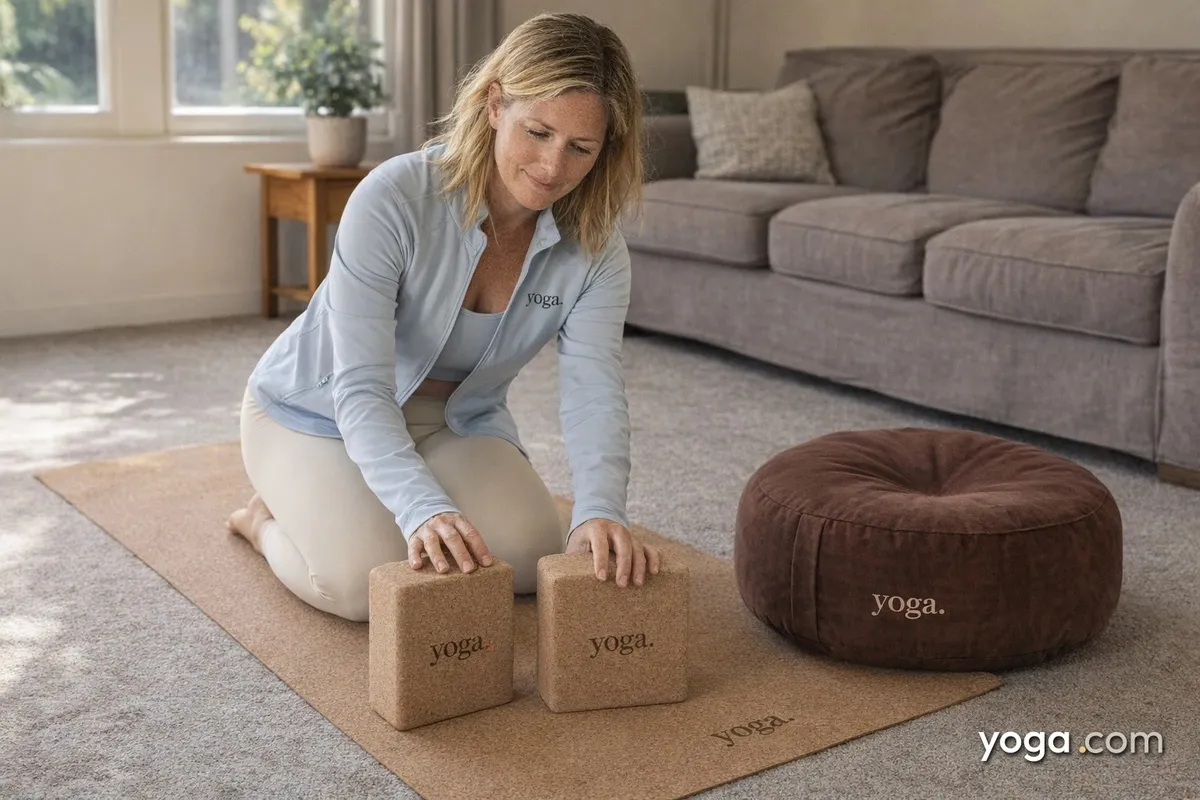
Yoga blocks are typically made of foam, rubber, cork, or wood. Foam is lightweight and forgiving; cork and wood are firmer and more stable under bodyweight. Basic yoga blocks cost under $15 - one of the easiest investments you can make in your practice.
The concept is simple: when your hand cannot reach the floor, you raise the floor to meet your hand. A block placed outside your front foot fills that gap without asking your spine to round or your shoulder to collapse.
Three heights, one block. Turn a foam or cork block onto any of its three sides to adjust the height:
- Tallest side - maximum lift, great for tight hamstrings or hips
- Medium side - moderate support for most poses
- Flattest side - minimal lift as your flexibility grows
Try it in Extended Triangle Pose (Utthita Trikonasana). Place the block on its medium height just outside your front foot. Press your hand firmly into the block and let your chest rotate open toward the ceiling. Without the block, many students collapse through the front shoulder chasing the floor and lose the alignment entirely.
Blocks also work well in seated poses. Raising the hips slightly can ease strain on the lower back and hips by letting the pelvis tilt forward more easily. Place one block under each sitting bone in Easy Pose (Sukhasana) and notice how much more length you find in your spine.
Yoga Straps: Extending Your Reach Safely
A strap is a long, flat band with a buckle or D-ring at one end. Straps are usually made of hemp, cotton, or nylon and come in lengths of six to ten feet. An adjustable yoga strap costs about $8 - $12.
A strap bridges the gap between your hands and whatever they cannot quite reach - your foot, your shin, the back of your leg - without forcing you to round your spine to get there.
Try it in Seated Forward Fold (Paschimottanasana). Loop the strap around the balls of your feet and hold the ends with both hands. Sit tall, and on each exhale, hinge forward from your hips - do not pull yourself forward with your arms. The strap helps you keep length through your hamstrings and reduces the tendency to round your lower back.
One important note: if you have a recent hamstring strain or tear, avoid deep hamstring loading until you have been cleared by a physical therapist. The strap makes the stretch accessible, but it cannot override an injury that needs rest.
Straps are also useful for shoulder work. Hold the strap between both hands behind your back to build shoulder mobility without forcing a range of motion your joints are not ready for.
Bolsters and Blankets: Full Support for Restorative Poses
Restorative poses are held for several minutes. Muscles cannot sustain that without tension creeping in - that's where bolsters and blankets earn their place.
A bolster is a large, firm pillow (round or rectangular) that supports your body so you can release completely. Placed under the spine in Supported Fish Pose (Matsyasana) or under the knees in Corpse Pose (Savasana), a bolster removes the muscular effort of holding so your nervous system can settle.
A blanket offers softer, adjustable support. Fold it to different thicknesses and slide it under your knees, hips, or head. A blanket also doubles as a warm layer during Savasana - getting chilly in final relaxation is a fast way to cut the pose short.
Chairs and Walls: Free Props You Already Own
Chair yoga uses a seat to support standing, seated, and balance poses - making the practice accessible when getting up and down from the floor is difficult or painful. The chair doesn't replace the pose; it makes the pose possible.
A wall is the best training tool for balance poses. Place one hand lightly on the wall while learning Tree Pose (Vrksasana) or Warrior III (Virabhadrasana III). You are giving your nervous system just enough information to find your balance point; over time you will rely on the wall less and less. A 12-week yoga intervention in older adults showed significant improvements in balance and functional mobility, with the yoga group also showing meaningful reductions in fear of falling, anxiety, and depression - and building balance safely, with support, is exactly the point.
The Most Common Prop Mistakes (and How to Avoid Them)
- Treating a prop as something to graduate from. Props aren't training wheels. Many students use blocks for years - not because they can't do without them, but because the block makes the pose better.
- Buying too many props before learning the basics. Start with a block or two and one strap. Add other props only when you have a clear reason for them.
- Skipping the prop out of embarrassment. If you're straining and compensating through your joints, a prop would fix that immediately. Your teacher wants you to use it.
- Using the wrong height or tension. A block that's too tall can throw off your alignment just as much as no block at all. A strap you grip and yank will round your spine. Adjust and check your posture before committing to a hold.
A Simple Starter Kit
You don't need much to get going. The right yoga props for stability and comfort can be assembled affordably with just a few items:
- Two yoga blocks (foam to start, cork if you want longevity) - under $15 each
- One yoga strap, six to eight feet long - about $8 - $12
- A firm blanket - a folded household blanket works perfectly well to start
Bolsters, chairs, and walls you can explore as your practice grows and your needs become clearer.
Where This Leaves You
Bodies are different, and a pose that feels effortless for one person may be genuinely inaccessible for another without support. Using a block, a strap, or a bolster means meeting your body where it actually is - so you can practice consistently, stay safe, and feel the real benefits of the poses.
If you have an injury, a chronic condition, or balance concerns you haven't yet discussed with a professional, please do so before beginning or expanding your practice. Props help enormously - but professional guidance matters too.