Maybe you've watched a friend move through poses with surprising ease and thought, I could never do that. Or maybe your doctor mentioned that gentle movement would help, and yoga crossed your mind for the first time in years. Wherever you're starting from, this guide walks you through what to expect - and how to take your first step with confidence.
Your Body Has Changed - and That's the Whole Point
Yoga at 50 is not yoga at 25. Your joints may be stiffer. Recovery takes longer. Flexibility you had in your twenties may have quietly packed its bags. None of that disqualifies you. It just means the right starting point looks a little different.
The styles best suited to older beginners are gentle and unhurried. Look for:
- Hatha yoga - foundational poses held long enough to understand them
- Restorative yoga - supported poses using props, focused on deep relaxation
- Chair yoga - traditional poses adapted for a chair, ideal if getting up and down from the floor is difficult
- Gentle or beginner yoga - any class explicitly labeled for newcomers or seniors
The slower pace isn't a consolation prize. It's what keeps you safe and lets you actually learn.
Real Benefits Worth Knowing About
Yoga is exercise - not just stretching. Physical activity reduces the risk of fall-related injuries in older people by 32-40%, and one in four adults aged 65 and older falls in the United States every year.
Yoga directly addresses one of the biggest risk factors for falls: balance. A systematic review and meta-analysis of six clinical trials found that yoga-based exercise among people aged 60 and older had a meaningful effect on balance (Hedges' g = 0.40) and on physical mobility (Hedges' g = 0.50). For everyday life - navigating stairs, stepping off a curb, reaching for something on a shelf - those improvements translate into real confidence.
A review covered by the Harvard Gazette examined 33 studies including 2,384 participants over 65, with a mean age of 72. The standout finding: improved walking speed had the strongest association with yoga practice compared to groups who were inactive or received only educational interventions. Walking speed is a key marker of independence as you age.
If your knees are a particular concern, a randomized controlled trial involving 117 adults aged 40 and older with clinically diagnosed knee osteoarthritis compared a structured yoga program to a traditional strengthening regimen over 12 weeks. By 24 weeks, the yoga group showed slightly greater improvements in physical function, symptom management, and overall quality of life than the strengthening group. Yoga is not a cure for osteoarthritis, and individual results vary - but the comparison is encouraging. If you have a diagnosed joint condition, talk to your doctor before starting.
Pain is one of the biggest reasons older adults pull back from activity altogether. Women report bothersome pain at higher rates than men - 58% vs. 47% in the past month - and gentle yoga offers a low-impact way to keep moving when pain makes other exercise feel daunting. People also tend to stick with it: in one yoga program studied for chronic pain, attendance rates reached 91%, retention 97%, and 89% of participants were satisfied - with 87% saying they'd recommend it to others. Those are unusually high numbers for any exercise program.
Among adults who practiced yoga in 2022, 80% did so to restore their overall health. Yet only 8% of adults 65 and older practiced yoga in the past year, compared to more than 21% of younger adults. That gap is worth closing.
Does Yoga Count Toward Weekly Activity Guidelines?
Yes - and it can help you tick more than one box. The CDC recommends that adults 65 and older get at least 150 minutes of moderate-intensity aerobic activity per week, plus at least 2 days of muscle-strengthening activity. A vigorous yoga flow can contribute to the aerobic minutes; strength-building poses - like Warrior II (Virabhadrasana II) or Chair Pose (Utkatasana) - count toward strength training days. Gentler styles like restorative or chair yoga may not meet the aerobic threshold on their own, but they are a legitimate, research-backed way to build the habit and keep your body moving safely.
The Risks - and How to Keep Them Small
Yoga is generally safe, but go in clear-eyed. In a survey of 2,508 yoga practitioners, muscular pain was the most common adverse event at 5.3%, followed by joint pain at 4.9%. These are real possibilities, not reasons to stay home - but they're worth respecting.
Only 1.9% of participants reported adverse outcomes serious enough to discontinue practice. You can lower the risk further with a few simple habits.
Before your first class
- Talk to your doctor, especially if you have a chronic condition, heart issues, or joint problems. This is a real step, not a formality.
- Arrive a few minutes early and introduce yourself to the teacher. Mention any injuries or limitations - quietly, before class begins. A good teacher will adapt poses for you.
- Get a non-slip mat. A mat that slides is a genuine safety risk. You don't need anything expensive - just grippy.
- Wear clothes you can move in freely. That's genuinely all you need.
During class
- Do not push through pain. A broad, dull pull across a muscle is a stretch. A sharp or pinpoint sensation in a joint is a warning. Back off immediately.
- Use props - blocks, straps, blankets, a chair - without apology. They're tools, not crutches. Experienced practitioners use them all the time.
- Don't measure yourself against the person on the next mat. Someone folding effortlessly to the floor may have a decade of practice behind them.
A Few Poses Worth Knowing
These beginner-friendly poses are commonly used in gentle and senior yoga classes and are a good starting point:
- Mountain Pose (Tadasana) - builds postural awareness and balance while standing.
- Child's Pose (Balasana) - a resting pose that gently stretches the lower back and hips.
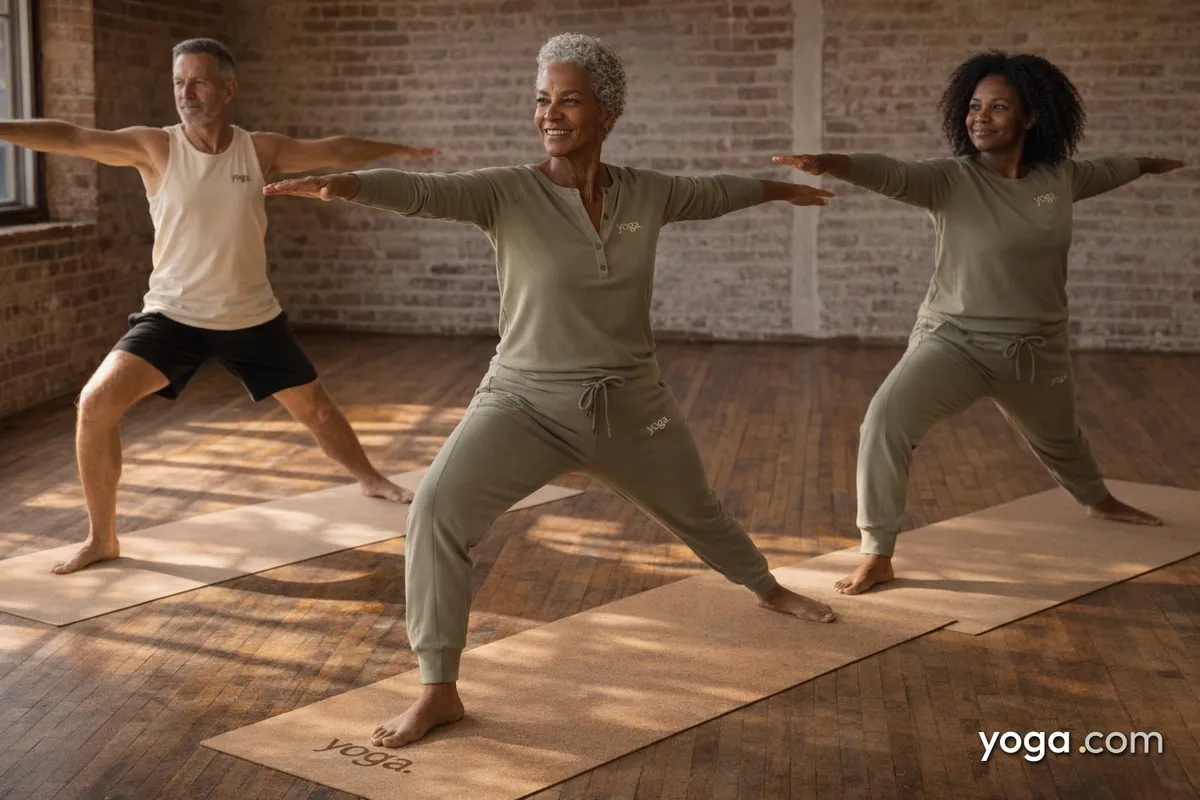
- Warrior II (Virabhadrasana II) - strengthens the legs and improves hip stability.
- Tree Pose (Vrksasana) - a gentle balance challenge that you can practice near a wall.
- Legs Up the Wall (Viparita Karani) - a restorative pose that eases tired legs and calms the nervous system.
- Seated Forward Fold (Paschimottanasana) - stretches the hamstrings and lower back; easily done in a chair.
If you are starting with chair yoga, you can practice all the core postures - including seated Cat-Cow (Marjaryasana-Bitilasana), seated Forward Fold (Paschimottanasana variation), and seated Warrior - without getting down on the floor. No flexibility required to begin. If any pose causes sharp pain, stop and check in with your teacher or healthcare provider.
Three Mistakes Older Beginners Make (and How to Avoid Them)
1. Treating props as failure
A foam block has three heights depending on which side you stand it on. If the tallest side feels like too much, flip it. The pose works. Props exist precisely to make safe alignment possible for every body.
2. Chasing depth instead of alignment
A deeper stretch is not automatically a better stretch. Straining to match someone else's range of motion in your first week is exactly how a hamstring gets pulled. Go to the edge of comfortable, then breathe there.
3. Skipping Savasana
That final rest - Corpse Pose (Savasana) - is not a waiting period. It's the moment your body and mind settle and absorb the practice; many teachers consider it the most important pose of the class. Skipping it is like closing a book mid-sentence. Stay for it.
You Don't Have to Start From Zero Alone
Michelle Marchildon began practicing yoga at 40 with no previous experience - and went on to become a well-known yoga writer and teacher. Starting later isn't a disadvantage. For many women, it's the right moment.
Yoga also doesn't have to carry your entire fitness load. Walking, swimming, or light resistance training pair well with a yoga practice. Teacher Desiree Rumbaugh complemented her yoga practice with strength training, resistance work, and cardio - and found the combination more effective than any single approach alone.
What To Do With All This
Starting yoga after 40, 50, or 60 is not about becoming someone younger or more flexible. It's about moving your body in a way that supports the life you're actually living now. Begin with a gentle or beginner class. Tell your teacher what's going on in your body. Use every prop in the room. And give yourself the same patience you'd offer a good friend on her first day.
Sources
- PMC / National Institutes of Health - Yoga for Healthy Aging: A Systematic Review (2021)
- Yoga Journal - 6 Ways to Fine-Tune Your Yoga Practice as You Age
- American College of Sports Medicine - Physical Activity and Function in Older Age
- CDC National Center for Health Statistics - Yoga and Meditation Data Brief (2022)
- PMC / National Library of Medicine - Chronic Pain in Older Adults
- CDC - Physical Activity Guidelines for Older Adults
- Southern California University of Health Sciences - Yoga May Offer Cost-Effective Solution for Knee Osteoarthritis
- Harvard Gazette - Strong Evidence That Yoga Protects Against Frailty in Older Adults