A dull ache spreading across the lower back, a neck that protests every glance away from the screen, shoulders that have quietly climbed all afternoon: if your workday lives at a desk, your body is paying a quiet tax. Yoga for desk workers doesn't require a studio or a lunch break - a complete desk yoga practice can take five minutes or less, and it targets exactly the places that hurt most.
Before you begin: if you have sharp, radiating, or worsening pain, a recent injury, or a diagnosed neck or spine condition - including disc-related conditions or sciatica - check with a doctor or physical therapist before trying any of the poses in this article. The movements below are gentle, but individual presentations vary and professional guidance matters. This article is educational and isn't a substitute for individual medical advice.
Why Your Desk Is Hard on Your Body
Sitting still for hours loads the same muscles and joints repeatedly without recovery. Office workers spend an average of 6.29 hours of an 8-hour shift sitting, and 73.6% feel exhausted during the workday. That exhaustion has a physical address: neck (53.5%), lower back (53.2%), and shoulder (51.6%) symptoms are the most common complaints among office workers.
The position you hold is the real culprit. Most of us drift into a familiar shape: chin jutting forward, shoulders rounding, lower back flattening into the chair. In a neutral position, your head weighs roughly 10-12 lb - a load your cervical spine handles easily when your head is stacked properly. But when your neck shifts forward, pressure on your posterior vertebrae and muscles increases by more than four times. 78% of the population shows deformation of the cervical spine linked to forward head posture - driven by prolonged use of computers, smartphones, and tablets.
The lower back takes its own hit. More than 1 in 4 working adults experience low back pain, and 20% of workers with back pain are told by a health professional that their pain is work-related. Between 6 and 10% of affected workers stopped working, changed jobs, or significantly altered their work activities because of low back pain. Work-related musculoskeletal disorders are among the most frequently reported causes of lost or restricted work time: American companies could save $20 billion a year in workers' compensation alone by eliminating repetitive stress injuries, with another $100 billion lost to reduced productivity, employee turnover, and other indirect costs. On top of that physical toll, work-related stress accounts for 12.8 million lost working days each year.
Your body was built to move, not to hold one position for eight hours. Small, consistent movement breaks - even at your desk - help interrupt that cycle before it becomes serious pain.
Why Yoga Helps - Specifically
Yoga works on desk posture from two directions at once. Stretching releases muscles that have shortened and tightened - chest, hip flexors, front of the shoulders. Holding and strengthening rebuilds the muscles that have gone passive from underuse - mid-back, deep neck flexors, core stabilizers.
There's also the mental layer. Yoga builds body awareness. You can't correct a posture you can't feel. Over time, the mindful quality of practice makes you more sensitive to the moment your shoulders start creeping toward your ears - and that awareness is genuinely useful at a desk.
The evidence behind it is solid. Just 15 minutes of chair-based yoga postures or guided meditation performed in the office can elicit a relaxation response - with yoga and meditation significantly reducing perceived stress versus control, an effect maintained after the intervention ended, and respiration rate measurably lower during yoga and meditation compared to control. A meta-analysis of six studies found that workplace yoga interventions produced an overall effect size of −0.67 in favor of yoga for reducing stress - a meaningful result across 266 yoga participants compared to 221 controls. For back pain specifically, the American College of Physicians recommends yoga as a first-line treatment for chronic low back pain, and a 2018 review of 8 trials found that yoga improved pain and function for low-back pain in both the short term and intermediate term.
What a Desk Yoga Practice Actually Targets
A desk yoga sequence focuses on the hips, lower back, shoulders, chest, and wrists - the exact areas that bear the brunt of prolonged sitting and typing. You don't need a mat, a studio, or special clothes. You need your chair and about five minutes. Many of these poses can be done in 30 seconds or less, making them realistic on a busy workday.
Seven Poses to Try Right Now
Before you start: if you have sharp, radiating, or worsening pain, a recent injury, or a diagnosed neck or spine condition, check with a doctor or physical therapist before trying these poses.
Work through these in order, or pick the two or three that speak to where you're holding tension today.
1. Chin Tuck
Sit tall. Gently draw your head straight back over your shoulders - like making a soft double chin - while keeping your eyes level. Hold for three breaths, release, and repeat five times. This targets the deep cervical flexors, the muscles that weaken when your head drifts forward all day. The common mistake is tipping the chin up or down instead of moving straight back - fix it by imagining the back of your skull sliding straight back along a flat shelf.
2. Seated Neck Release
Sit tall and drop your right ear toward your right shoulder. Hold for three slow breaths, then switch sides. This gently stretches the upper trapezius and the muscles along the side of your neck that spend all day holding your head over a screen. Avoid full circular head rolls that take your head far back - that can compress the cervical spine. Keep the movement in front of the midline at all times.
3. Seated Cat-Cow (Seated Bitilasana Marjaryasana)
Place both hands on your knees. On an inhale, lift your chest and gently arch your lower back. On an exhale, round your spine and drop your chin toward your chest. Repeat five times, letting your breath lead the movement. This wakes up the entire spine and gives it movement that sitting rarely provides. Note: if you have a known disc injury, check with your healthcare provider before adding spinal flexion to your routine.
4. Seated Spinal Twist (Seated Bharadvajasana)
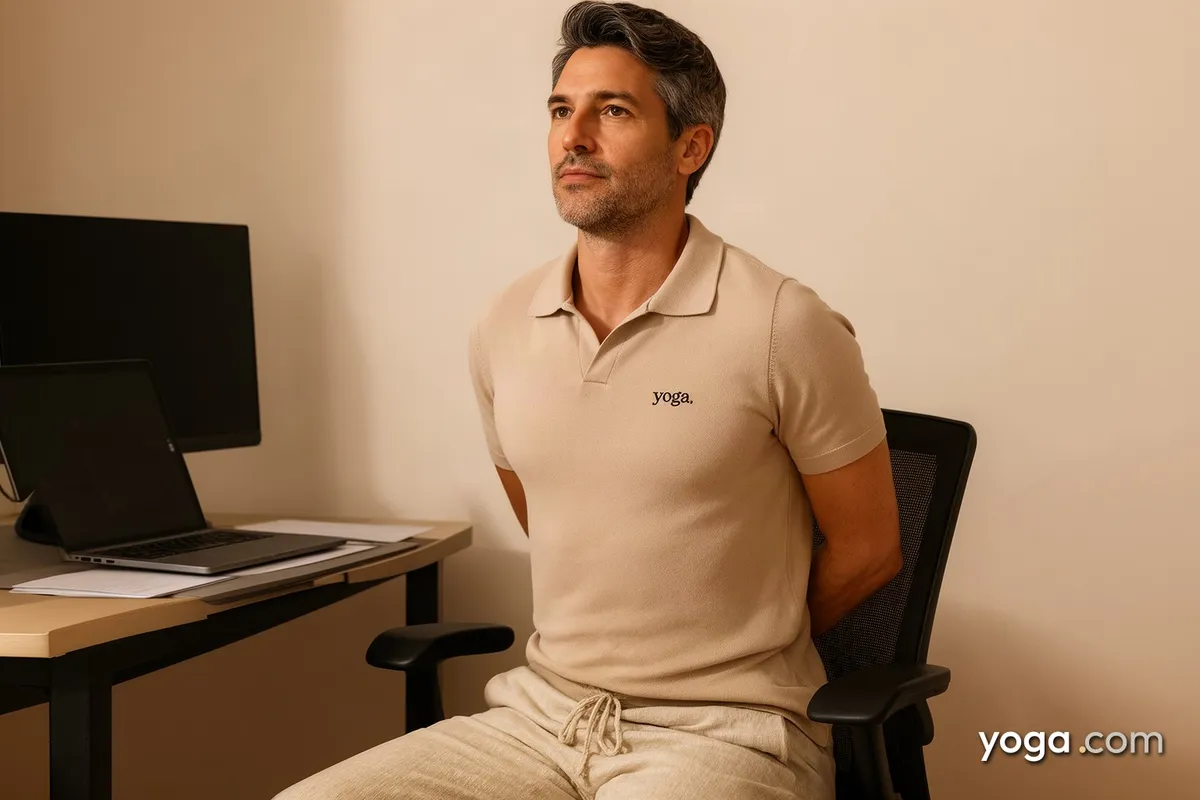
Sit up straight. Place your right hand on your left knee and your left hand on the back of your chair. Inhale to lengthen your spine, then exhale and gently rotate to the left. Hold three to five breaths, then switch sides. Keep your hips square - the rotation comes from the upper back (thoracic spine), which is where your body actually has room to turn.
5. Eagle Arms (Garudasana Arms)
Extend both arms forward, then cross your right arm under your left. Bend your elbows and try to bring your palms together (or as close as they'll go). Lift your elbows slightly and breathe into your upper back. Hold for five breaths, then switch which arm is on top. This targets the muscles across your upper back - you'll feel real relief here if your shoulders are tight and rounded from desk work.
6. Seated Figure-Four Hip Opener
Cross your right ankle over your left knee, flex your right foot, and sit forward slightly with a long spine. Hold 30-45 seconds, then switch sides. You'll feel this in the outer hip and glute - areas that rarely get attention at a desk, yet bear the full load of sitting all day.
7. Seated Forward Fold (Seated Uttanasana)
Sit at the edge of your chair with feet flat on the floor. Hinge forward from your hips - not your waist - and let your arms hang toward the floor. Let your head be heavy. If your hamstrings are very tight, cross your arms and rest them on your thighs instead. Hold for five slow breaths. You'll feel this in your lower back and the backs of your legs.
Important flexion screen: If forward bending increases your back pain, or you have a disc-related condition or sciatica (pain radiating down a leg), skip this pose - spinal flexion can aggravate these presentations. A gentle backbend or Cat-Cow is a safer choice; check with a physical therapist first. If you have a lower back injury, keep a gentle bend in the knees and hinge with a flat back rather than rounding.
Set Up Your Workspace First
Yoga breaks help most when your workstation isn't actively fighting against you. The goal of ergonomics is to prevent the injuries and discomfort that happen at work - and a few simple adjustments make a real difference.
- Monitor height: The top of your screen should sit at or just below eye level so your neck isn't constantly tilting forward or down. Even a small tilt held for many hours leaves your neck muscles working much harder than they should.
- Monitor distance: OSHA recommends placing your monitor directly in front of you, at least 20 inches away - aim for roughly 20-40 inches from your eyes, close enough to read easily, far enough that you're not straining. Wrong monitor distance leads to leaning forward without realizing it, compounding postural load.
- Leg clearance: Clearance under your desktop should generally be between 20-28 inches (50-72 cm) high so your hips and thighs sit comfortably without compression.
- Chair support: Your backrest should support your lower and mid-back. If your chair lets you recline slightly, use that option - many ergonomists suggest a slight recline can reduce static load on your spinal muscles over a long workday.
- Feet: Both feet should rest flat on the floor or on a footrest. Dangling feet shift weight onto your lower back and make it harder for your whole body to stay in a balanced position.
- Elbows: OSHA recommends keeping elbows close to the body, bent between 90 and 120 degrees. When your elbows are well-positioned, your shoulders tend to stay more relaxed as well.
A Simple Daily Desk-Posture Routine
- Check your setup first - monitor distance, foot position, and elbow angle.
- Set a timer for every 45-60 minutes of sitting.
- When the timer goes off: stand up, do five chin tucks, and take five slow diaphragmatic breaths.
- Once a day (morning or lunch): move through the seven poses above in about 8-10 minutes.
- End your routine with 2-3 minutes of slow nasal breathing - inhale for 4-5 counts, exhale for 6-7. Try this before a high-pressure meeting or any time tension starts creeping up your neck.
Make It a Habit, Not a One-Off
The biggest mistake desk yogis make is saving the whole practice for the end of the day. By then, tension has already built for hours. Spreading short movement breaks across the day gives your muscles repeated chances to recover rather than relying on a single late-day rescue.
A few approaches that help habits stick:
- Anchor practices to existing triggers. Do two minutes of slow breathing every time you make coffee. Do your seated twist every time you finish a document.
- Pick your timing wisely. A movement break taken right after finishing a task feels natural and is far easier to sustain than one jammed into the middle of deep focus work.
- Start with one practice. Start with one - just one - and do it every workday for two weeks. Build from there. A routine you follow every day beats a heroic plan you follow once in a while.
The second most common mistake is rushing through the poses without breathing. Slow, full inhales and complete exhales are not optional extras - they are half the benefit. Without them, your body doesn't get the recovery signal it needs.
Know When to Seek Extra Help
A short daily practice is a genuinely useful tool - increasingly recognized by mainstream medicine. A Johns Hopkins review of 11 studies found that gentle yoga can ease discomfort from tender, swollen joints in people with arthritis. It is not, however, a substitute for professional care when pain is sharp, persistent, or getting worse. If your neck, shoulder, or back pain has been going on for weeks - or is interfering with sleep or daily tasks - talk to a doctor or physical therapist. General stiffness from sitting? These poses are a great place to begin. Sharp, shooting, or worsening pain? Get that assessed first. This article is educational and isn't a substitute for individual medical advice.
Your Body Will Thank You
You don't need a yoga studio, a lunch break, or even a change of clothes. You need five minutes, a little consistency, and the willingness to actually breathe while you do it. Start with two or three poses today, tuck them into natural breaks in your day, and notice how your body feels by Friday.
Sources
- OSHA - Ergonomics
- CDC / NIOSH - Ergonomics and Musculoskeletal Disorders
- Yoga Journal - Desk Yoga Stretches
- Yoga Journal - Desk Yoga Poses
- Yoga Journal - Office Yoga Tips
- CDC / NIOSH - Ergonomics
- CDC / NIOSH - Work-Related Low Back Pain
- PMC / NCBI - Forward Head Posture and Cervical Spine Deformation
- PMC / NCBI - Chair-Based Yoga and Workplace Stress
- OSHA - Computer Workstations: Desks
- PMC / NCBI - Workplace Yoga Interventions and Stress Outcomes: Meta-Analysis
- PMC / NCBI - Sitting Time and Health Symptoms Among Office Workers
- OSHA - Computer Workstations: Positions
- Johns Hopkins Medicine - 9 Benefits of Yoga
- NCCIH - Yoga for Health: What the Science Says