You're sitting at your desk, shoulders creeping toward your ears, mind jumping between seventeen tabs. A full yoga class feels impossible today. But ten to fifteen minutes of seated movement and slow breathing? That you can do - right now, right where you are. This sequence is designed to bring you back to yourself: calmer, clearer, and ready to focus.
Why a Seated Practice Actually Works
Seated yoga is not a shortcut or a compromise. Seated yoga is a legitimate practice with real, measurable effects on your body and mind, and that is an important point to understand.
A study of 20 participants found that just fifteen minutes of chair-based yoga postures performed in the office significantly reduced perceived stress compared to a control condition, and respiration rate dropped during both yoga and meditation sessions. Your nervous system responds even when the session is short, so you do not need a long or complicated routine to get a real result.
Research has shown that slowing your breath to release tension results in decreased anxiety and a greater ability to withstand whatever life throws at you. Keep in mind that the breath is not just a nice addition to the poses. The breath is doing real work the entire time you are practicing, and your body feels that work even in a seated position.
On top of that, consistency compounds over time. Most studies show benefits from at least eight weeks of practice, with classes at least two or three times a week, and so showing up regularly, even briefly, matters more than any single long session. Your regular effort adds up in a way that one occasional session simply cannot match.
What This Practice Does for Your Mind
Calm and focus are not separate goals. Calm and focus are closely connected, and seated yoga helps you work on both at the same time.
A USC Leonard Davis School of Gerontology study found that just 10-15 minutes of guided mindfulness practice per day for 30 days significantly enhanced key aspects of attentional control across multiple age groups. Keep in mind that when you pair that breathwork with gentle movement, you have a practice that is very hard to beat for a busy day, and this combination works because your body and mind are being trained together at the same time.
Science also indicates that early morning yoga can improve focus, and that stepping away from your work periodically throughout the day can enhance your attention span. On top of that, even a short midday seated sequence counts and gives your mind a real break.
A 2019 analysis by researcher Gothe found yoga could hold promise as a means of offsetting age-related and neurodegenerative declines in several brain regions, and this finding is a compelling reason for you to build the habit now, at any age, because the brain benefits of regular yoga practice appear to be real and meaningful.
The Sequence: 6 Poses, ~12 Minutes
You can do this in a sturdy chair or on the floor. Move slowly. Hold each pose for 3-5 full breaths before moving on. If anything causes sharp pain, ease out of it immediately.
If you have a back injury, disc problem, pregnancy, hip replacement, or any medical concern, check with your healthcare provider before starting.
1. Seated Cat-Cow (Chakravakasana variation)
Sit tall with hands on your thighs. On your inhale, gently arch your spine and lift your chest. On your exhale, round your back and let your chin drop toward your chest. Repeat 4-6 times.
- Common mistake: Jamming the lower back at the end of the arch.
- Fix: Keep the movement small and breath-led - the breath drives the shape, not the other way around.
2. Seated Forward Fold (Paschimottanasana variation)
Sit toward the front of your chair with feet flat on the floor. Inhale to lengthen your spine, then hinge forward from your hips, reaching toward your shins or feet.
- Common mistake: Rounding the upper back and yanking yourself down, which loads the lumbar discs.
- Fix: Lead with a long chest, hinge from the hips, and only go as far as feels easy. If you have a lower back issue, keep the bend very small or hold the sides of the chair.
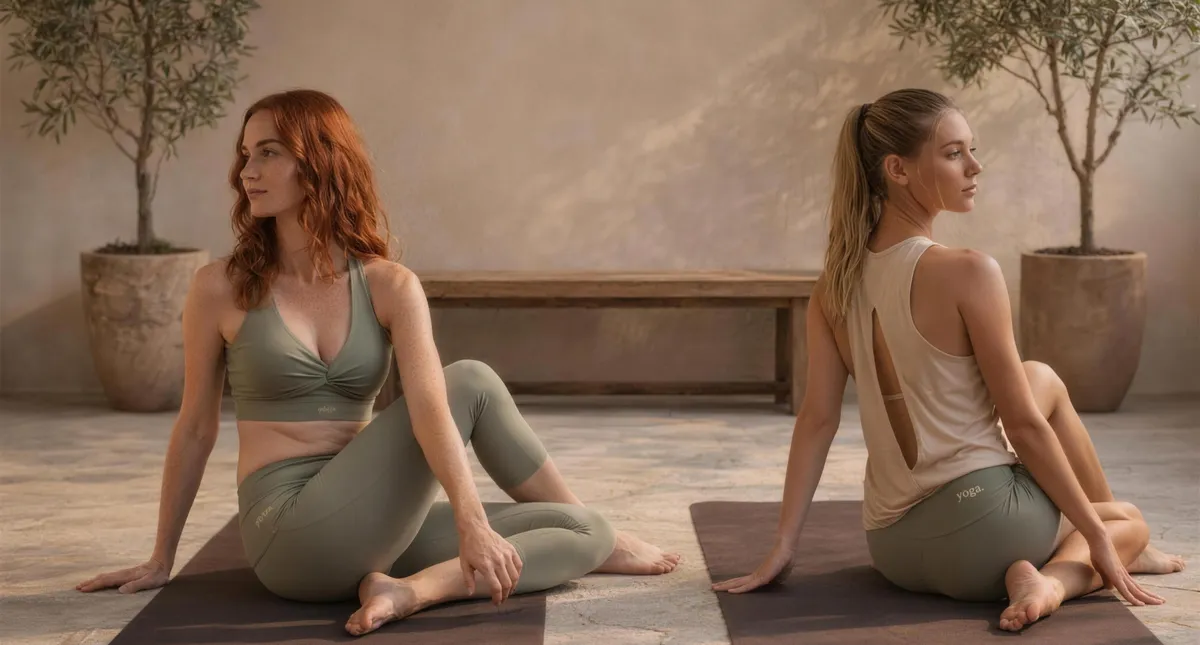
3. Seated Spinal Twist (Ardha Matsyendrasana variation)
Sit tall. On an inhale, lengthen your spine. On the exhale, rotate gently to one side - hand to the outside of the opposite knee, other hand behind you. Hold, then switch sides.
- Common mistake: Cranking the neck and shoulders to force more rotation.
- Fix: Initiate the turn from your low belly and let it travel upward, vertebra by vertebra. Keep your neck soft. Skip or keep very gentle if you're pregnant or have a disc issue.
4. Seated Side Bend (Parsva Sukhasana variation)
Ground both sitting bones into your seat. Inhale one arm up overhead, then exhale and arc it toward the opposite side, opening the ribs and the side waist. Hold, then switch.
- Common mistake: Collapsing the chest forward instead of bending directly to the side.
- Fix: Imagine bending between two panes of glass - everything stays in one plane.
5. Seated Hip Opener (Sukhasana variation / Figure-Four)
Cross one ankle over the opposite knee, flex the foot gently, and hinge slightly forward from your hips until you feel a stretch in the outer hip. Hold, then switch sides.
- Common mistake: Pressing the top knee down forcefully.
- Fix: Let the hip open in its own time. If you have a hip replacement or hip injury, skip this one and consult a teacher.
6. Seated Neck Stretch (Parsva variation)
Sit tall, relax your shoulders. Slowly let one ear drop toward the same shoulder. Breathe into the stretch for several breaths, then lift your head and switch sides.
- Common mistake: Pulling the head down with your hand.
- Fix: Let gravity do the work. If you feel any tingling or numbness down your arm, come out of the pose immediately - that's a signal you've gone too far.
How to Build the Habit (Without Overhauling Your Day)
Start with 10-15 minutes. Morning works well - science suggests early yoga can sharpen focus for the hours ahead - but any time you can carve out consistently is the right time.
The goal isn't a perfect session. It's a regular one. Even three or four times a week, practiced over weeks and months, builds real change. According to the 2012 National Health Interview Survey, 85% of yoga practitioners reported reduced stress - and that result comes from sustained practice, not a one-time try.
One practical tip: anchor the sequence to something you already do. Right after your morning coffee, before your first meeting, or as a midday reset. A reliable cue makes it stick.
A Note on Safety
Seated yoga is gentle, but "gentle" doesn't mean risk-free. Research shows yoga-related adverse events have a 12-month prevalence of about 4.6%, though serious injuries are rare - under 2%. Most problems come from pushing too hard, too fast.
The rules are simple: never force a pose, respect any pain signals your body sends, and if you have a chronic condition or injury, get clearance from your doctor or physical therapist before starting.
Science Behind Seated Serenity
You don't need an hour, a studio, or a mat to feel the difference yoga makes. A short seated sequence - done with slow, intentional breath and a little consistency - can genuinely shift how you feel in your body and how clearly you think. Start with these six poses today. Stick with them for a few weeks. Your nervous system will notice.
Sources
- PubMed Central - Effects of Chair-Based Yoga on Stress and Mental Wellbeing
- Yoga Journal - Seated Sequence for Focus
- USC Leonard Davis School of Gerontology - Mindfulness Meditation and Attentional Control
- American Heart Association - Yoga Isn't Just for Flexibility: It May Also Protect Brain Health
- U.S. Department of Veterans Affairs Whole Health Library - Yoga