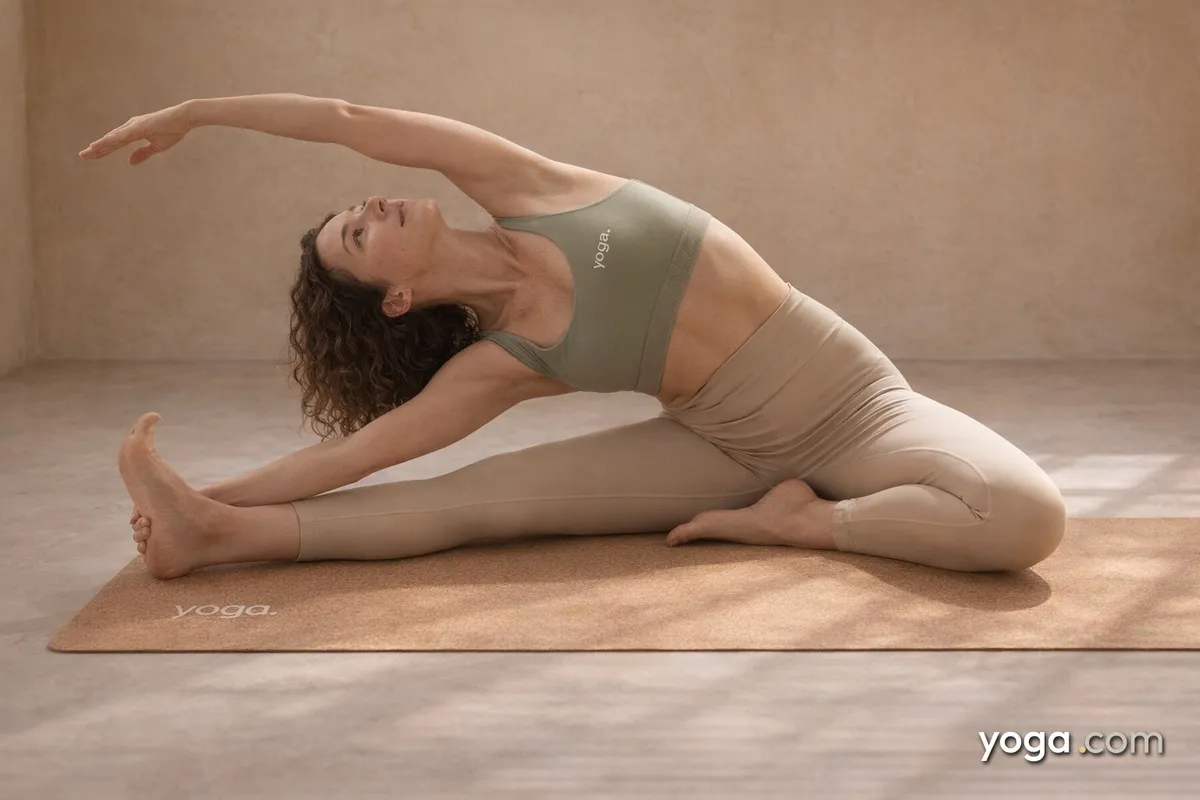
Parivrtta Jānuśīrṣāsana - from the Sanskrit parivrtta (revolved), jānu (knee), śīrṣa (head), and āsana (pose) - is a seated twist that pairs a forward fold over the extended right leg with a lateral rotation of the spine and torso. The combination asks the hamstrings, obliques, and intercostals to work simultaneously, making it a genuinely layered intermediate shape.
At a Glance
- Level: Intermediate
- Type: Twist
- Targets: Right hamstring, left hip flexors and inner groin, obliques and intercostals (bilateral), thoracic rotators, left IT band
- Good for: Spinal rotation, lateral hip and side-body opening, hamstring lengthening, breath awareness
How to Do Bend to Right Leg with Rotation
Coming in:
- Sit on your mat with both legs extended in front of you (Dandasana). Ground through your sitting bones and lengthen your spine upward.
- Bend your left knee and draw the left foot toward your left inner thigh, allowing the left knee to open out to the left and rest toward the floor. Your right leg stays extended straight ahead.
- On an inhale, root both sitting bones and grow tall through your crown. Avoid collapsing into the left hip.
- Begin to rotate your torso to the left - away from the right leg - so your chest faces left and slightly upward. This is the rotation that defines the pose: you are twisting toward the bent-knee side, not forward over the straight leg.
- Exhale and begin to hinge sideways and forward, reaching your right arm down toward your right foot or shin, palm facing up. At the same time, sweep your left arm up and over your head, reaching toward your right foot so the left arm forms an arc overhead. Both arms can hold the right foot if your range allows; otherwise the right hand rests on the shin or ankle.
- On each inhale, lengthen the left side body from hip to fingertip; on each exhale, deepen the rotation gently, encouraging the chest to open toward the ceiling rather than collapsing toward the floor.
- Hold for 5-8 breaths, keeping the right leg active - flex through the right heel and press the back of the right thigh toward the mat.
Coming out:
- On an inhale, use your core to unwind the torso and walk both hands back to center.
- Extend the left leg back alongside the right, return to Dandasana, and pause for a breath before switching sides.
Benefits
- Hamstring lengthening: Lateral flexion over the straight right leg creates a strong eccentric stretch along the right posterior chain from sit bone to heel.
- Thoracic mobility: The rotational component specifically targets mid-back rotation, where mobility is often restricted by prolonged sitting.
- Intercostal and side-body opening: The arc of the left arm over the head creates space between the left ribs, supporting fuller lateral breathing.
- Hip adductor release: The bent left knee in external rotation lengthens the left inner groin and adductors over time.
- Core coordination: Maintaining the twist while hinging laterally requires coordinated activation of the obliques and deep spinal stabilizers on both sides.
Common Mistakes and Alignment Cues
Collapsing the chest toward the floor The defining quality of this pose is rotation, not a forward fold. Keep drawing the left shoulder blade toward the spine and the chest open to the left and upward. Right sitting bone lifting off the mat If the right hip floats, the stretch shifts into the lower back rather than the hamstring. Sit on a folded blanket to keep both sitting bones grounded. Locking or hyperextending the right knee Maintain a micro-bend in the right knee if needed, and press actively through the right heel to keep the leg engaged without strain at the joint. Forcing depth with the arms Pulling yourself into the pose with arm strength compresses the spine. Lead with the breath and the rotation; let the reach come as a consequence of length, not force. Left knee creeping forward off the floor The left knee should rest passively to the left. If it hovers, place a block or folded blanket beneath it so the left hip can soften without gripping.
Modifications and Props
- Tight hamstrings: Sit on a folded blanket to tilt the pelvis forward, making it easier to hinge without rounding the low back aggressively.
- Limited shoulder mobility: Keep the left hand on your left hip or rest it on the mat behind you instead of arcing it overhead; focus on the spinal rotation first.
- Strap assist: Loop a strap around the right foot and hold it with both hands so you can maintain the rotation without collapsing the chest forward.
- Left knee support: Place a block under the left knee to reduce external rotation demand at the left hip joint and protect the left knee.
- Deepening: If both hands comfortably reach the right foot, interlace the fingers around the right foot's ball and use the bind to encourage more thoracic opening on each exhale.
Cautions
- Move carefully if you have any current hamstring strain or tear on either side - the combination of lateral flexion and rotation increases load on the right posterior chain.
- Avoid deep rotation if you have a herniated disc or acute low-back condition; work with a neutral spine and minimal twist instead.
- Those with knee ligament injuries should not allow the left knee to be forced toward the floor; support it fully with props.
- If you feel sharp or pinching pain in the right knee or either hip, ease out of the pose immediately.
- If you're working with an injury or a medical condition, check with a qualified professional before practicing.
Related Poses
- Bend to Left Leg with Rotation - the direct mirror of this pose; practice both sides for balanced spinal rotation.
- Sage Twist (Right) - another seated twist emphasizing thoracic rotation from a different leg configuration.
- Left Twist with Left Leg Bent - a complementary seated twist that reinforces the rotational pattern from the opposite direction.
- Revolved Triangle Pose with Right Arm Behind Left Foot - a standing pose that shares the lateral hamstring stretch and spinal rotation of this shape.