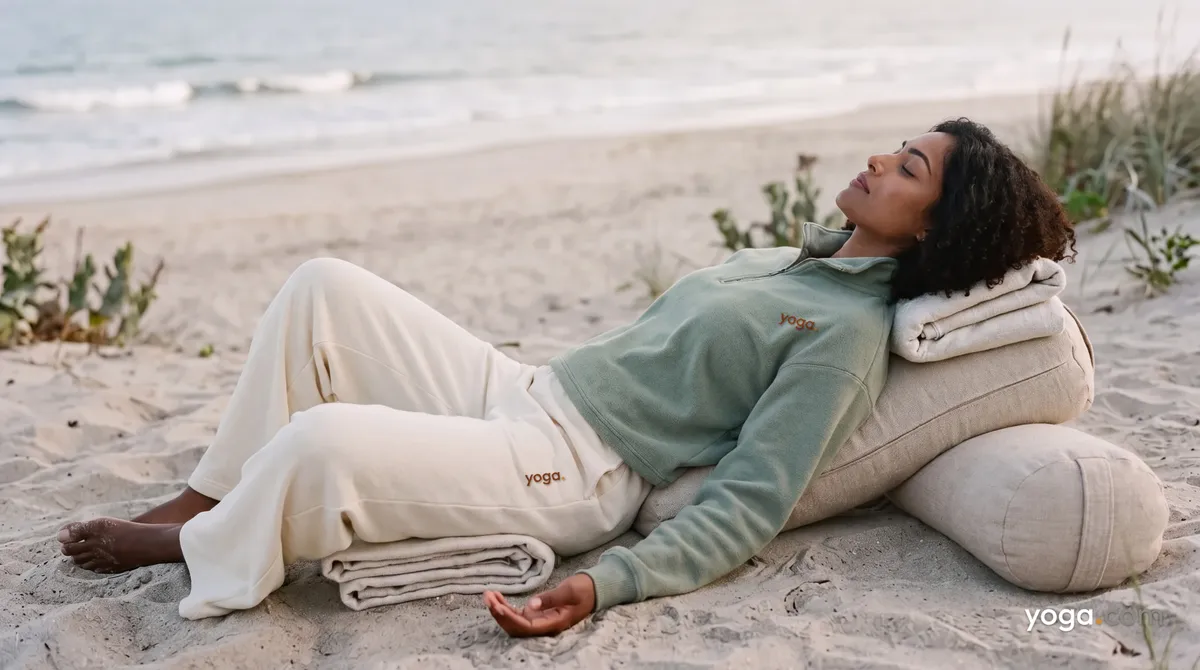
You lie back over a bolster, a folded blanket under your knees, an eye pillow resting across your eyes - and you simply stay there for ten minutes. No flowing sequences, no warrior poses, no sweat. If that sounds like the yoga class you've been quietly wishing existed, restorative yoga might be exactly what you need.
What Makes Restorative Yoga Different
Most yoga styles ask your body to work - to build strength, improve flexibility, or move through a sequence. Restorative yoga asks your body to do the opposite: rest completely. The goal isn't effort. It's the deliberate, supported release of effort.
Sessions are built around just a handful of poses, each held for five to ten minutes or longer. In a typical one-hour class, you might move through only two to four poses total, staying in each for ten to twenty minutes. The slow pace isn't accidental - it's the whole mechanism.
Where It Comes From
Restorative yoga was devised by Judith Lasater in the 1990s, who synthesized ancient knowledge and modern science drawing on her experience as both a yoga teacher and a physical therapist. Most restorative practices are rooted in the teachings of B.K.S. Iyengar, who created Iyengar Yoga with alignment and therapeutic benefits in mind.
Iyengar's central insight - that props could support the body so deeply that it could open without strain - became the structural DNA of restorative practice. That idea is still very much alive every time a teacher slides a bolster under your spine.
The Props: Why They're the Point
Restorative yoga uses blocks, straps, blankets, and bolsters to allow you to completely relax and rest in each shape. Without props, your muscles stay subtly engaged just to hold you up. With props, that muscular work disappears - and that's when the nervous system can genuinely settle.
Here's what each prop typically does:
- Bolsters - large, firm cushions that support your torso, legs, or back in backbends, forward folds, and reclined poses
- Blankets- folded and stacked to raise body parts, cushion bony areas, or simply keep you warm during long holds
- Blocks - placed under your head, hands, or hips to reduce any reaching or gripping
- Straps - used to secure limbs gently so you don't have to hold a shape actively
- Eye pillows - lightweight covers that encourage your eyes to close and your face to soften
Props aren't a sign you're "not doing it right." They're the entire reason the practice works.
What Happens in Your Body During Long Holds
When you stop bracing against gravity, your nervous system gets a clear signal: you're safe, you can stand down. This shifts your body toward the parasympathetic state - sometimes called rest-and-digest - the opposite of the fight-or-flight response that stress keeps activating.
Restorative poses are often sequenced to move your spine gently in multiple directions over a session - supported backbends, forward folds, side stretches, and twists - so by the end, your whole back body has been touched without a single muscle being asked to work hard.
What the Research Actually Shows
The evidence base for restorative yoga is growing, and it's genuinely encouraging - though it's still early days, and restorative yoga isn't a replacement for medical care.
Stress and mental clarity
- In 2023, third-year medical students who practiced restorative yoga for 45 minutes once a week over six weeks reported feeling more relaxed, with improved self-esteem and clearer thinking.
- A 2019 randomized crossover trial of 20 female nurses working night shifts found that psychological and physical stress reactions were significantly reduced after a single one-hour group restorative yoga session.
Cancer recovery and cognitive function
- A 2018 study compared 12 weeks of restorative yoga against 12 weeks of vigorous yoga in adults with a history of Stage 0-3 breast or ovarian cancer.
- A 2022 study found that previously sedentary women who had completed treatment for breast or ovarian cancer showed improved fluid cognitive function after 24 weeks of restorative yoga compared to vigorous yoga.
Metabolic health - with an honest caveat
The PRYSMS randomized trial (2009-2012) found that at 12 months, fasting glucose decreased more in a restorative yoga group than in a stretching group (−0.35 mmol/L vs. −0.03 mmol/L). That's a meaningful signal for metabolic health.
But the same trial also showed that on some stress measures, the stretching group performed comparably - or even slightly better at certain time points. The honest takeaway: restorative yoga isn't automatically superior to all other gentle movement for every outcome. It's one strong option among several.
Restorative vs. Yin: What's the Difference?
People often confuse these two slow practices. Both involve long holds - but the intention is different.
- Restorative yoga uses full prop support so your body is completely passive. There's no target sensation. Pure rest.
- Yin yoga targets the connective tissues - fascia, ligaments, joint capsules - with gentle, sustained stress. In a typical Yin practice, you hold poses for three to five minutes, often feeling a mild edge of sensation. Props are used, but the body isn't fully "off."
Think of it this way: Yin is quiet work. Restorative is quiet rest.
What to Expect in Your First Class
Walking into a restorative class for the first time can feel almost disorienting - it's that different from what most people picture when they hear "yoga."
- The room is usually dim, warm, and quiet.
- Your teacher will help you build a prop setup before you get into each pose - this takes time and that's normal.
- Once you're in a pose, you stay. Your teacher may offer gentle adjustments or simply leave you in silence.
- Feeling sleepy is completely normal. It's a sign your nervous system is doing exactly what the practice intends.
- The class usually closes in a supported version of Corpse Pose (Savasana) - the final, quietest rest of all.
A Few Poses You're Likely to Encounter
- Supported Child's Pose (Balasana) - a bolster under your torso lets your hips sink back without any rounding effort in your spine
- Supported Reclining Bound Angle Pose (Supta Baddha Konasana) - lying back over a bolster, soles of the feet together, blocks supporting the outer thighs
- Legs Up the Wall (Viparita Karani) - a gentle inversion with your legs resting against a wall; note that inversions may not suit everyone (see below)
- Supported Supine Spinal Twist (Supta Matsyendrasana) - lying on your back, knees draped to one side over a bolster
Is It Right for You? A Few Safety Notes
Restorative yoga is genuinely gentle for most people. That said, "most people" isn't everyone.
- If you have a recent injury, surgery, or a condition that affects how you lie down or remain still, check with your doctor or physical therapist before attending a class.
- Supported inversions like Legs Up the Wall may not be appropriate if you have uncontrolled high blood pressure, glaucoma, or are in late-stage pregnancy - ask your teacher to offer an alternative.
- If you're managing a serious health condition, work with both your healthcare provider and a qualified yoga teacher, rather than treating any yoga practice as a standalone therapy.
Rest as Its Own Practice
Restorative yoga is one of the most accessible, evidence-supported styles of yoga available - and one of the most underrated. You don't need fitness, flexibility, or any prior yoga experience to begin. You need a bolster, a blanket, a quiet room, and the willingness to do something that feels almost radical in a busy life: nothing at all, very deliberately. If you've been meaning to slow down, this is a genuinely good place to start.