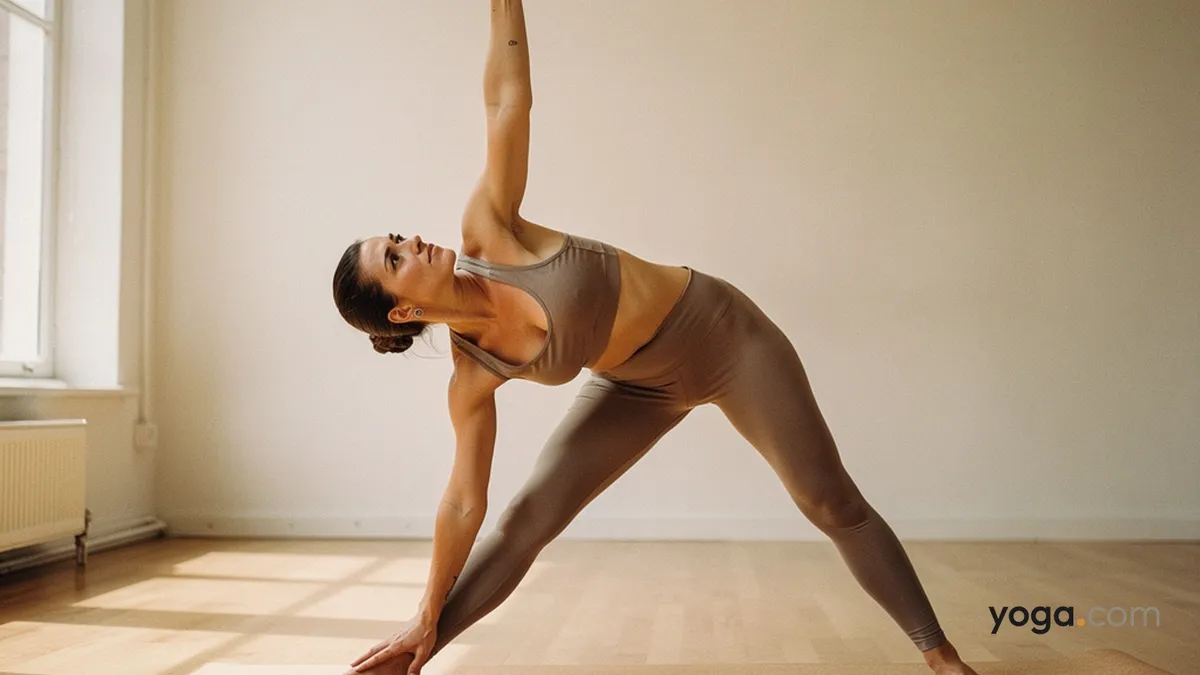
Revolved Triangle Pose with the left arm behind the right foot is a standing twist that asks your spine, hips, and hamstrings to work in precise coordination. Its Sanskrit name, Parivṛtta Trikoṇāsana (left arm behind right foot), translates roughly as "revolved triangle pose"—parivṛtta meaning turned or revolved, trikoṇa meaning triangle. This particular variation, with the left hand placed behind the right foot rather than in front of it, intensifies the rotation and demands greater hip mobility and shoulder opening, making it a natural challenge pose once the standard revolve feels steady.
At a Glance
Level: IntermediateType: TwistTargets: Hamstrings, thoracic spine, hip rotators, obliquesGood for: Building spinal rotation, lengthening the posterior chain, developing single-leg hip stabilityHow to Do Revolved Triangle Pose with Left Arm Behind Right Foot
Set your stance. Stand with your feet about three to three-and-a-half feet apart. Turn your right foot out 90 degrees and your left foot in approximately 45–60 degrees. Square your hips forward over the right leg as much as your range allows—left hip draws forward, right hip draws back.Ground through both feet. Press evenly through the outer edge of your back foot and the ball and heel of your front foot. Engage your front quadriceps to stabilize the right knee directly over the second toe.Lengthen before you twist. Inhale and reach your torso long over the right leg, keeping the spine neutral. Avoid rounding the lower back as you hinge forward; think length first, rotation second.Place the left hand behind the right foot. Bring your left hand to the floor (or a block) on the outer right edge of the right foot, behind the heel rather than in front of it. This placement rotates the left shoulder toward the floor and sets the starting position for the deeper twist.Revolve and reach. On an exhale, rotate your torso to the right, drawing your right ribs up and back. Extend your right arm toward the ceiling, stacking the right shoulder over the left. Keep your neck long; gaze can travel up toward the right hand if the cervical spine is comfortable, or stay neutral looking forward.Refine the hips. Resist the tendency to let the left hip hike up. Press your back foot firmly and draw the left hip toward the floor to keep the pelvis as level as possible. The twist lives in your thoracic spine, not in a tilted pelvis.Hold and breathe. Stay for five to eight full breaths, using each exhale to deepen the rotation without forcing it.Come out with care. On an inhale, lower the right arm, unwind the torso, and slowly return to upright. Step your feet together briefly, reset, and repeat on the second side if this is part of a balanced sequence.Benefits
Stretches the hamstrings and calves of the front leg through an extended lengthening positionMobilizes the thoracic spine in rotation, countering the forward-flexion bias of most daily movementStrengthens the hip stabilizers and gluteus medius of the standing legEngages and lengthens the obliques and paraspinal muscles on both sides of the torsoBuilds proprioceptive balance and single-leg stability under a complex loadOpens the anterior shoulder and chest of the raised arm through active extensionCommon Mistakes and Alignment Cues
Mistake: Twisting from the lower back instead of the thoracic spine. Cue: Anchor your pelvis level, then initiate the rotation from the mid-back and ribs—imagine your lower ribs spiraling away from the floor.Mistake: Collapsing the front knee inward. Cue: Firm the right quadriceps and press the knee gently outward so it tracks over the second toe throughout the pose.Mistake: Rounding the spine to reach the floor. Cue: Place a block under the left hand so you can keep the spine long; a flat back with less rotation is more effective than a deep twist with a rounded spine.Mistake: Letting the back heel lift. Cue: Root the outer edge of the left foot firmly down—this grounds the pelvis and protects the lumbar spine.Mistake: Cranking the neck to look up. Cue: If the upper gaze strains the neck, keep your chin neutral and gaze forward instead; the twist in the thoracic spine is unchanged.Modifications and Props
Block under the left hand: If the floor is out of reach, place a block on its highest, medium, or lowest setting just behind the outer right heel. This preserves spinal length and lets the twist develop organically.Wall for hip support: Stand with your back heel pressing into a wall to stabilize the pelvis and prevent the back hip from drifting outward.Shorter stance: Narrow the distance between your feet if tight hamstrings pull you into a rounded lower back; a shorter stance reduces the demand on hip flexion.Hand to shin instead of floor: Rest the left hand on the right shin rather than reaching for the floor if shoulder mobility limits you; this still cultivates the rotational awareness of the full pose.Cautions
Low-back sensitivity: The combination of forward bend and deep rotation places significant load on the lumbar spine. Move slowly, keep the core engaged, and reduce the range of motion if you feel compression or sharp sensation in the lower back.Hamstring injury: Avoid full extension of the front leg if you are working through a hamstring strain; bend the right knee slightly to reduce the pull on the tendon attachments.Neck issues: Skip the upward gaze and keep your head in a neutral position aligned with the spine throughout the pose.Balance concerns: Practice near a wall or use a block to reduce fall risk; the behind-the-foot hand placement shifts your center of gravity more than the standard variation.If you're working with an injury or a medical condition, check with a qualified professional before practicing.
Related Poses
Bend to Left Leg with Rotation — a seated preparation that introduces the same spinal rotation pattern with greater hip supportRevolved Triangle Pose with Right Arm Behind Left Foot — the mirror-side counterpart; practice both to balance the rotation through the thoracic spineRevolved Side Angle Pose with Rotation to Right Leg — a natural next progression that adds a bent front knee for deeper hip work alongside the twistMountain Pose — a grounding counter-pose to reset alignment and breath after strong standing twistsLooking to work this pose into a flowing sequence? See A Gentle Yoga Routine for Tired, Low-Energy Days for a slower-paced context, or explore A 10-Move Chair Yoga Sequence for a Midday Reset for supported twist alternatives.