"How do I get into Lotus without hurting my knees?" If you've ever asked a teacher that, you're asking the right question. Lotus Pose (Padmasana) is beautiful - and one of the most demanding hip openers in yoga, with real strain waiting for knees and hips that arrive unprepared. These 5 poses to prepare you for Lotus open exactly what Padmasana asks for: your hip flexors, external rotators, and inner-thigh muscles - build toward it patiently and it becomes one of the most rewarding postures you'll ever practice.
Practice them consistently, and the full pose will come - on its own timeline.
Why Lotus Takes More Than Flexibility
Padmasana isn't just a deep hip stretch. The pose requires a specific kind of external rotation in the hip joint - rotation that most of us, who spend hours sitting at desks or in cars, simply haven't developed. Research suggests that two-thirds of people have limited hip extension flexibility and tight hip flexors., largely because sedentary habits are so common across all age groups. Keep in mind that this kind of limited hip rotation is not a rare problem - it is very normal and very common for most people today.
The good news is that flexibility is trainable and your body can genuinely change with consistent work. A 10-week yoga practice with twice-weekly sessions produced significant gains in flexibility and balance in study participants, and so this is real proof that steady, regular effort pays off because the body responds to repeated practice over time. You don't need hours on the mat every day. You need the right poses, done often, and you need to do those poses with patience.
One important note: if you have existing knee, hip, or sacroiliac issues, please check with a healthcare provider before working toward Lotus. You should never force the pose - sensation is informative, but sharp pain is a stop sign and your body is telling you to stop.
The 5 Best Preparatory Poses for Lotus
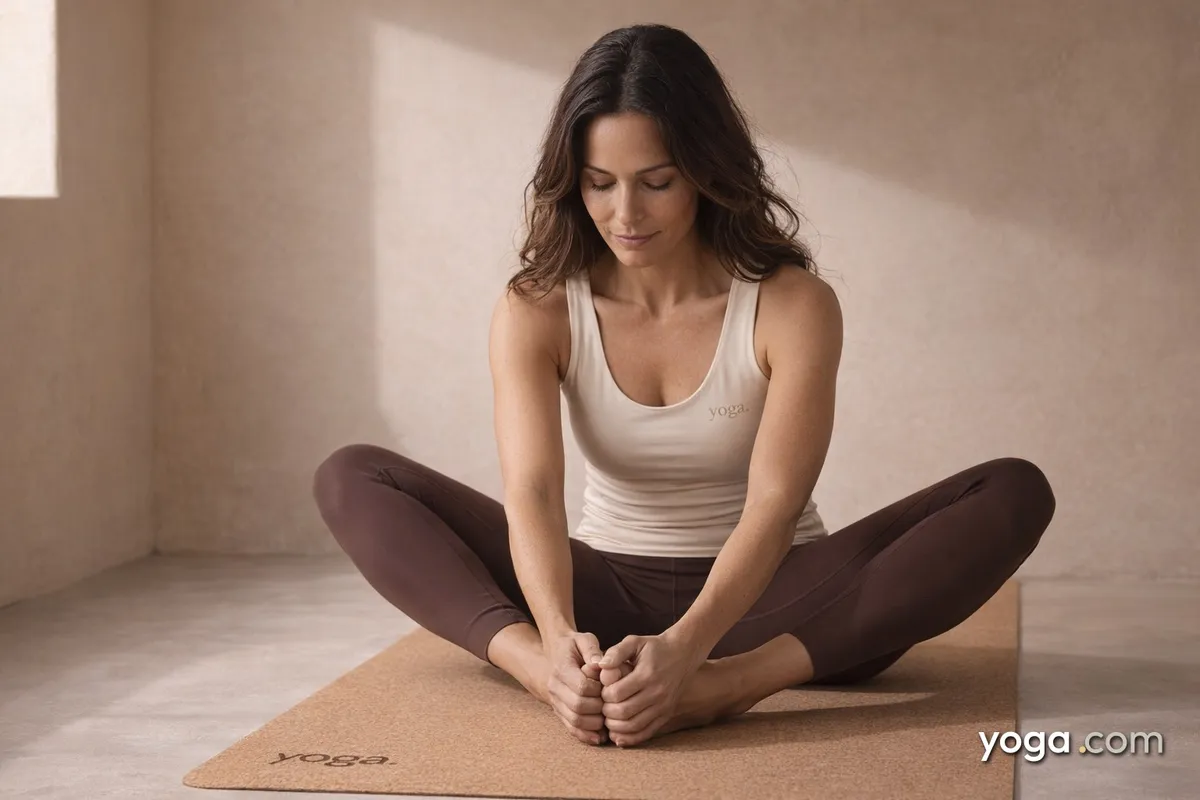
1. Bound Angle Pose (Baddha Konasana)
This is your foundation, and it is a good place for every student to begin. Sit tall, bring the soles of your feet together, and let your knees drop wide. Hold for 1-2 minutes, breathing into your inner groin with every exhale. Bound Angle Pose is a gentle but powerful external hip rotator opener and it targets exactly the movement pattern that Lotus asks for, so this pose is one you should not skip.
- Tip: Sit on a folded blanket if your lower back rounds. Height frees the pelvis to tilt forward naturally.
- Avoid pressing your knees down with your hands - let gravity do the work over time.
2. Fire Log Pose (Agnistambhasana)
Stack your shins parallel, one on top of the other, with your ankles resting on the opposite knee. Keep in mind that this pose targets the piriformis and deep external rotators, and these are the muscles that allow the femur to rotate outward in the hip socket, which is the key action in Lotus. Because these muscles are so important for Lotus, Fire Log Pose is one of the most direct ways to prepare your hips.
- If your top knee floats high above your bottom foot, slide a folded blanket underneath it for support.
- Fold forward slowly from your hips (not your waist) to deepen the stretch.
- Hold each side for 1-3 minutes.
3. Half Lotus Pose (Ardha Padmasana)
This is the direct stepping stone, and the closest preparation you can do for full Lotus is Half Lotus Pose. Sit cross-legged, then lift one foot onto the opposite thigh, sole facing up. The bottom leg stays relaxed in a simple cross-legged position. Ardha Padmasana lets you feel the rotation that Lotus requires in one hip at a time, and this is helpful because your body does not have to handle the load of both hips rotating at once.
- Critical safety check: The rotation should come from your hip, not your knee. If you feel any strain in the knee joint, back off and return to Baddha Konasana.
- Switch sides evenly - asymmetry is common and worth addressing.
4. Pigeon Pose (Eka Pada Rajakapotasana - Reclined Variation)
Lying on your back, cross your right ankle above your left knee in a figure-four shape. Flex your right foot actively. Draw your left knee toward your chest and feel the stretch bloom through your right outer hip. On top of that, this supine version gives you all the benefit of traditional Pigeon without compressing the knee or straining the lower back, so this reclined variation is a very safe choice for your practice.
- Hold for 1-3 minutes per side.
- The deeper you draw the bottom knee toward you, the more intense the stretch - go slowly.
- This is also a wonderful evening pose for unwinding after a long day of sitting.
5. Seated Wide-Angle Pose (Upavistha Konasana)
Extend both legs wide in a V-shape and sit tall. Walk your hands forward between your legs, hinging from your hips rather than rounding your spine. This pose works your inner thighs (adductors) and hamstrings and both of these muscle groups need length and ease so that your legs can settle comfortably into Lotus without pulling on the knee. Keep in mind that tight adductors and hamstrings are a very common reason students struggle with Lotus, so Seated Wide-Angle Pose is worth your time.
- Sit on a folded blanket if your pelvis tips backward.
- Don't chase the floor with your chest. A long spine matters more than distance.
- Hold for 1-3 minutes, breathing steadily.
How to Put It All Together
You do not need to do all five poses every day. A realistic and sustainable approach for most people looks something like this:
- 3-4 times per week: Practice 2-3 of these poses after a gentle warm-up or at the end of a longer practice, when your muscles are already warm and so the poses will be more effective because warm tissue responds better to stretching.
- Hold times matter: Aim for at least 60-90 seconds per side. Keep in mind that shorter holds build awareness, and longer holds build genuine tissue change, so the hold time you choose makes a real difference in your results.
- Be patient with asymmetry: One hip will almost always be tighter than the other hip. Give your stiffer side a little extra time without forcing it, and do not get discouraged if that side takes longer to open up.
- Revisit Half Lotus regularly: Half Lotus is the clearest signal of your readiness. On top of that, when Ardha Padmasana feels easeful - no knee strain, no white-knuckling - full Lotus is close, and revisiting this pose regularly will help you track your progress honestly.
What to Avoid on the Way to Lotus
A few common mistakes can stall your progress - or worse, cause injury:
- Forcing the knee: The knee is a hinge joint; it doesn't rotate. Any rotation for Lotus must come from the hip. Pain in the knee means the hip isn't open enough yet.
- Skipping the warm-up: Cold muscles and connective tissue don't stretch safely. Always ease in with a few minutes of gentle movement first.
- Holding your breath: Tension and held breath go together. If you notice you've stopped breathing, you've probably gone too deep.
- Comparing your timeline to someone else's: Hip anatomy varies widely from person to person - some hip sockets are oriented in ways that make deep external rotation easier or harder. Your practice is yours.
What To Do With All This
Lotus Pose isn't a destination you rush toward - it's something you grow into, one breath and one practice at a time. These 5 poses prepare you for Lotus by working together to open the hips, release the external rotators, and give your knees the protection they deserve. Show up for them consistently, listen to your body honestly, and Padmasana will meet you when you're truly ready. That's the practice.