You roll up your mat, grab your water bottle, and head for the door. Sound familiar? Most of us finish a session and move straight into the next thing - errands, work, the rest of life. But those quiet minutes right after practice are some of the most valuable you'll ever spend on your training. Here's how to use them.
Why Reflecting After Practice Actually Works
Reflection isn't just journaling for the sake of it. Philosopher John Dewey defined it as "the active, persistent and careful consideration of any belief or supposed form of knowledge in the light of the grounds that support it" - which is a formal way of saying: thinking deliberately about what you just did, and why.
That deliberate thinking is what separates progress from repetition. Without it, you can practice the same habits - helpful or unhelpful - for months without noticing. With it, you start to see patterns: what's opening up, what keeps stalling, where your edge actually is.
This is also why research on deliberate practice has attracted so much attention - the idea that how you engage with practice matters as much as how much time you log. Accumulated hours alone don't guarantee improvement. Conscious attention to those hours does.
Step 1: Pause Before You Pack Up
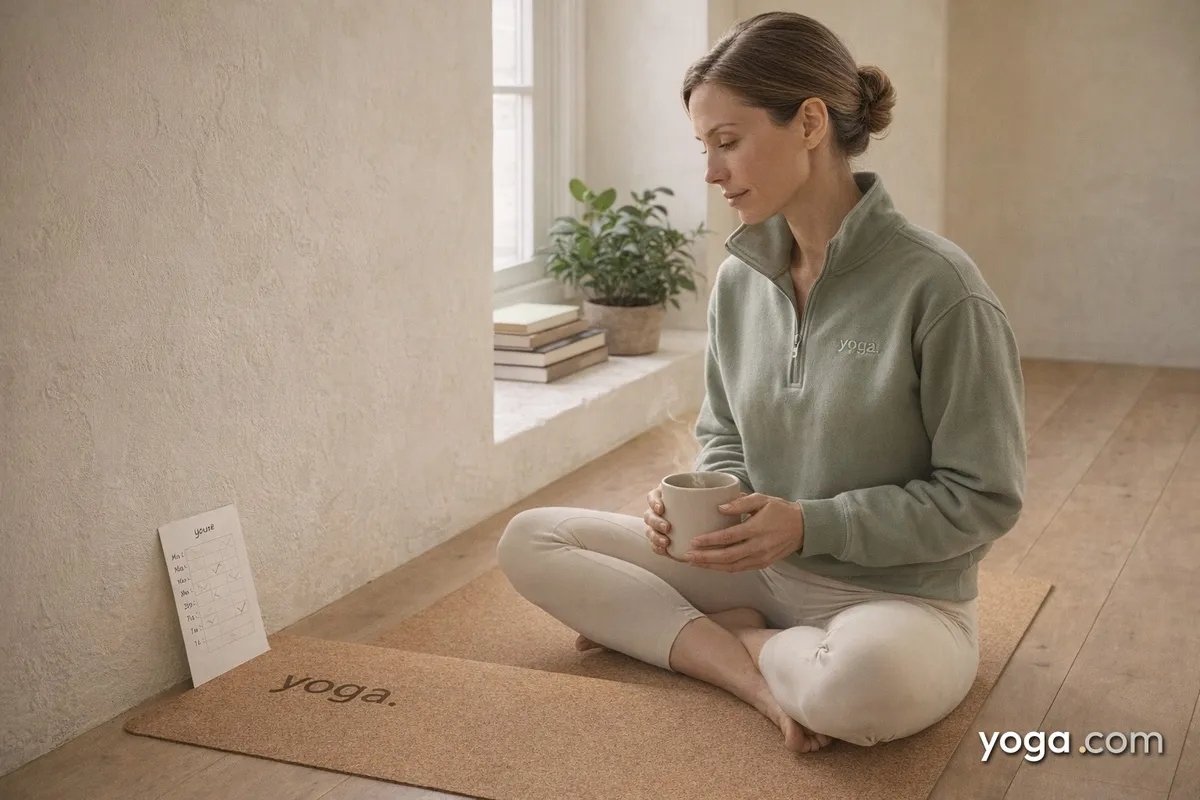
The single most effective thing you can do? Don't leave immediately. Give yourself a physical transition - even two minutes of stillness.
If you practice yoga, this is exactly what Corpse Pose (Savasana) is for. It isn't optional, and it isn't a waiting room. It's the moment your nervous system processes everything that happened in the session. Students who stay for it look noticeably different when they return to class - more settled, more integrated.
If your practice is cycling, running, or strength training, the equivalent is sitting quietly for a few breaths before you check your phone. It's a small boundary, but it changes everything that follows.
Step 2: Do a Quick Body Scan
Once you're still, notice what's actually happening in your body. This doesn't have to be elaborate.
- Where do you feel warmth or fatigue?
- Is anything tight, tender, or unexpectedly open?
- How is your breath settling - slow, shallow, easy?
- What's your energy level compared to when you started?
You're not looking for problems. You're gathering information. Over weeks and months, this body-check becomes a reliable internal compass - you'll start to recognize patterns long before they become injuries or plateaus.
If something feels sharp, painful, or persistently wrong, please check in with a qualified healthcare provider. General reflection is no substitute for professional guidance when something needs attention.
Step 3: Use Slow Breathing to Settle Your Mind
After a hard session, your mind is still moving fast. Slow, intentional breathing is one of the most practical ways to shift into a reflective state - and you only need a few minutes.
Try this simple pattern:
- Inhale slowly through your nose for a count of four.
- Exhale fully through your mouth for a count of six to eight.
- Repeat five to eight times.
Lengthening the exhale activates your parasympathetic nervous system - the "rest and digest" mode. When your system slows down, thinking becomes clearer and more honest. That's exactly the state you want for reflection.
Step 4: Ask Yourself Three Plain Questions
You don't need a complicated app or a beautiful journal (though both are fine if you love them). You need three honest questions, asked after every session:
- What went well today?
- What felt hard or unclear?
- What would I do differently next time?
That's it. Simple, repeatable, honest. The consistency is what makes them powerful - not the depth of any single answer.
One thing to watch: don't skip this on the good days. Sessions that felt open, connected, and easy carry just as much information as the hard ones. They tell you what's working - and that's exactly what you need to know in order to repeat it.
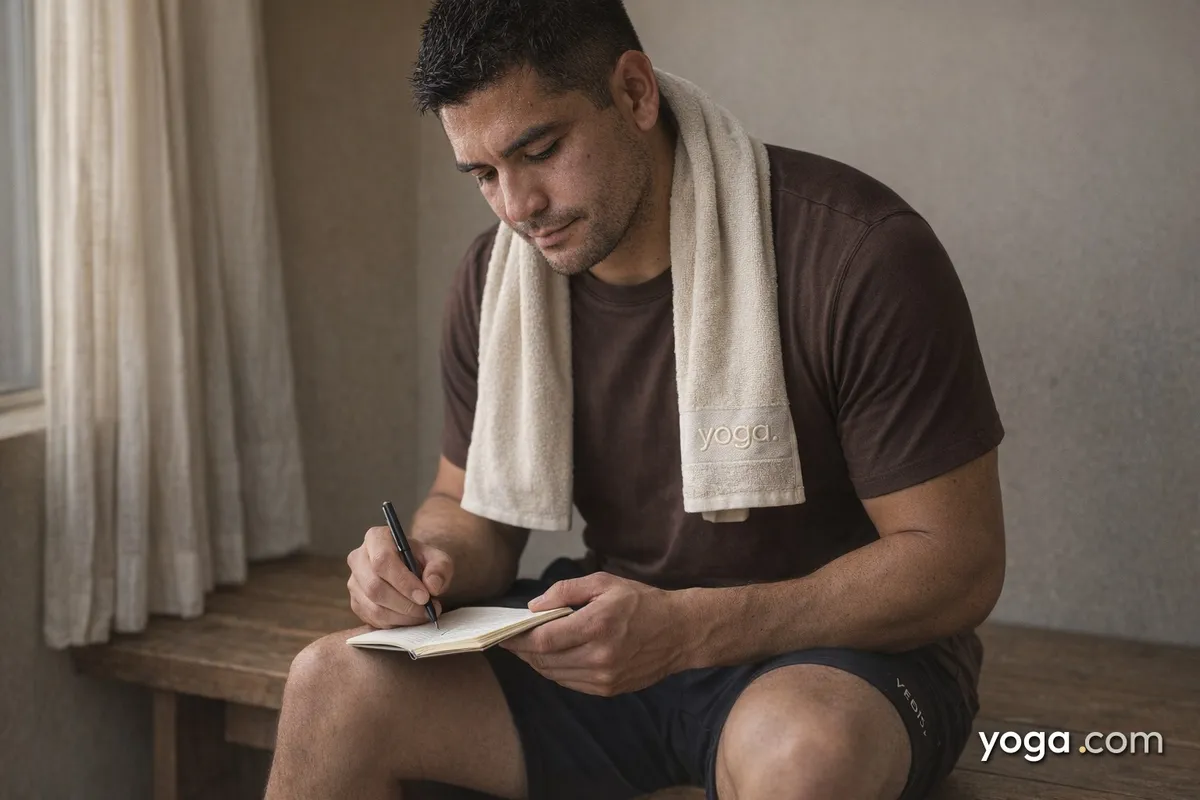
Step 5: Write Two or Three Sentences
Writing doesn't have to mean keeping a detailed training diary. It can be as minimal as:
- The date and what you practiced
- One thing that went well
- One thing you want to explore next time
That's three lines. But those three lines, accumulated over months, become something genuinely useful. You'll spot recurring patterns - the hip that keeps gripping, the breathing that improves under effort, the poses that feel different on Tuesday mornings than Saturday afternoons.
The act of writing also slows you down just enough to think more carefully. It closes the loop on the session in a way that silent reflection alone sometimes doesn't.
What Gets in the Way (And How to Work Around It)
You're always in a rush
Set a five-minute timer on your phone before you even start practice. When class ends, that window is already protected and so you do not need to find extra time because the time is already set aside. Five minutes is genuinely enough to breathe, scan your body, and answer one question. Keep in mind that five minutes is a very small commitment for something that can help your practice a lot.
Reflection feels forced or awkward at first
That feeling is completely normal. Reflective practice is a skill, not a personality trait, and so it does not come naturally to everyone right away. Reflective practice gets easier and more natural with repetition. Start smaller than you think you need to, and over time the process will feel much more comfortable for you.
You only reflect after bad sessions
This is the most common pattern that teachers fall into. You should check in after every session, not just the sessions that went wrong. The sessions that felt alive and connected are actually the most important sessions to understand and so those sessions deserve your attention too. Good sessions teach you just as much as difficult ones do.
A Note on Mental Recovery
Physical recovery gets most of the attention, things like sleep, nutrition, and rest days. But research on athlete recovery increasingly recognizes that mental and emotional recovery matter just as much. Reflection is one of the simplest ways to support both at once, because you are winding down mentally while also processing what your body just did, so your mind and body both get a chance to recover at the same time.
Keep in mind that these things work together and they are not separate processes. A practice that ends with intentional stillness and honest self-inquiry is a more complete practice, both physically and mentally. On top of that, when you skip the mental side of recovery you are only giving yourself part of what you actually need. A complete practice means you are taking care of the whole picture, not just the physical part.
Your Five-Minute Post-Practice Routine at a Glance
- Pause - stay in Savasana or sit quietly for two minutes. Don't reach for your phone.
- Breathe - five to eight slow, full breaths. Lengthen the exhale.
- Scan - notice how your body feels without judgment.
- Ask - what went well, what was hard, what's next?
- Write - two or three sentences in a notebook or your notes app.
The Takeaway
Finishing practice and walking straight out the door leaves real value on the table. Five quiet minutes - a breath, a body check, a few honest questions - can do more for your long-term progress than an extra hour on the mat, and that's where much of the real learning actually settles in. Start tonight. Start small. Let the habit build itself over time.
And if you are managing an injury, a health condition, or chronic pain, please work with a qualified teacher or healthcare provider to adapt any practice to your specific situation. Keep in mind that these steps are general guidelines and so the steps may not fit every person without some adjustment. You are not a general case. Your situation is your own, and your practice should reflect that.