You know that feeling on Sunday evening - the quiet resolve that this week will be different? You'll move more, sleep better, eat with a little more intention. Then Thursday arrives and the plan has quietly dissolved. Building a weekly wellness rhythm isn't about willpower or perfection. It's about designing a realistic, repeatable pattern - one that holds up even when life gets messy.
What a Weekly Wellness Rhythm Actually Is
Think of it less like a schedule and more like a heartbeat, a predictable pulse of sleep, movement, nourishment, and rest that runs quietly in the background of your week. It does not need to be elaborate. The simple fact is, it needs to be repeatable, and a rhythm that is repeatable is one you can actually sustain week after week because it fits into your real life.
A plan you follow for three days and then abandon is not a rhythm. Keep in mind that a simpler plan, one you return to again and again each week, is a true rhythm and that is what you are really aiming for. Start with that simpler plan, and build your weekly wellness rhythm from there.
Why It's Worth the Effort
The stakes are real, and the good news is genuinely encouraging. Keep in mind that men and women who increased their physical activity levels saw reductions in relative risk of death of about 20-35%. These are not small numbers, and they show that increasing your physical activity can make a meaningful difference to your life. Even more striking: people who went from unfit to fit over a five-year period reduced their relative risk of death by 44% compared with those who stayed unfit. On top of that, this improvement happened over just five years, and so your body can respond to consistent effort faster than you might expect because the body is designed to adapt.
You don't need to overhaul your entire life to get these kinds of results. What you need is a rhythm you will actually keep, and a rhythm you can return to even after a bad week. A consistent routine you stick with will always do more for your health than a perfect plan you abandon after a month.
Start With Sleep - Not Movement
Most of us reach for a new workout plan first. Sleep is actually the smarter starting point. Poor sleep undermines every other habit you're trying to build - your energy, your appetite, your motivation to move.
Anchor your rhythm around a consistent bedtime and wake time, seven days a week. Same time Saturday as Monday. That consistency is what trains your body's internal clock.
Simple sleep habits that help
- Set a firm lights-out time and work backward from your wake alarm.
- Dim screens 30 minutes before bed - the light signals your brain to stay alert.
- Keep your last heavy meal at least two to three hours before sleep.
- Make your bedroom cool, dark, and as quiet as possible.
If you're managing a sleep disorder or chronic fatigue, please speak with your doctor before making changes to your routine.
Plan Your Movement Across the Full Week
The most common mistake? Cramming all your exercise into one or two frantic days. That pattern creates soreness, burnout, and eventually - nothing.
The U.S. Department of Health and Human Services recommends at least 150 minutes of moderate aerobic activity per week, or 75 minutes of vigorous activity for most healthy adults. Spread across five days, that's just 30 minutes of a brisk walk. Manageable. Real.
And the payoff for simply moving more adds up fast. An estimated 110,000 deaths per year could be prevented if U.S. adults ages 40 and older increased their moderate-to-vigorous physical activity.
A simple weekly movement template
- Monday / Wednesday / Friday: 30 minutes of aerobic movement - walking, cycling, a yoga flow.
- Tuesday / Thursday: Strength or resistance work - bodyweight, bands, or weights.
- Saturday: Something you enjoy - hiking, dancing, a longer yoga class.
- Sunday: Full rest or gentle movement only (see below).
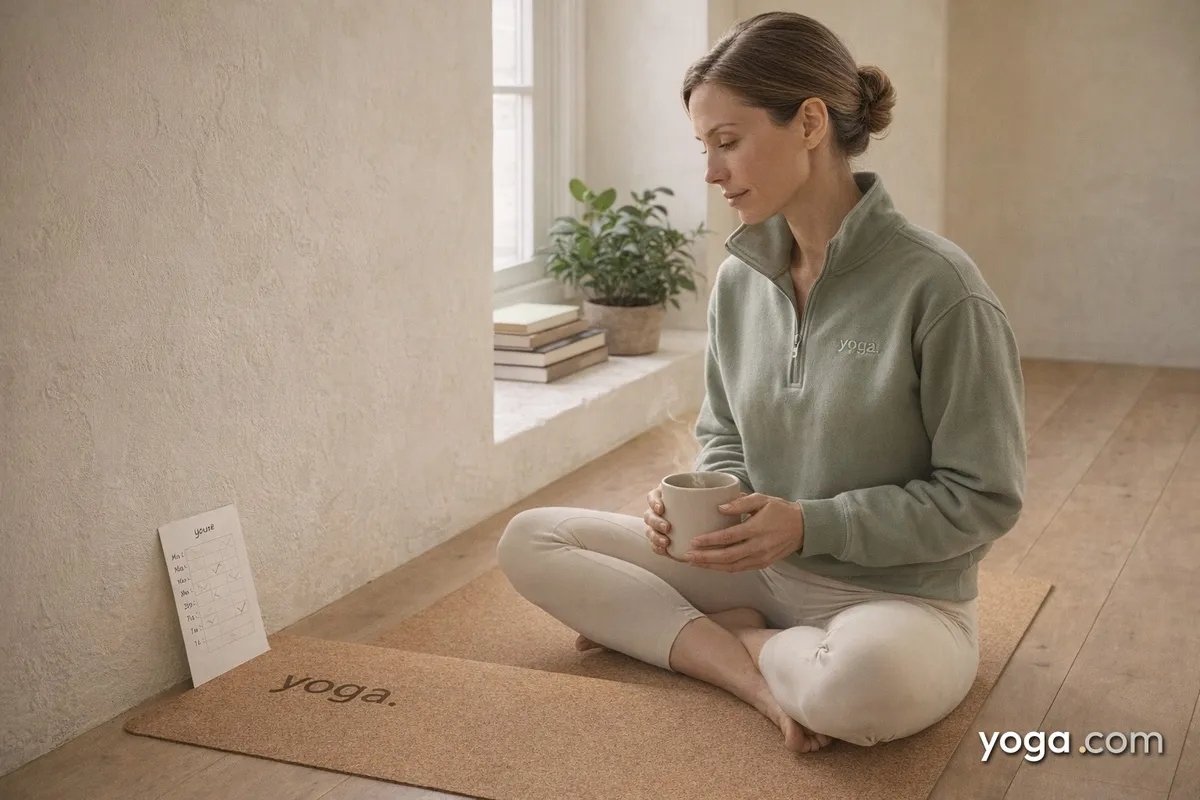
Write it in your calendar. A movement plan that only exists in your head rarely survives contact with a busy Tuesday.
Protect Your Rest Days
Rest days are not wasted days. They're when your body repairs, rebuilds, and consolidates all the work you've done. Skipping them doesn't make you dedicated - it makes you more likely to quit.
On rest days, gentle movement like Child's Pose (Balasana), a slow walk, or some easy stretching is perfectly fine. What you're avoiding is intensity. Let your nervous system settle.
One honest note: a rest day that ends with two hours of late-night scrolling and five hours of sleep isn't doing much recovering. The rest has to be actual rest.
Add Food and Hydration Habits - Simply
You don't need a meal plan. What you need is regular eating times and enough water every day. Erratic mealtimes make steady energy harder to sustain and can disrupt your sleep quality, a connection many people overlook because they never think to connect the two things together.
Easy anchors to add to your week
- Eat at roughly the same times each day so your body knows what to expect and can work with a steady rhythm.
- Start each morning with a full glass of water before your coffee, because your body needs hydration first.
- Drink a glass of water before each meal - this is a simple habit and a simple habit repeated daily has a real cumulative effect on your health.
- Prep one or two simple, nourishing meals on Sunday to reduce your weekday decision fatigue so you make better choices when you are tired.
None of this requires perfection. Keep in mind that what it requires is repetition, and repetition is something any person can do.
How Long Until It Feels Automatic?
Nobody tells you that it takes longer than three weeks. A UK study found it took an average of 66 days for habits to feel automatic, with individual ranges from 18 to 254 days. A 2024 systematic review of 20 studies found habit formation could range from as few as 4 days to as many as 335, with significant individual variability.
That range is actually reassuring. It means there's no universal timeline you're failing to meet. Your rhythm will become automatic at your own pace - as long as you keep returning to it.
The One Mistake That Breaks Most Wellness Routines
Treating the whole thing like an on/off switch. You're either doing everything perfectly or you've "fallen off" and doing nothing.
A habit you practice 80% of the time is a real habit. A two-week perfect streak followed by abandonment is not. One skipped session doesn't break your rhythm. It's only when you let one skipped session become a week of inaction that the pattern frays.
When you miss a day - and you will - you simply start again the next day. The rhythm is always there to return to.
Build slowly to last longer
- Start with two or three habits, not ten.
- Let those feel normal before adding anything new.
- Add one new habit every two to three weeks.
- Expect imperfect weeks. Plan for them.
A Quick Note on Safety
This article offers general wellness guidance for healthy adults. Keep in mind that general guidance like this has real limits and cannot cover every individual situation. If you have a chronic health condition, are recovering from an injury, are pregnant, or are unsure what level of activity is appropriate for you, please consult your doctor or a qualified health professional before starting a new routine. Your situation is specific, so the advice here may not apply to you in the same way it applies to someone else. It is always best to check with a professional first. Your health is too important to leave to general advice alone.
Your Rhythm, Your Rules
A weekly wellness rhythm isn't a program you complete. It's a pattern you return to - for sleep, movement, nourishment, and rest - in a form that fits your actual life. Start smaller than you think you need to. Be more consistent than you think matters. And trust that showing up imperfectly, week after week, is exactly how this works.
Sources
- PMC / Canadian Medical Association Journal - Physical activity and health: an overview
- Mayo Clinic - Depression and exercise: What you need to know
- CDC - Benefits of physical activity
- PMC - How are habits formed: modelling habit formation in the real world
- PMC - 2024 systematic review and meta-analysis on habit formation