You roll your neck, reach for your coffee, and feel that familiar dull ache creeping across your shoulders. Sound familiar? Tight shoulders can quietly limit how you move, work, and sleep - but a consistent, targeted yoga practice can genuinely help. Here's what you need to know before you start, plus a simple sequence you can try today.
Why Your Shoulders Get So Stiff
The shoulder is the most mobile joint in the body - which is exactly what makes it vulnerable. That mobility comes at a price: stability depends on a delicate network of muscles and tendons rather than a deep bony socket.
The rotator cuff alone involves four muscles - the supraspinatus, infraspinatus, teres minor, and subscapularis - and that's just one part of the picture. When any of these muscles get overworked, underused, or chronically shortened from desk posture, the whole shoulder complex can tighten up.
If you work at a desk, you're especially susceptible. Shoulder pain is the third most prevalent musculoskeletal complaint among sedentary workers, accounting for about 21% of all complaints. Hours of hunching forward - over a laptop, a phone, a keyboard - gradually pulls the shoulders out of their optimal position.
When to Check With a Professional First
Not all shoulder tightness is the same. Before you dive into a sequence, it's worth pausing on a few key points.
Frozen shoulder (adhesive capsulitis) is one condition that calls for professional guidance before you self-treat with yoga. It affects 2-5% of the general population, with a slight preponderance in women, and mainly strikes those in the 35-65 age group. It's also worth knowing that the association with diabetes is 2-4 times higher than in the general population - so if you have diabetes and are experiencing significant shoulder stiffness, please see your doctor.
Sharp, stabbing pain is always a stop sign. A mild pulling or stretching sensation is normal. Sharp pain is not - and it should prompt a visit to a physical therapist or physician before you continue.
If your pain has lingered for months, take that seriously too. Research shows that on average, 50% of people with shoulder pain still report symptoms six months after presenting in primary care. Persistent shoulder pain deserves professional eyes on it.
Does Yoga Actually Help Tight Shoulders?
Yes, and there is solid evidence to support it. A 2025 review of 52 prospective clinical studies involving 4,151 patients found that all studies demonstrated marked benefits, with measurable outcomes and self-reported improvements consistently higher in yoga groups than in controls. These results come from a large number of studies and a large number of patients, so the evidence here is not just one small finding.
Even in athletic populations, the results are clear and worth paying attention to. A 10-week study of college athletes found significant gains in shoulder flexibility (P = 0.03) in the yoga group compared to controls. Keep in mind that ten weeks is a realistic and achievable window for you to start noticing real change in your own shoulders, and so this study matters because it shows yoga works even for people who are already physically active.
The key word is consistent. On top of that, the way you practice matters just as much as whether you practice at all, and a short daily practice will outperform one long session a week every time. A short daily practice done consistently will always beat a longer session done only once in a while.
The Sequence: Five Moves for Tight Shoulders
This sequence takes 15-20 minutes. Move slowly, breathe fully, and never force a pose. Start with a brief warm-up, then work through the poses in the order listed. Doing the poses in this order matters, so please follow the sequence as it is given.
Warm-Up: 2-3 Minutes
- Slow neck rolls - 3 circles each direction
- Gentle shoulder shrugs - inhale to lift, exhale to drop, 6-8 times
- Arm circles - forward and back, 5 each direction
1. Thread-the-Needle (Parsva Balasana)
From hands and knees, slide one arm under your body along the floor, palm facing up, until your shoulder and cheek rest on the mat. This rotates and opens the upper back and the back of the shoulder at the same time. Keep in mind that this pose works the upper back and the shoulder together, and so it is a very useful starting point for tight shoulders.
- Hold: 5-8 slow breaths each side (roughly 30-45 seconds)
- Common mistake: Letting the hips shift toward the threading arm - keep both hip bones level so the rotation comes from the upper back, not the hips
- Modification: Go only as far as your range allows; even a small rotation is effective and will grow over time
- Caution: If you feel pain on inward rotation of the arm, skip this one and consult a physical therapist
2. Eagle Arms (Garudasana Arms)
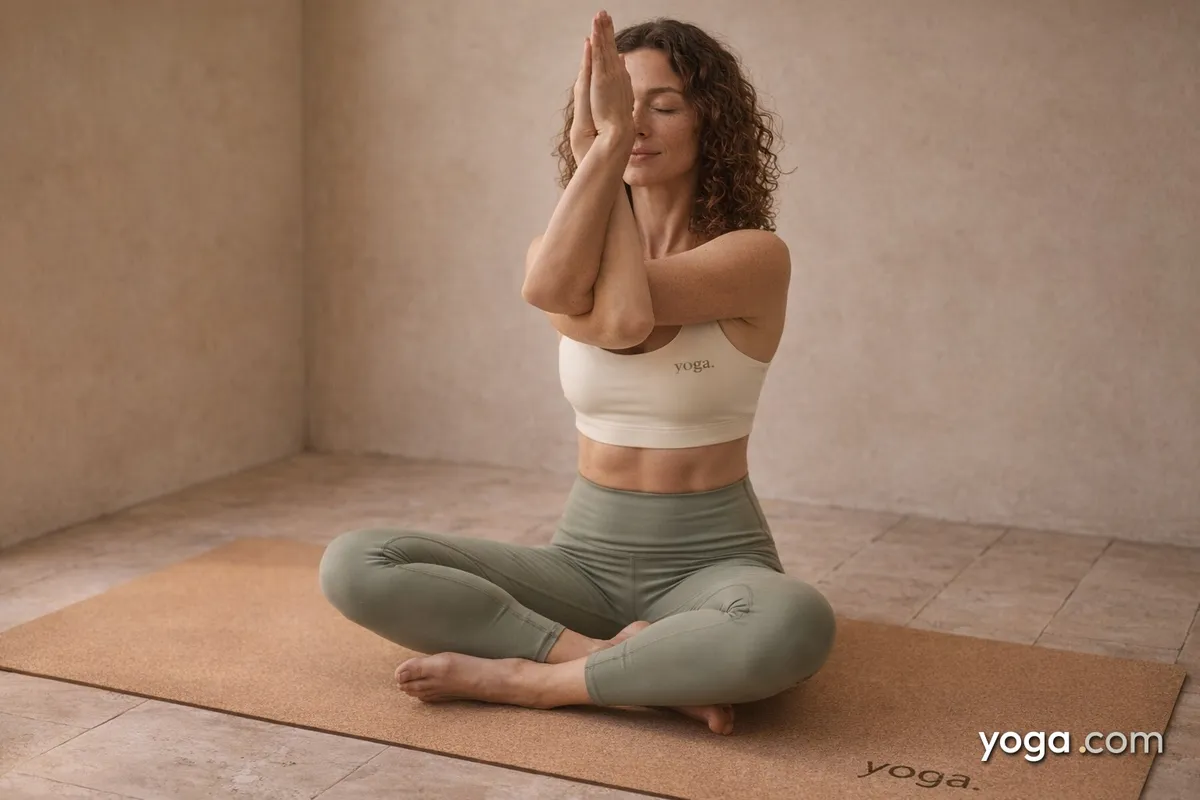
Sitting comfortably, cross one arm under the other at the elbow and try to bring the palms together. This targets the posterior shoulder capsule and the space between the shoulder blades - exactly where desk tension accumulates. On top of that, Eagle Arms is one of the most direct ways to reach the back of the shoulder, which is an area that most people never stretch on its own.
- Hold: 30 seconds each side
- Common mistake: Rounding the upper back to get the hands closer - instead, lift the elbows up and away from the chest while keeping the spine tall
- Modification: If the palms can't meet, simply cross the arms and hold the opposite shoulders
3. Cow Face Arms (Gomukhasana Arms)
Reach one arm overhead and bend the elbow, dropping the hand down your back. Reach the other arm behind your back from below and try to clasp fingers. The top arm opens the front of the shoulder and the bottom arm works the posterior capsule, and so together these two arms give you a full shoulder opening in just one pose. Cow Face Arms covers both the front and the back of the shoulder at the same time, which is why this pose is so useful.
- Hold: 30-45 seconds each side
- Common mistake: Forcing the hands together when the gap is too wide
- Modification: Use a yoga strap or a folded towel between the hands - close the gap gradually over several weeks
4. Puppy Pose (Uttana Shishosana)
From hands and knees, walk your hands forward while keeping your hips over your knees, letting your chest melt toward the floor. Puppy Pose lengthens the entire shoulder girdle and the thoracic spine at the same time, and so this pose does a great deal of good work for your whole upper body in one simple position.
- Hold: 5-8 breaths
- Common mistake: Collapsing in the lower back - keep a gentle engagement in the core
- Modification: Rest your forehead on a folded blanket if the floor is too far away
5. Standing Chest Opener or Doorway Stretch
Place both forearms on a doorframe, elbows at shoulder height, and gently step one foot forward until you feel a stretch across your chest and the fronts of your shoulders. Releasing the chest is directly connected to releasing the shoulders because you really cannot fully open one without addressing the other. Keep in mind that tight chest muscles pull the shoulders forward, and so opening the chest is not optional if you want your shoulders to feel better.
- Hold: 30-45 seconds, twice
- Common mistake: Jutting the chin forward - keep the head neutral and the chest broad
Quick Reference: Sequence at a Glance
Below is the full sequence in order so you can follow along easily. Keep in mind that doing these steps in the correct order helps your body warm up properly and get the most benefit from each movement.
- Warm-up - 2-3 minutes (neck rolls, shoulder shrugs, arm circles)
- Thread-the-Needle - 5-8 breaths each side
- Eagle Arms - 30 seconds each side
- Cow Face Arms - 30-45 seconds each side (strap if needed)
- Puppy Pose - 5-8 breaths
- Doorway Chest Stretch - 30-45 seconds, twice
Following this sequence from start to finish gives your shoulders and upper back a complete release and so your body has time to open up gradually because rushing from one step to the next does not allow enough time for each stretch to work. You should go through each step in order and repeat the sequence daily for the best results.
One More Thing: Yoga Is Safe, But Alignment Matters
Yoga has an excellent safety profile overall - serious adverse events are rare, occurring in fewer than 2% of injuries reported. Still, the shoulder is a complex joint that can be strained by too much force or poor alignment. Move with attention, not ambition.
If anything in this sequence causes sharp pain, stop immediately. And if your shoulder pain is severe or has been ongoing, please work with a physical therapist or physician alongside your yoga practice.
Your Shoulders, Unlocked
Tight shoulders are common, they're often tied to how we sit and move through the day - and they respond well to consistent, thoughtful yoga practice. This sequence asks for 15-20 minutes and a willingness to move slowly. Do it most days, give it a few weeks, and your shoulders will thank you.
Sources
- PMC - Epidemiology of shoulder pain: a systematic review
- PMC - Yoga for musculoskeletal disorders: a 2025 systematic review
- PMC - Musculoskeletal disorders in sedentary and office workers
- PMC - Effects of yoga on flexibility and balance in college athletes
- Yoga Journal - Yoga for tight shoulders: anatomy and poses
- U.S. Department of Veterans Affairs - Yoga: Whole Health Library
- PMC - Frozen shoulder: a systematic review of its epidemiology and risk factors