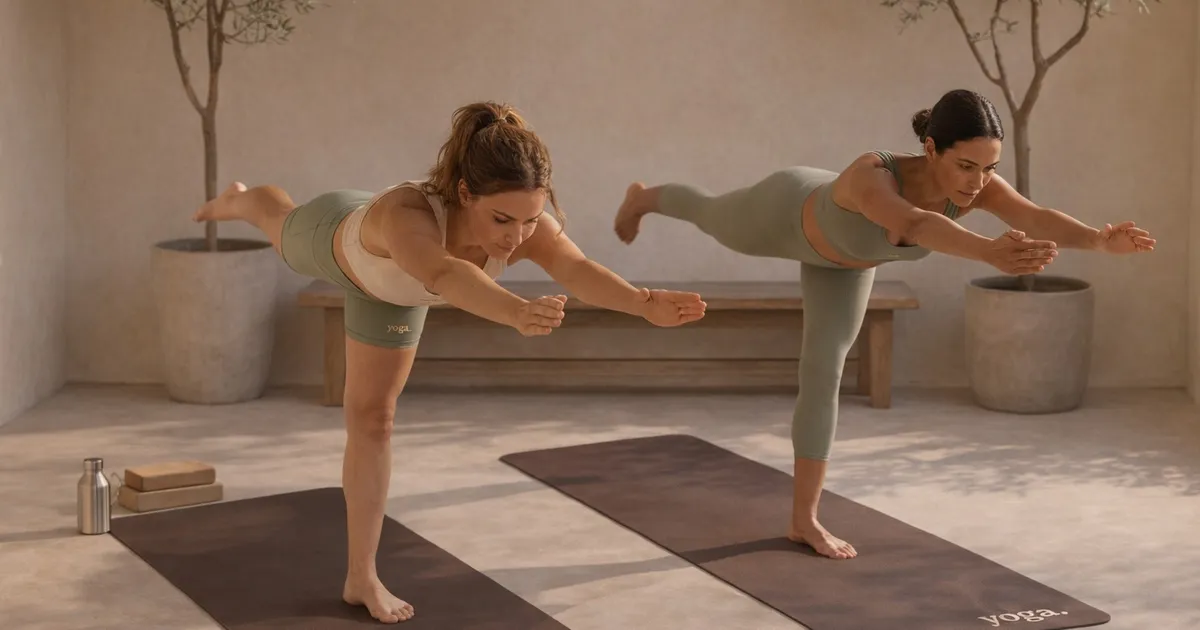
You know that slight wobble when you step off a curb, or the split-second scramble when you slip on a wet floor? That's your balance system working hard - and it can be trained. A well-chosen yoga sequence for balance and stability is one of the most practical tools you have, whether you're a complete beginner or someone who's been on the mat for years. Here's exactly how it works and how to get started today.
What's Actually Happening in Your Body During Balance Poses
Balance is not just about having strong legs. Balance is a full-body communication system where your eyes, inner ear, and muscles send signals to your brain, which responds by making tiny adjustments to keep you upright; therefore, every time you hold a balance pose, you are training that entire communication system. Keep in mind that this process is happening constantly, even when you feel completely still.
Balance poses challenge two distinct skills:
- Static balance - holding steady in one place without swaying.
- Dynamic balance - anticipating and reacting to movement, like walking on uneven ground.
Both of these skills matter enormously in your daily life. On top of that, yoga trains both static balance and dynamic balance, and yoga often trains both skills within the same pose. Your body is doing a lot more work during a balance pose than most people realize.
Why Your Core Is the Real Foundation
Your core is not just your abs. The core includes your back muscles, abdominal muscles, and the muscles around your pelvis - and that is a much wider team than most people picture when they hear the word "core." Keep in mind that when this whole group is weak, your entire stability system struggles to do its job.
The good news is that yoga poses that look like "leg work" are almost always core work too, and so you are training your core even when you do not realize it. Tree Pose (Vrksasana), Warrior III (Virabhadrasana III), and Chair Pose (Utkatasana) all require your core to fire continuously because your body needs that constant engagement to hold the pose steady. This is not a side effect of these poses; it is the whole point of practicing them.
A Simple Starter Sequence: Five Poses Worth Doing
You don't need a long list. A handful of well-chosen poses practiced consistently will do far more for your balance than rushing through twenty poses all at once. Keep in mind that these five poses below are enough to get you started on the right path:
- Mountain Pose (Tadasana) - Standing tall with correct alignment teaches your body where "steady" actually feels like. Mountain Pose is a reset you will return to between every pose, and so it is worth taking your time with it.
- Tree Pose (Vrksasana) - Stand on one foot, pressing the sole of the other foot against your inner calf or thigh (never the knee joint - lateral pressure on the knee risks a sprain). Your gluteus medius, ankle stabilizers, and core all have to coordinate together, and so this pose asks more of your body than it may first appear. If Tree Pose feels shaky, keep the toes of your lifted foot lightly on the floor while you find your alignment first.
- Chair Pose (Utkatasana) - Chair Pose is a powerful thigh and core strengthener. Sink your hips back as if sitting into a chair, keep your chest lifted, and breathe. The burn you feel is exactly what builds the strength that steadies you over time.
- Warrior III (Virabhadrasana III) - Hinge forward and lift one leg behind you until your body forms a T-shape. Your standing leg, hip stabilizers, and core all work together because no single muscle group can hold this position alone. On top of that, Warrior III is more demanding than the earlier poses, so save it until Tree Pose feels solid.
- Standing Half Forward Bend (Ardha Uttanasana) - This pose is a gentle hamstring and back release that keeps the posterior chain supple. Keep in mind that tight hamstrings limit your range of motion and, over time, tight hamstrings will compromise your balance as well.
The Detail Most People Skip: Slow Entries and Exits
Here's something most beginners don't hear: the transition into and out of a balance pose is as valuable as the held position. If you flip into Warrior III quickly and step out just as fast, you're only getting the static hold - and missing a real piece of the training.
Try this instead: count five or six slow seconds going in, hold for a few breaths, then count five or six seconds coming back out. That controlled movement trains the same coordination your body needs to step off a curb safely or catch yourself mid-slip.
Use Your Drishti - Your Gaze Point
In yoga, a fixed gaze point is called a drishti. It's not a decorative detail - it's functional. Your eyes are constantly feeding your brain information about where your body is in space. When your gaze is soft and wandering, that information is noisy. When you fix it on one still point, your whole body steadies.
Don't believe it? Try Tree Pose with your eyes closed for five seconds. You'll feel the difference immediately - and you'll never skip your drishti again.
How Often Should You Practice?
Frequency matters more than session length when it comes to balance training. How often you train matters more than how long each session is. Research published in Medicine & Science in Sports & Exercise recommends that adults perform neuromotor exercise - including balance, agility, and coordination - on two to three days per week. That is a manageable target for most people, and it is backed by solid evidence, so you do not need to feel like you have to train every day.
The same research recommends flexibility exercises for each major muscle-tendon group for approximately 60 seconds per exercise on at least two days per week. Keep in mind that stretching and balance work are not really separate things, because tight muscles limit your range of motion and limited range of motion directly undermines your stability. On top of that, when your muscles are tight you make balance training harder for yourself than it needs to be.
The American College of Sports Medicine also recommends that every adult perform activities that maintain or increase muscular strength and endurance for a minimum of two days per week. Strength, flexibility, and balance all support each other, and so you really do need all three working together. The simple truth is that leaving out any one of these three areas will hold back your progress in the other two areas as well.
What the Research Says About Yoga and Balance
The evidence is genuinely encouraging, though not every study is perfectly consistent. A 2014 systematic review found that of 15 studies meeting inclusion criteria for yoga and balance, 11 found positive results on at least one balance outcome. That is not a guarantee, but it is a meaningful signal and it tells you that yoga has a real pattern of helping with balance across many different studies. When most studies point in the same direction, that direction is worth paying attention to.
A 10-week study of college athletes found significant gains in balance (stork stand, P = 0.05) and flexibility in the yoga group compared to a control group. Keep in mind that these were college athletes who were already fit and active, and so the fact that yoga still made a measurable difference for these athletes is important for you to know. On top of that, if yoga can improve balance in people who are already in good physical condition, it is very likely that yoga can help improve your balance too.
Starting Safely: What to Watch For
Balance training is gentle, but a few smart habits will protect you and so it is worth paying attention to these habits especially at the start. How you begin matters a lot for your safety.
- Practice near a wall. Practicing near a wall is not cheating. The wall is a sensible tool that lets you push a little further without the risk of a real fall, and using the wall means you can train with more confidence.
- Progress slowly. If Tree Pose still feels wobbly, Warrior III can wait. Let the easier poses feel genuinely solid before you move on, because moving on too fast can undo the progress you have already made.
- Skip poses if something hurts. Keep in mind that discomfort is normal, but sharp pain is a clear signal to stop. Your body is telling you something important when sharp pain appears, so listen to your body.
- Talk to your doctor first if you have a history of falls, inner ear issues, or any condition that affects your balance. A qualified yoga instructor can also help you modify poses to fit your needs safely, and getting that guidance from a qualified yoga instructor is always a good idea when you are starting out.
Your Next Step
Better balance does not require a gym, special equipment, or an hour a day. Better balance requires showing up a few times a week and paying attention to the details, which include slow transitions, a steady gaze, and an engaged core. Keep in mind that your nervous system also needs time to adapt, so you should not expect changes to happen overnight. On top of that, the details matter more than the duration, and so even a short focused session is more useful than a long careless one. Start with Mountain Pose and Tree Pose. Practice those two poses twice this week, and notice what changes in your body and your steadiness. That is how it begins, and that is how real progress in balance is made.
Sources
- PMC / National Library of Medicine - Yoga and Balance: A Systematic Review
- PubMed - ACSM Quantity and Quality of Exercise Recommendations (Medicine & Science in Sports & Exercise)
- American College of Sports Medicine - Physical Activity Guidelines
- PMC / National Library of Medicine - Effects of Yoga on Flexibility and Balance in College Athletes