Yoga tradition has always kept a handful of simple poses that practitioners return to day after day, and modern practice is no different. Building something meaningful doesn't take a 90-minute class, a perfect wardrobe, or years of experience - just a few poses you can trust to stretch, strengthen, and ground you every day. These five are exactly that: time-tested, beginner-friendly, and genuinely transformative when practiced consistently.
Why Consistency Beats Variety (Especially at the Start)
It's tempting to seek out new poses constantly. But most teachers agree that a 20-minute daily practice is more valuable than an hour and a half twice a week. Even 15 to 20 minutes is enough time to align your day and come home to your body.
The five poses below give you a complete, balanced foundation - covering posture, strength, flexibility, and recovery. Master these before you add anything else.
1. Mountain Pose (Tadasana): Your Posture Reset
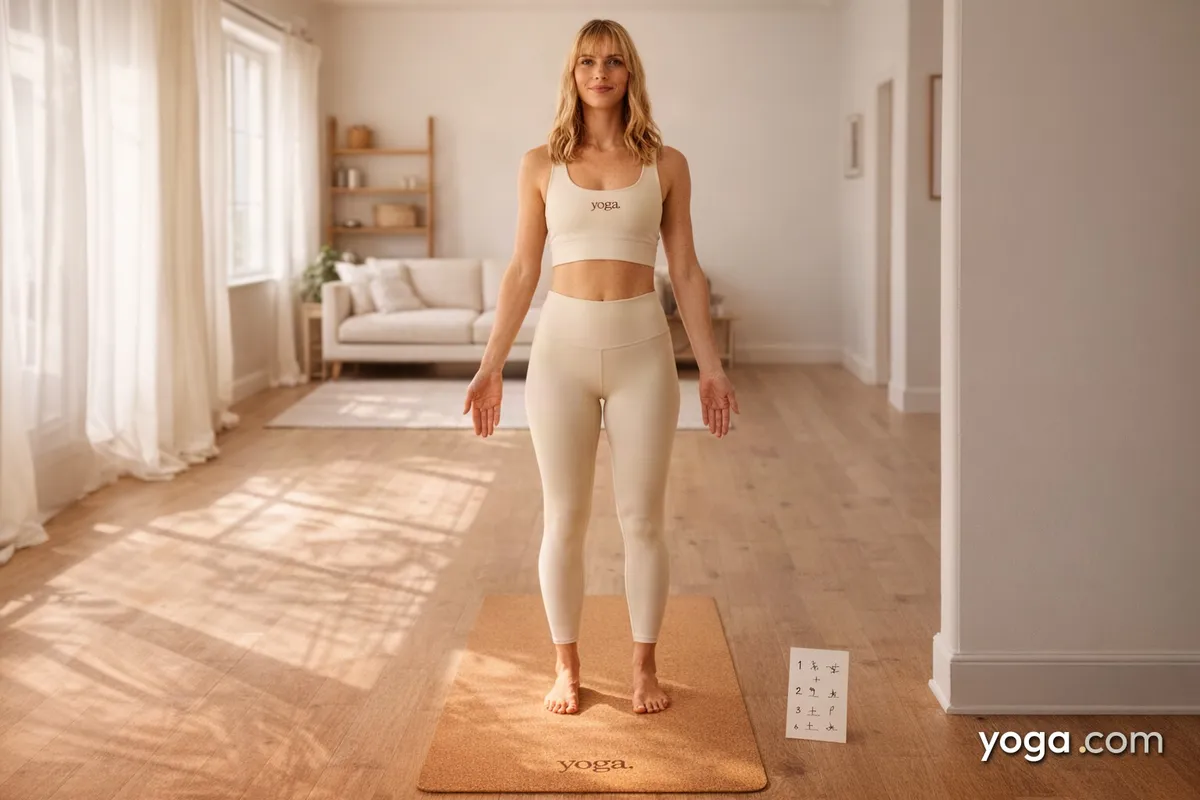
It looks like standing still. It isn't. Mountain Pose is the blueprint for almost every standing pose you'll ever do, and it trains the body awareness and alignment that everything else builds on.
How to do it
- Stand with feet together or hip-width apart, all four corners of each foot pressing into the floor.
- Engage your thighs gently, lift through the crown of your head, and let your arms hang naturally at your sides.
- Draw your lower ribs in slightly - just enough to lengthen the lower back without tucking the pelvis hard.
- Relax your shoulders away from your ears and breathe steadily.
Common mistake
Letting the lower back arch and the ribs flare forward. The fix: a subtle engagement of the lower abdominals brings the spine into its neutral length.
Caution: If you have low blood pressure, hold for only 30-60 seconds at first and notice any lightheadedness.
2. Child's Pose (Balasana): Your Built-In Rest Stop
Every practice needs a place to land when things feel like too much. Child's Pose is that place - and it does real work while you rest, gently releasing the lower back, hips, and inner thighs.
How to do it
- Kneel on the floor and sit your hips back toward your heels.
- Fold your torso forward and extend your arms long in front of you (or rest them alongside your body).
- With each exhale, consciously soften your hips down and back - don't just hold the shape.
- Let your forehead rest on the mat and breathe into your lower back.
Common mistake
Keeping the hips lifted away from the heels, which removes the lower-back stretch entirely. Think: hips sink, spine lengthens.
Research supports yoga's impact on back health: a 2018 Agency for Healthcare Research and Quality report evaluating 8 trials of yoga for low-back pain - 1,466 total participants - found that yoga improved both pain and function in the short and intermediate term. Child's Pose is a staple in those kinds of programs.
Caution: Knee injuries or replacements? Place a folded blanket behind the knees to reduce the bend angle.
3. Downward Facing Dog (Adho Mukha Svanasana): The Full-Body Reset
This is the pose you will see in nearly every beginner class - and for good reason. Downward Facing Dog stretches the hamstrings, calves, and entire back of the body while building shoulder and arm strength at the same time. This pose works your whole body at once, making it one of the most useful poses you can learn as a beginner.
How to do it
- Start on hands and knees, then tuck your toes and lift your hips up and back into an inverted V-shape.
- Press the floor away with straight arms and rotate your upper arms slightly outward so your shoulder blades spread apart.
- Keep your spine long - prioritize a flat back over straight legs if your hamstrings are tight, because a long spine matters more than straight legs at this stage.
- Press your heels toward the floor (they don't need to touch - that comes with time).
Common mistake
Bending the elbows and rounding the upper back is a very common problem. When you bend your elbows and round your upper back, this dumps load into your wrists and rounds the spine out of its neutral line. Keep in mind that straight arms and a broad upper back are the target, and so you should check your arms every time you come into this pose.
Caution: Carpal tunnel syndrome or wrist injuries? Come onto your forearms instead (Dolphin Pose). On top of that, those with very high blood pressure should also use the forearm variation.
4. Warrior I (Virabhadrasana I): Strength You Can Feel
Beginners are often surprised by how demanding this pose is. Warrior I builds real strength in the quadriceps, hip flexors, core, and shoulders - and it also challenges your balance and your focus at the same time, so you are working many parts of your body all at once.
How to do it
- Step one foot forward into a lunge and keep the back leg straight with the back heel pressing firmly into the floor.
- Bend the front knee to approximately 90 degrees, stacking the front knee directly over the ankle.
- Square your hips toward the front of the mat as much as possible, then raise both arms overhead.
- Engage your core to prevent your lower back from arching.
Common mistake
The front knee collapsing inward or drifting past the ankle is a very common problem. Keep in mind that your knee should be tracking toward the little-toe side of the foot and always over the ankle - not beyond the ankle. Keeping your knee in the right position protects your joint and makes the pose more effective for you.
For anyone managing joint concerns, it is encouraging to know that a 2018 meta-analysis of 13 clinical trials involving 1,557 patients found that regular yoga training may help reduce arthritic knee symptoms and promote physical function. On top of that, the research is a good reminder that yoga can be genuinely helpful for your joints and so it is worth practicing carefully. That said, if you have existing knee or hip issues, check with your doctor or a qualified yoga teacher before practicing strong standing poses.
Caution: Acute knee injuries, recent hip surgery, or sacroiliac joint issues? Reduce the depth of your lunge significantly, or skip this pose until you have been cleared by a healthcare provider.
5. Seated Forward Fold (Paschimottanasana): Patience in Action
The Sanskrit name translates roughly as "intense stretch of the west" - the "west" being the entire back of the body. Seated Forward Fold works the hamstrings, calves, and the long muscles of the spine. This pose also teaches something less tangible: how to be patient with your body, and rushing will only work against you.
How to do it
- Sit on the floor with both legs extended straight in front of you. (Sit on a folded blanket if your hamstrings are tight - this is smart, not a shortcut.)
- Tilt your pelvis forward - bring your belly toward your thighs, not your forehead toward your shins. Keep in mind that the direction of the tilt matters more than how far you go.
- Extend through your spine as you fold and use a strap looped around your feet if you cannot reach your feet comfortably, because keeping the spine long is more important than reaching farther.
- Hold the shape and breathe, letting the fold deepen gradually with each exhale.
Common mistake
Rounding the lower back while the hips stay tilted backward - all spine, no hamstring stretch. On top of that, this rounding puts unnecessary pressure on the lower back and so your hamstrings do not get the stretch they need. A blanket under the hips immediately frees the pelvis to tip forward the way the pelvis needs to.
Caution: Herniated discs or sciatica? Forward folds can aggravate both conditions. Please consult a physical therapist or qualified yoga teacher before attempting this pose.
What a Short Daily Practice Can Do
Even a brief, consistent practice adds up over time. Small daily efforts really do produce real results. In one 8-week Iyengar yoga program, 83% of participants reported improved physical function and, separately, 83% reported reduced stress and anxiety and enhanced calmness. Those are not small numbers for an 8-week commitment, and those numbers show that your consistency matters more than the length of each session.
Keep in mind that you can run through all five poses in sequence and you will have a well-rounded 15-20 minute practice. That 15-20 minutes is enough for you to feel the difference - today, and over time. On top of that, because the practice is short and does not demand much in the way of equipment or space, you are more likely to stick with your practice every day and so you will keep building on the progress you have already made.
Your Next Step
Pick one pose. Do that one pose today, before you move on to anything else. Noticing what you feel is the real starting point, so you should pay attention to what is actually there, not what you think you should feel. Keep in mind that this kind of quiet, honest attention is where yoga truly begins. These five poses will meet you exactly where you are right now, and these five poses will continue to grow with you as you grow too.