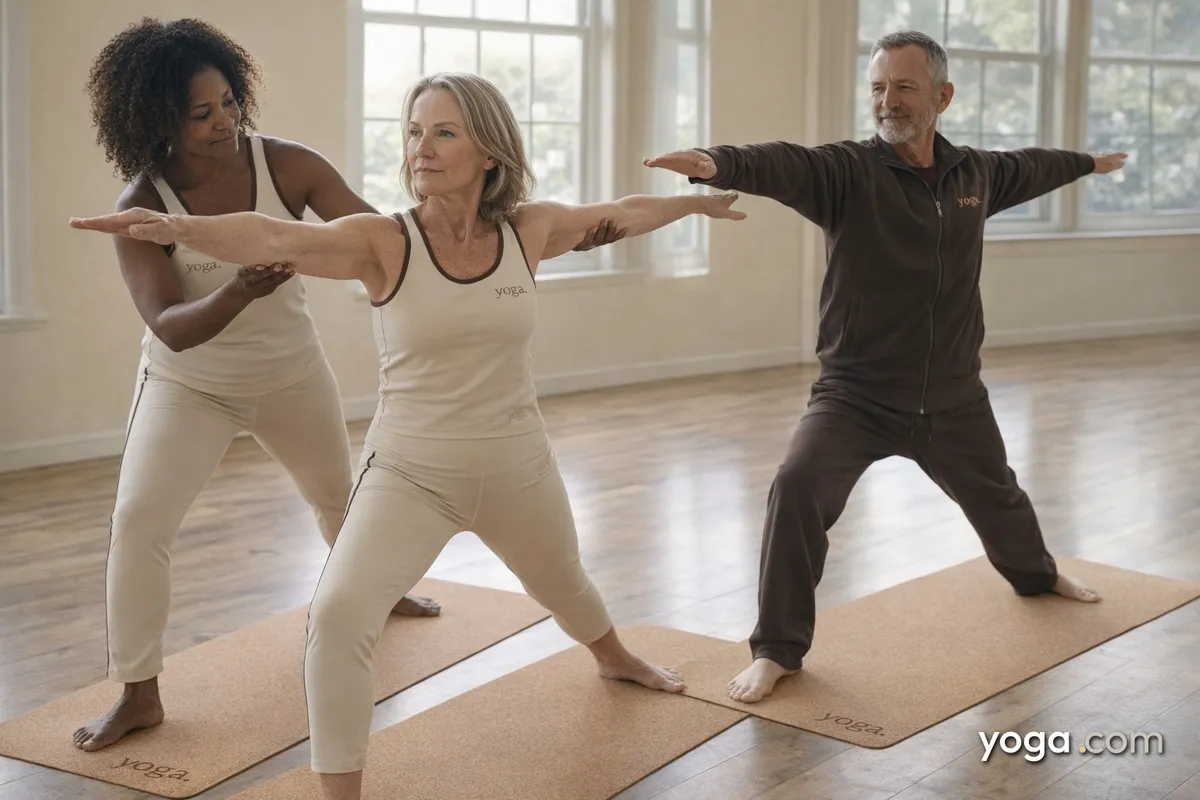
You don't have to lift heavy weights or run marathons to stay strong as you get older. Yoga - practiced consistently and with the right guidance - can build real, functional strength that helps you move with confidence, stay steady on your feet, and feel genuinely good in your body. Here's what the research actually shows, and how to get started.
Why Strength Matters More Than Ever After 65
Muscle does not stick around forever on its own and you cannot just assume it will stay with you as you get older. According to the National Institute on Aging's Baltimore Longitudinal Study of Aging, muscle mass and strength peak around ages 30-35, and decline accelerates after 65 for women and 70 for men. This muscle loss is a normal part of aging, and knowing this is not a reason to panic - it is a reason to move and to take action for your body.
About 30% of adults over 70 have trouble walking, getting up from a chair, or climbing stairs. Keep in mind that these struggles are not just small inconveniences in your daily life. These struggles are early signs of declining functional strength, and declining functional strength is exactly the kind of problem that yoga directly addresses for your body.
The Fall Risk Is Real - and So Is the Solution
Falls are one of the most serious health risks for older adults. Over 14 million older adults - 1 in 4 people aged 65 and older - report falling every year. And falling once doubles your chances of falling again.
The consequences can be serious. About 37% of older adults who fall report an injury requiring medical treatment or restricted activity for at least a day - resulting in an estimated nine million fall injuries each year. Each year, there are around three million emergency department visits and nearly 319,000 hospitalizations for hip fractures due to falls.
The encouraging news? Strength and balance training - including yoga - can meaningfully reduce that risk.
What Yoga Actually Does for Your Body
Yoga isn't just stretching. Holding poses against your own body weight builds real muscular strength - particularly in the legs, hips, core, and ankles, and these are exactly the areas that keep your body upright and mobile, so they matter a great deal as you get older.
A 2023 review of 33 studies involving 2,384 participants over 65 - with a mean age of 72 - published in Annals of Internal Medicine found that yoga increases walking speed and the ability to rise from a chair, both markers of reduced frailty and greater longevity. Keep in mind that these are measurable, meaningful gains for your everyday life. On top of that, the ability to rise from a chair and walk at a steady speed are real signs that your body is staying strong and functional.
Balance improves too. A four-week yoga-based intervention with 500 older adult participants practicing 30 minutes daily showed significant improvements in static, dynamic, and total balance scores compared to a control group. Four weeks. Thirty minutes a day. This is a very accessible starting point for your routine, and it shows that you do not need to commit a huge amount of time to start seeing real improvements in your balance.
The Mental and Emotional Benefits Are Just as Real
Strength isn't only physical. Keep in mind that the mental and emotional benefits of yoga are just as real as the physical ones. The same four-week yoga study found positive psychosocial changes too - promoting calmness and happiness in male seniors and reducing fatigue, nervousness, and depression in female seniors. So the benefits you get from yoga go well beyond what your body can do.
In an 8-week Iyengar yoga program, 83% of participants reported that yoga improved their overall physical function and capacity - and the same percentage reported that it reduced stress and anxiety while enhancing calmness. Your mind and body work together, so when you take care of one, you are also taking care of the other, because they are deeply connected. This is something worth remembering when you think about your overall health and what yoga can do for you.
A Note on Intensity: Gentle Doesn't Mean Passive
This is important. There's a difference between a restorative session focused on rest and a gentle-but-active session that genuinely challenges your muscles. For strength to build, your muscles need to work.
A meta-analysis of strength training in older adults found no measurable strength improvements below a relative training load of 50% of 1RM - meaning effort below that threshold didn't produce gains. You don't need to strain. But you do need to feel your muscles working.
In yoga, that means holding standing poses for several breaths, pressing actively through your feet, and engaging your core - not simply moving through the shape and moving on.
The Best Poses for Building Functional Strength
Focus on poses that train the muscles most involved in everyday stability and mobility. A good beginner sequence might include:
- Mountain Pose (Tadasana) - teaches body awareness and active upright posture; the foundation of all standing work.
- Chair Pose (Utkatasana) - strengthens the quadriceps, glutes, and core. Hold for 3-5 breaths and feel it work.
- Warrior I (Virabhadrasana I) - builds single-leg stability, hip strength, and confidence in standing balance.
- Tree Pose (Vrksasana) - single-leg balance training directly relevant to fall prevention. Use a wall or chair for support until you feel steady.
- Bridge Pose (Setu Bandha Sarvangasana) - strengthens the glutes, hamstrings, and lower back from a safe lying position.
- Warrior II (Virabhadrasana II) - opens the hips and builds leg endurance. Hold longer than feels natural.
- Child's Pose (Balasana) - a gentle reset between more active poses; also gently stretches the hips and lower back.
Don't skip the transitions between standing, seated, and lying-down positions. Moving from the floor to standing and back again trains the exact coordination pattern your body needs to recover safely if you ever lose your balance.
How to Find the Right Class
Not every class labeled "beginner" or "gentle" is designed with older adults in mind. Here's what to look for:
- A teacher with specific training or experience working with older adults or populations with balance concerns.
- Classes that explicitly welcome props - blocks, straps, chairs, and walls. Props aren't a sign of weakness; they're good teaching.
- A pace that allows for held poses and mindful transitions, not a flow where everything blurs together.
- Small class sizes where the teacher can offer individual guidance.
Chair yoga is also a genuinely effective option if getting to and from the floor feels unsafe right now. It's not a lesser version of yoga - it's yoga adapted intelligently.
Before You Begin: A Practical Checklist
- Talk to your doctor first - especially if you have a history of falls, joint replacements, osteoporosis, or any cardiovascular condition. This step matters.
- Start with two to three sessions per week, 20-30 minutes each, and build gradually from there.
- Wear comfortable, form-fitting clothing and practice barefoot or in non-slip socks on a non-slip mat.
- Tell your teacher about any injuries or health conditions before class begins.
- Expect gradual progress. Balance and strength build over weeks and months - not after two or three sessions.
The Bottom Line
Staying strong and steady as you age isn't about pushing your body to its limits. It's about showing up consistently, working with intention, and choosing practices that meet you where you are. Yoga - done regularly, with real muscular engagement - can help you move better, feel more confident, and face the years ahead from a place of genuine physical resilience. You don't need to be flexible to start. You just need to start.
Sources
- PMC / National Library of Medicine - Strength training load in older adults: a meta-analysis
- CDC - Falls Data and Research
- PMC / National Library of Medicine - Yoga-based intervention for balance and psychosocial health in older adults
- PMC / National Library of Medicine - 8-week Iyengar yoga program outcomes
- National Institute on Aging - How strength training builds healthier bodies as we age
- Harvard Gazette - Strong evidence that yoga protects against frailty in older adults
- CDC - Falls Facts and Statistics