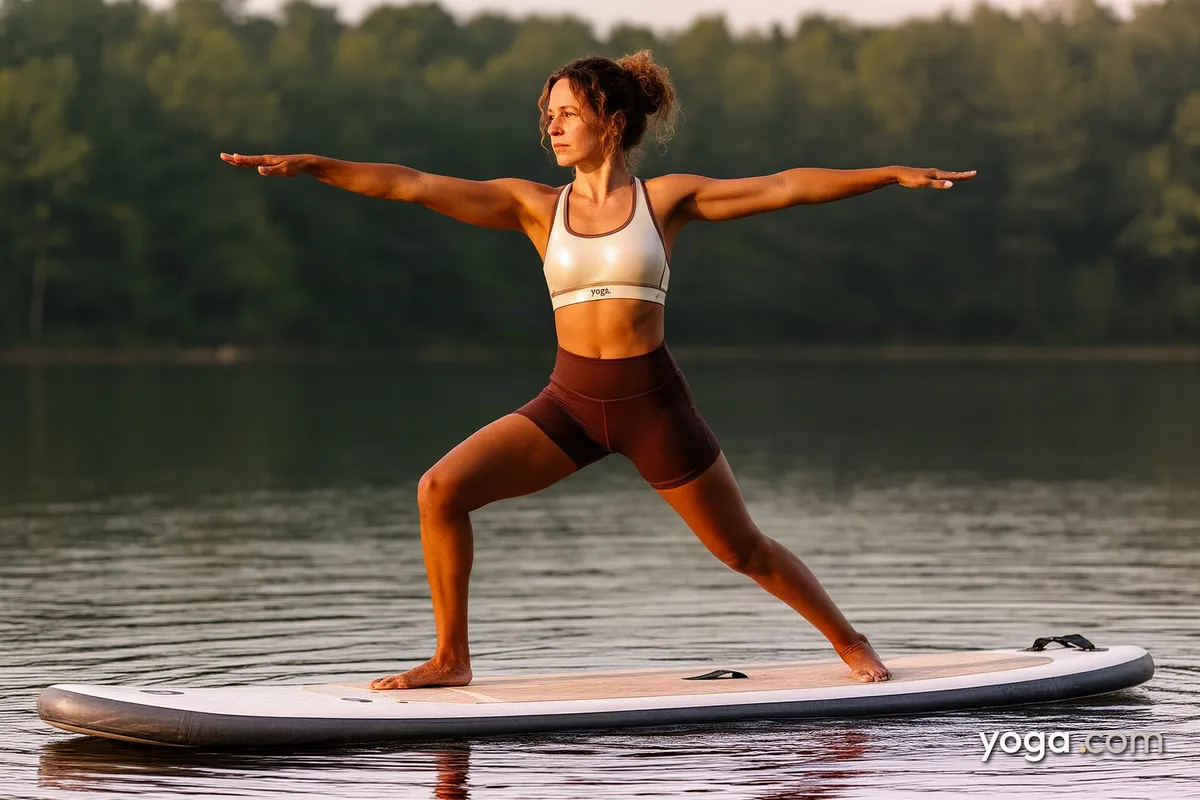
Picture yourself holding Warrior II (Virabhadrasana II) on a sun-warmed board, water lapping gently beneath you, the horizon stretching wide in every direction. If you're wondering about the top 5 reasons you should try paddle board yoga - yoga practiced on a standup paddleboard (SUP) on open water - it sounds like an Instagram fantasy, but it's one of the most rewarding ways to deepen your practice. Here's why you should give it a real shot.
1. Your Core Works Harder Than You Expect
On land, your body relies on a stable floor and so your stabilizing muscles do not have to work very hard. On a paddleboard, every pose asks your stabilizing muscles to constantly micro-adjust because the board is always moving beneath you. That invisible extra effort adds up fast, and the fact is that your core is working much harder than it feels like it is.
Remember that this is not just anecdotal. A 2016 study in BMC Sports Science, Medicine and Rehabilitation found that SUP training produced significant improvements in multidirectional core strength - prone (+19.78%), right side (+26.19%), left side (+28.31%), and the Biering-Sørensen back extension test (+21.33%). Those are real, measurable gains from spending time on the water, and the numbers show that your core strength can improve in a very meaningful way.
Poses that feel straightforward on a mat - Boat Pose (Navasana), Plank (Phalakasana), even a simple seated forward fold - become genuinely challenging the moment the board shifts beneath you. Beyond that, your body has to keep correcting its position over and over again, so your core muscles are getting a workout even when you do not realize it.
2. It Gives Your Fitness a Serious Boost
Yoga is rarely thought of as cardio. SUP yoga changes that equation. Simply keeping yourself balanced on moving water raises your heart rate in a way a studio floor never will, and so your body is working much harder than you might expect because the water is always shifting beneath you.
The same 2016 study found that six weeks of SUP sessions improved aerobic fitness by 23.57% and anaerobic fitness by 41.98% - after just three one-hour sessions per week. This is a meaningful cardiovascular upgrade, and that cardiovascular upgrade is layered right on top of all the flexibility and mindfulness work you are already doing. Remember that you are getting these fitness gains while still doing yoga, so you are not giving anything up.
Regular movement matters for your long-term health, too. Physical activity has been shown to lower the risk of heart disease by 40%, stroke by 27%, and reduce the incidence of hypertension by nearly 50%. Beyond that, SUP yoga is a genuinely enjoyable way to put more active minutes into your week, and putting more active minutes into your week is one of the most important things you can do for your body over time.
3. Water Is a Natural Mood Reset
There's something about being on open water that quiets the noise in your head. The research backs this up. A 2022 systematic review and meta-analysis found that aquatic exercise produced a statistically significant reduction in mental disorder symptoms, and light aquatic aerobic activity in particular likely has a better effect on mood and anxiety symptoms compared to higher-intensity formats.
Pair that water environment with the breath-focused, mindful movement of yoga, and you have a practice that works on your nervous system from multiple directions at once. Regular physical activity also improves the functioning of the hypothalamus-pituitary-adrenal (HPA) axis, lowering cortisol secretion and helping to restore hormonal balance. In plain terms: you'll likely step off that board calmer than you got on.
4. It Improves Your Quality of Life - Not Just Your Fitness
Better abs and a stronger heart are great. But how you feel day to day matters just as much. The 2016 SUP study found significant improvements in self-rated quality of life in both the physical domain (+19.99%) and the psychological domain (+17.49%).
That psychological lift is real and worth taking seriously. When exercise is genuinely fun - when it involves sunshine, water, and the slight thrill of not falling in - you're far more likely to keep doing it. Consistency is what actually changes your health.
And SUP yoga stacks up well against standard activity guidelines. Following the recommended 150 minutes of moderate-to-vigorous physical activity per week can reduce the risk of many chronic diseases by 20-30%. A couple of SUP yoga sessions can take a big bite out of that weekly goal.
5. It Makes You a Better Yogi on Land
This one surprises people. Practicing on an unstable surface forces you to slow down, find your true center of gravity, and breathe through uncertainty. When you return to a studio mat, poses that once challenged you may feel markedly more accessible.
The humility factor helps, too. You will wobble. You may fall in. That's not failure - it's the practice working exactly as it should, teaching you to stay present when things get uncomfortable.
Good Poses to Start With on the Board
- Child's Pose (Balasana) - a low center of gravity makes this a perfect reset when the board is rocking
- Cat-Cow (Marjaryasana-Bitilasana) - gentle spinal movement that helps you feel the board's movement
- Downward-Facing Dog (Adho Mukha Svanasana) - an accessible inversion that builds confidence
- Warrior II (Virabhadrasana II) - a standing challenge that trains lateral stability
- Seated Forward Fold (Paschimottanasana) - keeps your weight centered and low while stretching the hamstrings
Before You Step on the Board: A Few Practical Notes
Choosing the right board matters and so you should take the board size seriously because the wrong board will make your practice much harder. For yoga, look for a board that's 32 to 34 inches wide to maximize your surface area, and aim for at least 10 feet in length - the standard is about 10 feet 6 inches - to suit most body types comfortably. A wider, longer board gives you the stable platform your body needs to hold yoga poses on the water.
- Wear a personal flotation device (PFD) and know your local water safety rules
- Use a board leash so the board stays with you if you fall
- Start on calm, flat water - a lake or sheltered bay is ideal
- Anchor the board or practice near shore so you aren't drifting mid-flow
- Consider a class first: specialists like Amelia Travis, founder of Stoked Yogi, have trained over 165 yoga instructors specifically in how to adapt yoga safely to the paddleboard.
Remember that your body's health comes first and so if you have any injuries or health conditions, you should check with your doctor or physiotherapist before taking your practice onto the water. Beyond that, checking with a professional before you start is simply a good habit to build.
Where This Leaves You
Paddle board yoga is not a gimmick. The top 5 reasons you should try paddle board yoga - stronger core, improved fitness, better mood, higher quality of life, and a sharper land practice - add up to a compelling case for getting on the water. Remember that you do not need to be a seasoned yogi or a strong swimmer to try it. You just need curiosity, a wide enough board, and a willingness to get a little wet. Beyond that, the willingness to get wet is probably the most important part, because falling into the water is something every beginner experiences and that is completely fine.
Sources
- PMC / BMC Sports Science, Medicine and Rehabilitation - Effects of SUP training on physical fitness and quality of life (2016)
- PMC - Physical activity, chronic disease prevention, and hormonal regulation
- PMC - Aquatic exercise and mental health: 2022 systematic review and meta-analysis
- Yoga Journal - 10 SUP Yoga Poses for Beginners