Can yoga actually improve concentration and focus? It's a question teachers hear all the time, usually from someone whose attention keeps drifting minutes into the workday. The short answer is yes - and it may be one of the most accessible tools you have for sharpening focus. These 7 yoga poses work with your breath, your body, and your attention all at once, which is kind of the whole point.
Why Yoga and Focus Are a Natural Pair
The word "yoga" comes from the Sanskrit root yuj, meaning to unite, to yoke - and to direct and concentrate one's attention. Concentration isn't a side benefit of yoga. It's baked into the definition.
On a brain level, the effects are real. Regular practice leads to increased activation of the prefrontal cortex, the region responsible for decision-making, goal-setting, and your highest-order thinking. It also modulates the default mode network (DMN) - the mental chatter that pulls your attention away from whatever you're trying to do.
A meta-analysis of yoga studies in adult populations found moderate effect sizes for attention, processing speed, and executive function. In plain terms: a consistent practice can genuinely move the needle on focus.
A Quick Note Before You Begin
These poses are appropriate for most beginners, but everyone's body is different. If you have an injury, a chronic condition, or any medical concerns, check with your doctor or a qualified yoga teacher before starting. The goal here is to feel better - not to push through pain.
The 7 Poses
1. Child's Pose (Balasana)
Start here. Child's Pose asks you to do one thing: arrive. Kneeling with your forehead resting on the mat and arms extended forward (or alongside your body), you give your nervous system permission to downshift. Yoga helps regulate the autonomic nervous system, and Balasana is one of the gentlest ways to initiate that shift. Hold for 5-10 slow breaths before moving into the rest of your practice.
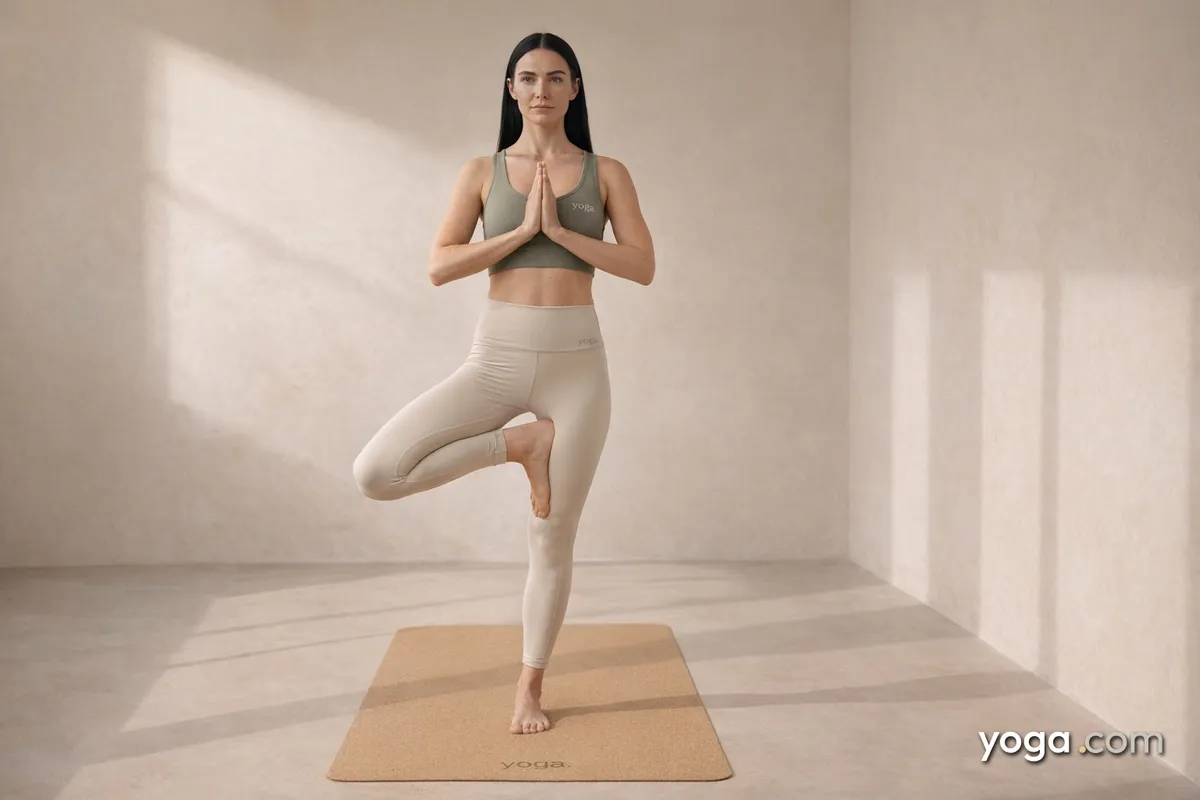
2. Tree Pose (Vrksasana)
Balance poses are focus poses - full stop. In Tree Pose, you stand on one foot with the other pressed against your inner calf or thigh (never the knee), hands at heart center or reaching overhead. Your mind has to be present. Wobble, come back. That returning of attention is the practice. Hold for 5-8 breaths per side.
3. Eagle Pose (Garudasana)
Eagle wraps and winds the body into a single concentrated point. Standing on one leg, you cross the opposite knee over the top and - if it's available to you - wrap the foot behind the standing calf. Arms cross at the elbows, forearms wind around each other. The physical complexity demands mental stillness. Stay for 5 breaths, then switch sides.
4. Warrior III (Virabhadrasana III)
This is the power pose of the sequence. From standing, you hinge forward at the hips and lift one leg behind you until your body forms a capital T - arms reaching forward, gaze soft on the floor. It strengthens the posterior chain and demands every bit of your concentration. Build up to 5 breaths per side. Use a block under your hands if you need more stability.
5. Seated Forward Fold (Paschimottanasana)
Seated with legs extended, you hinge from the hips and reach toward your feet - as far as is comfortable, no straining. This pose is quieting. It draws awareness inward and pairs beautifully with slow, deliberate breathing. Yogic practices reduce stress, anxiety, and chronic pain, and forward folds are some of the most effective poses for activating that calming response. Hold for 8-10 breaths.
6. Legs Up the Wall (Viparita Karani)
Scoot your hips close to a wall and extend your legs straight up. That's it. This gentle inversion shifts circulation and signals rest to your nervous system. Many practitioners report feeling more mentally clear after just a few minutes here. Stay for 2-5 minutes and focus entirely on the rhythm of your breath.
7. Corpse Pose with Focused Breathing (Savasana)
Don't skip this one. Lying flat on your back, arms slightly away from your sides, you let the body be completely still. The work of Savasana is purely mental: staying present without an anchor like balance or movement. Add a simple breath focus - count four counts in, hold for two, exhale for six. Even a 10-minute mindfulness session has been shown to improve reaction time and cognitive flexibility. Stay for at least 5 minutes.
How to Put It Together
You do not need to practice all seven poses every day. Keep in mind that a simple framework can help you stay consistent and make it easier to fit yoga into your schedule.
- Morning sharpener (15 min): Tree Pose → Warrior III → Eagle Pose → Savasana with breath focus
- Midday reset (10 min): Child's Pose → Seated Forward Fold → Legs Up the Wall
- Full sequence (30 min): All seven, in the order listed above
Consistency matters more than duration, and this is a point worth repeating because many people feel they need a long session to see any benefit. Even two or three shorter sessions a week will build real results over time, so you should not worry if your schedule only allows for the morning sharpener or the midday reset on most days. Doing your practice regularly is what actually moves your progress forward.
Don't Forget the Breath
The poses are only part of the picture. Of Patanjali's 196 Yoga Sutras, only three discuss physical posture - the rest address breathwork, meditation, and mental discipline. Every pose above becomes more potent when you tie it to slow, intentional breathing. If your mind wanders (it will), the breath is always there to come back to. That act of returning is the concentration training.
Where This Leaves You
Focus is not a fixed trait that you either have or you do not have. Focus is a skill, and these 7 yoga poses improve concentration and focus in a way that is both enjoyable and practical - asking your brain and your body to work together so they build the kind of present-moment awareness that carries off the mat and into your everyday life. Keep in mind that you do not need to master all seven poses at once because even returning to one pose you love on a consistent basis can produce real, noticeable results. Start with one pose that feels good to you, return to that pose regularly, and pay attention to what shifts over time. Your mind will follow your practice.