You lie down on your back, close your eyes, and a voice begins to guide you — no poses, no stretching, no experience required. That's yoga nidra. If it sounds almost too simple to do anything meaningful, the research says otherwise. Here's exactly what the practice is, what happens during a session, and how to start today.
What Yoga Nidra Actually Is (And What Makes It Different)
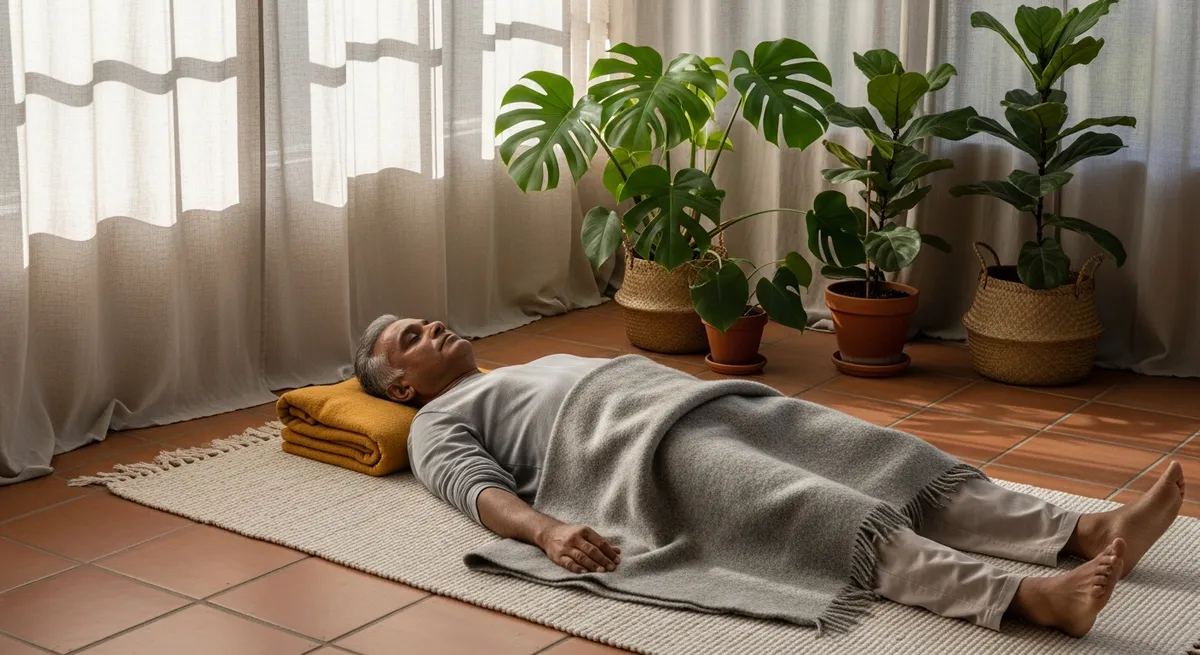
Yoga nidra is a guided meditation practice done lying completely still. There's no movement, no mat choreography, and no flexibility requirement. You follow a voice through a structured sequence of awareness cues while your body settles into deep rest.
The practice aims to bring you to the threshold between waking and sleep — a state called the hypnagogic state — where the mind produces slower theta brainwaves and becomes unusually receptive and relaxed. You're not asleep. You're not quite fully awake. You're hovering at the edge, guided the whole way.
Clinical research has shown that yoga nidra produces measurable physiological changes, including shifts in endogenous dopamine release and cerebral blood flow — effects that go well beyond ordinary relaxation.
The practice was systematized and introduced to the public in the 1960s by Swami Satyananda Saraswati. Today it's taught in wellness studios, clinical settings, and — yes — on YouTube, where one popular yoga nidra video has been listened to more than 12 million times.
The Stages of a Session — What Actually Happens
A well-structured yoga nidra session follows a recognizable arc every time. Knowing the stages before your first session makes the whole experience much less disorienting and so it is worth familiarizing yourself with the typical sequence before you begin. Here is what you can expect:
Each stage builds on the last, deepening relaxation and steadying attention incrementally. On top of that, the sequence itself is the point — no single stage works quite the same way on its own and so you should try to experience the full session rather than only parts of it.
Different Schools, Different Scripts
There are several yoga nidra lineages — including the Himalayan Institute, the Amrit School, and the iRest protocol — each with a distinct script and internal structure. If the first recording you try does not resonate with you, that is not a sign the practice is not for you. Try a different teacher or tradition before writing it off.
How Long Should a Session Be?
Sessions typically run anywhere from 20 minutes to an hour. For beginners, shorter is smarter because your mind wanders less and it is easier to stay with the guidance and a 20-minute session actually fits into a real day. The simple fact is that a shorter session you actually complete is always better than a longer session you keep skipping.
Consistency matters more than duration, especially early on. Keep in mind that a 20-minute session done several times a week will serve you better than one long session squeezed in occasionally. In other words, doing your practice regularly is more important than making each session as long as possible.
Research supports the idea that even brief sessions carry real benefit. A study comparing different session lengths found that an 11-minute yoga nidra session produced significant improvements in wellbeing compared to a waitlist control, and the short-form session significantly reduced depression compared to an active control (listening to music). On top of that, this research confirms that you do not need an hour to feel something shift. The simple fact is that even a short session can produce real results for your wellbeing.
What Yoga Nidra May Do for Sleep and Stress
Sleep and stress are the two most common reasons people find their way to this practice, and the research, while still growing, is genuinely encouraging. The simple fact is that yoga nidra is one of the more accessible tools available to you if sleep or stress is something you are struggling with.
On the stress side: a 2024 poll by the American Psychological Association found that 53 percent of Americans said stress impacts their mental health — context that makes accessible, low-barrier tools like yoga nidra especially worth knowing about. Keep in mind that when stress is this widespread, having a simple and low-cost practice you can do at home becomes very valuable for your daily life.
On the sleep side, one study tracking adults with self-reported insomnia found that yoga nidra produced a statistically significant reduction in respiratory rate — dropping 1.4 breaths per minute during the session and 2.1 breaths per minute afterward, while the control group showed no meaningful change. Slowing the breath is one of the clearest signals the nervous system is shifting toward rest, and so this kind of reduction in breathing rate is a real and meaningful result for your body because it shows the practice is doing something physical, not just mental.
A 2021 study also showed yoga nidra improved sleep quality, sleep time, and reduced wake duration in participants. On top of that, better sleep quality and less time spent awake during the night are exactly the outcomes that most people who try yoga nidra are hoping for.
Research has also shown yoga nidra can reduce measurable indices of mild depression and anxiety — though these benefits were not found to extend to severe depression or severe anxiety. The simple fact is that yoga nidra is helpful for milder concerns, but yoga nidra is not a replacement for professional care. If you are dealing with serious mental health concerns, please talk to a qualified healthcare provider. Yoga nidra can be a wonderful complement to professional care, and many people find it works well alongside the support they are already getting from a provider.
There's No Wrong Way to Experience It
Most beginners worry they are doing it wrong. The simple fact is, they are not doing it wrong. Keep in mind that your experience is valid no matter how it feels to you.
The only real task is to keep coming back to the guidance. That is it. Keep in mind that coming back to the guidance again and again is the whole practice, because the practice itself grows stronger every time you return to it.
One Group That Should Take Extra Care
For most healthy adults, yoga nidra is gentle and accessible. But if you are living with a trauma-related diagnosis — particularly PTSD — it is worth seeking out a trauma-informed instructor rather than starting with a generic recording. The simple fact is that the sustained body-scan elements of the practice can occasionally feel activating for people with trauma histories, and so people with trauma histories need to be a little more careful about how they approach yoga nidra because the wrong setting can make the experience uncomfortable.
Keep in mind that the iRest protocol was specifically developed for use in Veterans Affairs settings and builds in grounding steps to reduce that risk. On top of that, the iRest protocol is a good option to look into if this applies to you, and looking into iRest before you start with a general recording is a reasonable first step.
How to Start Today
You need almost nothing: a quiet space, something to lie on, a blanket for warmth, and a free recording. Here's a simple first-session checklist:
The bottom line
Yoga nidra asks remarkably little of you. The simple fact is that all you need is the willingness to lie down and listen, and the structure does the work for you. Keep in mind that whether you come to yoga nidra for sleep, for stress, or simply out of curiosity, even a single session can feel like a genuinely new kind of rest and so it is worth giving yoga nidra one honest try this week. Your nervous system will likely have something to say, because your nervous system responds to this kind of rest in ways that can surprise you.