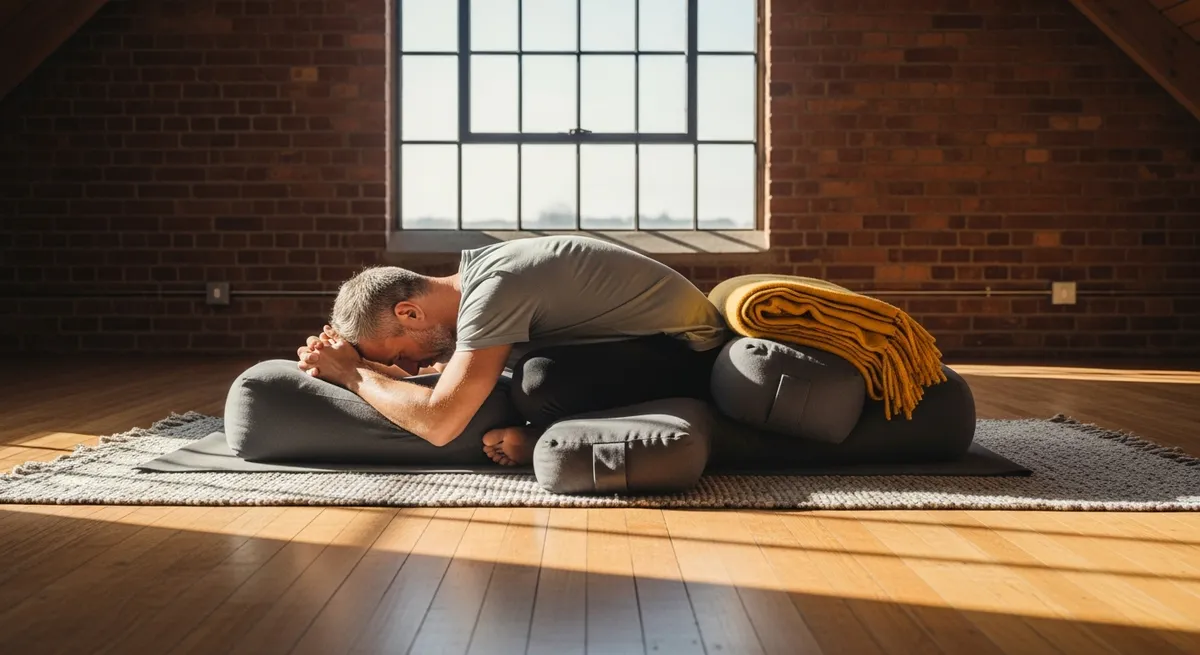

Maybe you've been curious about yoga for years but talked yourself out of it — bad knees, shaky balance, or the image of pretzel-shaped poses on the floor. Chair yoga removes that obstacle entirely. It brings the breathwork, the mindful movement, and the real physical benefits of yoga to anyone who needs a seat — and the research behind it is more compelling than you might expect.
What Chair Yoga Actually Is
Chair yoga adapts traditional poses so you can do them while seated or while using a chair for support. Nothing goes to the floor. You don't need to be flexible. The chair simply holds you steady during movements that might otherwise require balance or mobility you don't currently have.
A typical session flows through three stages:
It's a complete practice, not a watered-down version of "real" yoga. Your nervous system, your muscles, and your breath are all involved.
Who It's For (Hint: More People Than You Think)
Chair yoga is especially well-suited to older adults, people living with arthritis or joint pain, people recovering from injury, wheelchair users, and anyone who struggles with floor transitions. But it's also a genuinely good option if you're simply new to movement and want a low-risk starting point.
Pain and mobility challenges are far more common than the wellness world sometimes acknowledges. Osteoarthritis affects 33.6% of U.S. adults over age 65 — and it's the leading cause of long-term disability in that age group. If stiff or painful joints have kept you off the mat, chair yoga was essentially designed with you in mind.
What the Research Shows
Less pain, more function
In one small study among older adults with osteoarthritis in the lower body, doing chair yoga for 45 minutes twice a week for eight weeks led to less pain and fatigue compared to a health education program. Another small study found that adults with knee osteoarthritis were better able to carry out daily activities after a 12-week chair yoga program.
A separate study reinforces the pain picture: the chair yoga group showed greater reduction in pain interference during the intervention, a benefit that held through a 3-month follow-up. These are small studies, and individual results vary — but the direction of the findings is consistent.
Stronger, more capable in daily life
Functional fitness — your ability to do everyday things like stand from a chair, carry groceries, or climb stairs — is one of the clearest outcomes measured in chair yoga research. A study by Yao and Tseng found that improved functional fitness was correlated with participation in a twice-weekly chair yoga program in 31 elderly women over 65 with low physical activity levels. A separate 12-week chair yoga program showed significantly higher functional fitness and daily life activity scores after the intervention.
Better balance and less fear of falling
Falls are a serious concern as we age — at least 50% of adults over 80 fall annually. Chair yoga addresses this in two ways: building the strength and stability that reduce fall risk, and reducing the fear of falling itself.
In a study of seniors with a history of falls, a chair-based yoga program offered twice a week for 8 weeks produced measurable gains in fear of falling scores and sit-to-stand performance. Feeling steadier — physically and mentally — matters enormously for quality of life.
Real stress relief
In a third study, older adults experienced greater stress reduction after a six-week chair yoga program compared to those who did six weeks of chair aerobics, walking, or social games. The fact that yoga outperformed other healthy activities is worth sitting with. Slow, intentional breath combined with movement does something to the nervous system that brisk activity alone doesn't always replicate.
This aligns with why people practice yoga broadly. According to the 2012 National Health Interview Survey, 94% of yoga practitioners reported doing it for wellness reasons — not to replace medical care, but to feel better overall. Chair yoga fits that same intention.
What People Get Wrong About Chair Yoga
The most common misconception is that chair yoga is too easy to be worthwhile. The simple fact is, it is not easy at all. Holding yourself upright, breathing with intention, and actively engaging your core, shoulders, and hips in a seated pose is real work and it demands genuine effort from your body. Keep in mind that many beginners are genuinely surprised by how their back and shoulders feel after the first couple of sessions, because the work is more demanding than most people expect.
The other misconception is that any yoga teacher can run a chair yoga class safely. Adapting poses for someone with a hip replacement, severe arthritis, or very limited shoulder range requires specific training in adaptive yoga, and not every teacher has that training, so you should not assume the teacher in front of you does. Before you join a class, ask your instructor directly about their experience with seated and adaptive practice. A well-trained teacher will have a clear, specific answer. On top of that, a well-trained teacher will not hesitate or give you a vague response, because a teacher with real adaptive experience knows exactly what their background is.
A Few Honest Caveats
Chair yoga is not a replacement for physical therapy, medication, or medical advice. The simple fact is that chair yoga is a helpful practice, but chair yoga is not a substitute for professional medical care. If you have a recent surgery, a serious injury, or a complex health condition, talk to your doctor before starting any new physical practice and make sure your doctor knows what you are planning to do.
The research in this area, while encouraging, is still growing and most studies involve small groups over limited timeframes so the evidence is promising but not definitive. Keep in mind that promising evidence is not the same as proven evidence, and you should treat chair yoga as a valuable tool in a broader wellness approach and not as a cure-all. On top of that, you should always combine chair yoga with the other medical and lifestyle guidance your doctor has given you, because no single practice can replace a full and balanced approach to your health.
How to Start Today
The simplest entry point is a class — at a senior center, community center, gym, or online. If getting out is difficult, a well-produced video class works well. When you're ready to practice:
Common poses you'll encounter in a chair yoga class include Seated Mountain Pose (Tadasana), Seated Cat-Cow (Marjaryasana-Bitilasana), Seated Forward Fold (Uttanasana), Seated Warrior I (Virabhadrasana I), and Seated Spinal Twist (Ardha Matsyendrasana). Each can be adjusted to meet you exactly where you are.
The Bottom Line
Chair yoga is a real, research-backed practice and it is not a consolation prize for people who feel they cannot do real yoga. The simple fact is that chair yoga can ease pain, build functional strength, reduce stress, and improve balance, and all of this happens from a chair. Keep in mind that these are not small benefits. If physical limits have kept you off the mat, chair yoga is your invitation back in and it is an invitation that is fully supported by research. Start small, find a qualified teacher, and give chair yoga a few consistent weeks because your body needs time to respond and show results. On top of that, you do not need to make big changes to see a real difference. Start where you are, stay consistent, and your body will tell you the rest.