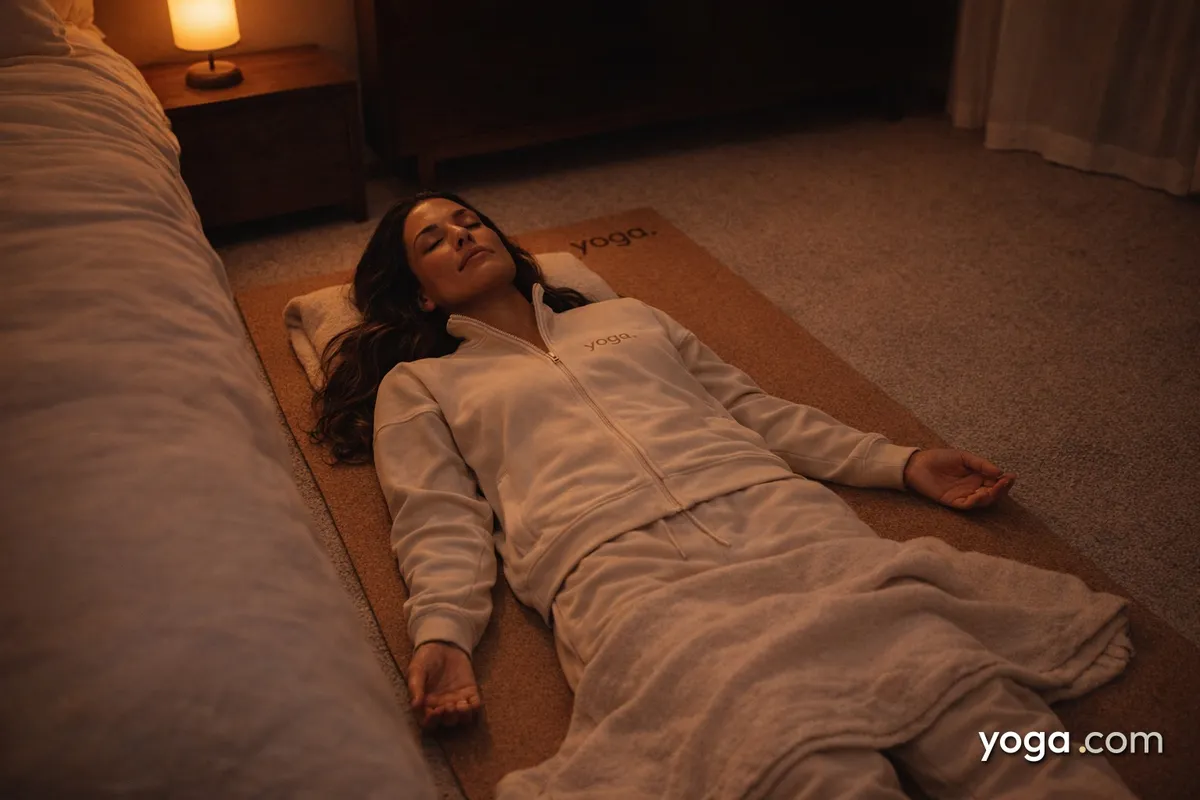
You lie down, close your eyes, and let a gentle voice guide you inward. No poses. No flexibility required. Yoga nidra is one of the most accessible practices in the yoga world - and one of the most misunderstood. Here's what it really is, what the research says, and exactly how to begin.
What Is Yoga Nidra?
Yoga nidra is a guided meditation that you practice lying down. You stay completely still, fully clothed, with your eyes closed, and an instructor or audio recording leads your attention through your body, your breath, and a series of inner experiences.
The goal of yoga nidra is to reach a state between waking and sleeping. Not quite awake, not quite asleep. Keep in mind that this threshold state is exactly where the practice does its work, and that threshold state is the whole point of the method.
Yoga nidra was systematized and introduced to the public in the 1960s through the writings of Swami Satyananda Saraswati - so this is a well-established practice with decades of use behind it. Yoga nidra is not a new trend, so you can feel confident that the practice has a long track record.
Sessions typically run 11 to 30 minutes, though some sessions go longer. On top of that, even the shorter formats have shown measurable effects (more on that below), so you do not need a long block of time to get something real out of your practice.
What Happens During a Session
Your first session will probably feel simpler than you expect. Keep in mind that most people find the basic structure very easy to follow. Here is the basic structure:
- Lie down in Corpse Pose (Savasana). Arms slightly away from your sides, legs a little apart, palms facing up. Get comfortable - use a blanket if you tend to get cold.
- Set a sankalpa. This is a short, heartfelt intention - a simple phrase or wish for yourself. Don't overthink it.
- Follow the body scan. The guide slowly moves your awareness through each part of your body, one at a time. This body scan draws attention inward and quiets the mental noise.
- Follow the breath and imagery cues. You may be asked to notice your breathing or to hold pairs of opposite sensations in mind simultaneously.
- Return gently. The guide brings you back to full awareness at the end of the session.
If you fall asleep your first few times, that is completely fine and very common. Falling asleep is especially likely when your body is running a sleep debt and so your body just takes what it needs, and because of this, you should not worry about it at all. Over time, regular practice helps you stay in that in-between state without dropping all the way under.
What the Research Actually Shows
The evidence base for yoga nidra is growing, and some findings are genuinely compelling. Keep in mind that the summary below is an honest look at what studies actually support - and where the real limits are.
Nervous system and sleep
A 2023 randomized controlled trial in adults with self-reported insomnia found that yoga nidra produced a statistically significant drop in respiratory rate - about 1.4 breaths per minute during the session and 2.1 breaths per minute afterward - compared to virtually no change in the control group. A slower breathing rate is a reliable sign that your nervous system is downshifting, and so this is a meaningful physiological shift from a single session. Your body is responding in a measurable way even after just one practice.
Mood and stress hormones
A 2025 randomized controlled trial with 362 participants found that an 11-minute daily yoga nidra practice over two months produced significant improvements compared to a waitlist control group, and also significantly reduced depression compared to an active music-listening group. Regular practice was associated with reductions in total cortisol and steeper diurnal cortisol slopes. On top of that, these results suggest that your stress hormone levels can shift noticeably when you keep up a consistent yoga nidra routine.
Brain chemistry
Two neuroimaging studies have shown that yoga nidra produces changes in endogenous dopamine release and cerebral blood flow. Clinical studies have also linked the practice to positive changes in hematological variables, red blood cell counts, blood glucose levels, and hormonal status. Keep in mind that these brain chemistry findings point to real biological changes happening in your body during yoga nidra practice.
The honest limits
Research shows yoga nidra can reduce psychometrically measured indices of mild depression and anxiety - but these benefits were not shown in experimental study to extend to severe depression or severe anxiety. Yoga nidra has real benefits for mild symptoms, but the research does not support using yoga nidra as a main treatment for severe mental health conditions.
If you are managing a serious mental health condition, please speak with a doctor or licensed mental health professional before relying on any wellness practice as a primary treatment. Yoga nidra can be a meaningful complement to your care - yoga nidra is not a replacement for professional care.
Common Beginner Mistakes (and How to Avoid Them)
- Trying too hard. This is the biggest one. Yoga nidra asks you to follow, not to achieve. If your mind wanders, gently bring it back. That's the whole practice.
- Skipping comfort prep. Find a quiet spot, silence your phone, and keep a blanket nearby. Lying still can drop your body temperature. Physical comfort matters.
- Judging a single session. You may not feel anything dramatic while it's happening. Many of the benefits - calmer sleep, a lower baseline stress level - show up in the days that follow.
- Practicing once and stopping. The 2025 trial tracked participants over two months for a reason. Benefits build with regularity, not from a single try.
How to Find a Session That Works for You
You don't need to go to a studio to start. Pre-recorded audio and video sessions work well - and research confirms they can deliver the practice effectively when used consistently.
A few practical tips:
- Start short. An 11-minute session is enough to experience the practice and, as the research above shows, enough to produce real effects.
- Try a few different guides. Styles vary - some are more traditional, some more contemporary. Find a voice and pacing that feel natural to you.
- British yoga teacher Lizzy Hill's 'Yoga Nidra 20-Minute Guided Meditation' on YouTube has been listened to more than 12 million times - a solid starting point for beginners.
- There's no ideal time of day. Morning, midday, or before bed - consistency matters more than timing.
Andrew Huberman, professor of neurobiology at Stanford School of Medicine, has extensively studied yoga nidra and other forms of non-sleep deep rest (NSDR) for their role in learning and recovery - which has helped bring the practice to a much wider audience in recent years.
Your First Week: A Simple Plan
- Pick one 11-20 minute recording you like.
- Commit to five sessions across the week - same time each day if possible.
- Keep a blanket, an eye pillow if light bothers you, and your phone on silent.
- After each session, notice how you feel - not during, but an hour later.
- Don't stop if you fall asleep. Just keep showing up.
Drifting Into Deep Rest
Yoga nidra asks almost nothing of you. No flexibility, no gear, no prior experience. You lie down, follow a voice, and let your nervous system do what it already knows how to do - rest. The research behind it is real, the practice is genuinely beginner-friendly, and even a short daily commitment can make a difference over time. Start with 11 minutes. See how you feel. That's enough.
Sources
- PMC / National Library of Medicine - Yoga Nidra review (Pandi-Perumal et al.)
- PMC / National Library of Medicine - Yoga Nidra randomized controlled trial, insomnia and respiratory rate (2023)
- PMC / National Library of Medicine - Yoga Nidra RCT, depression and cortisol (Stress and Health, 2025)
- NUNM Helfgott Research Institute - Yoga Nidra sleep and anxiety findings (Dr. Erica Sharpe, 2021)
- Yoga Journal - Best Yoga Nidra videos on YouTube