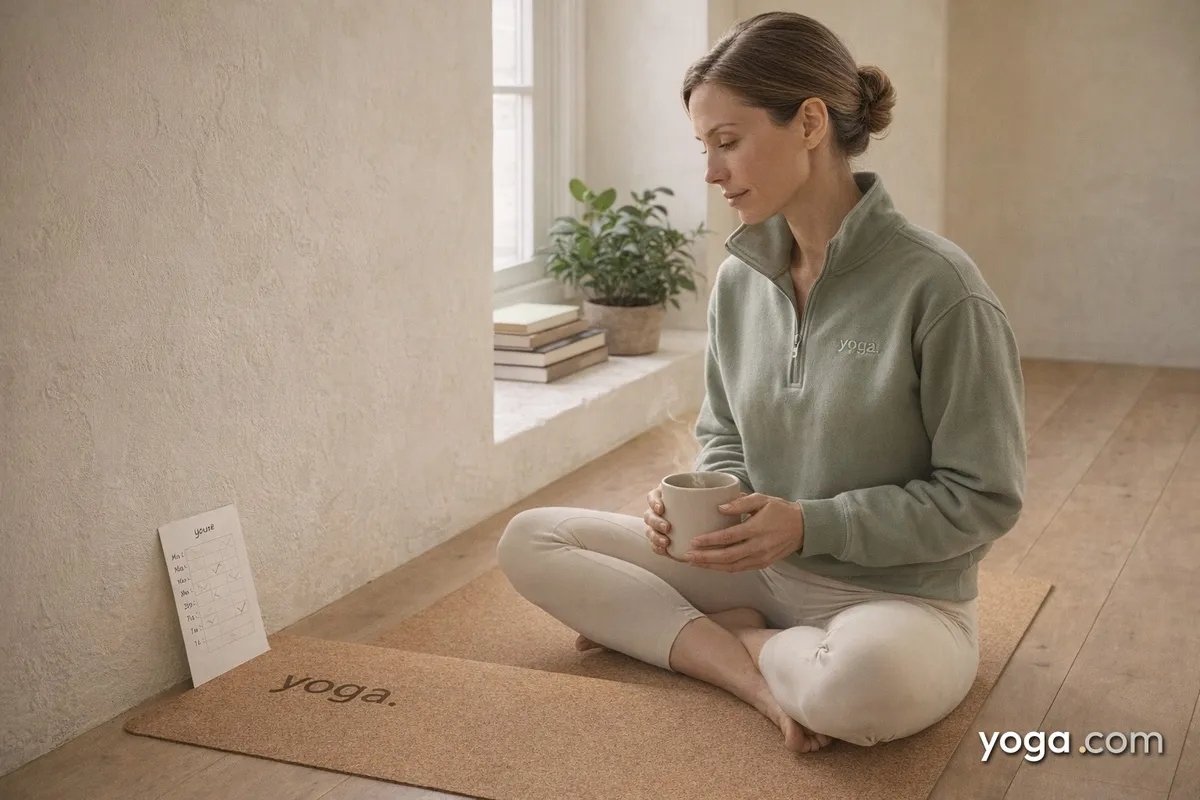
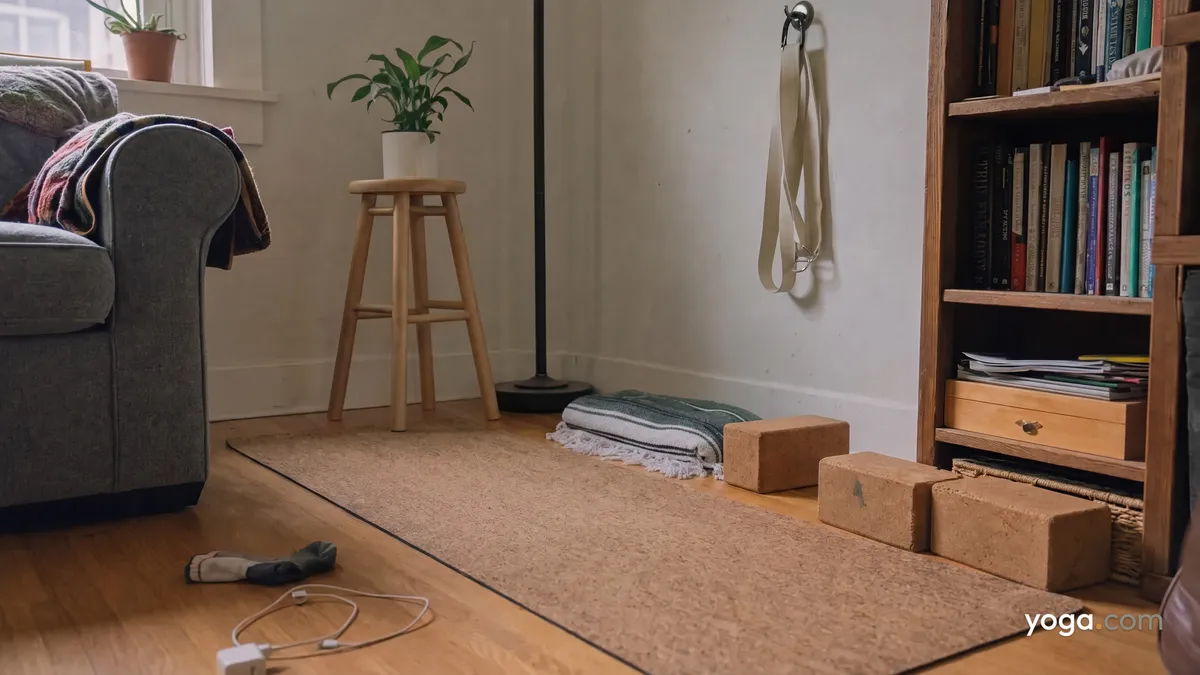
A standard yoga mat covers about 11.3 square feet of floor - 68 by 24 inches. That is the entire real-estate requirement for a home yoga corner: one mat, a little clearance, and a reason to come back tomorrow.
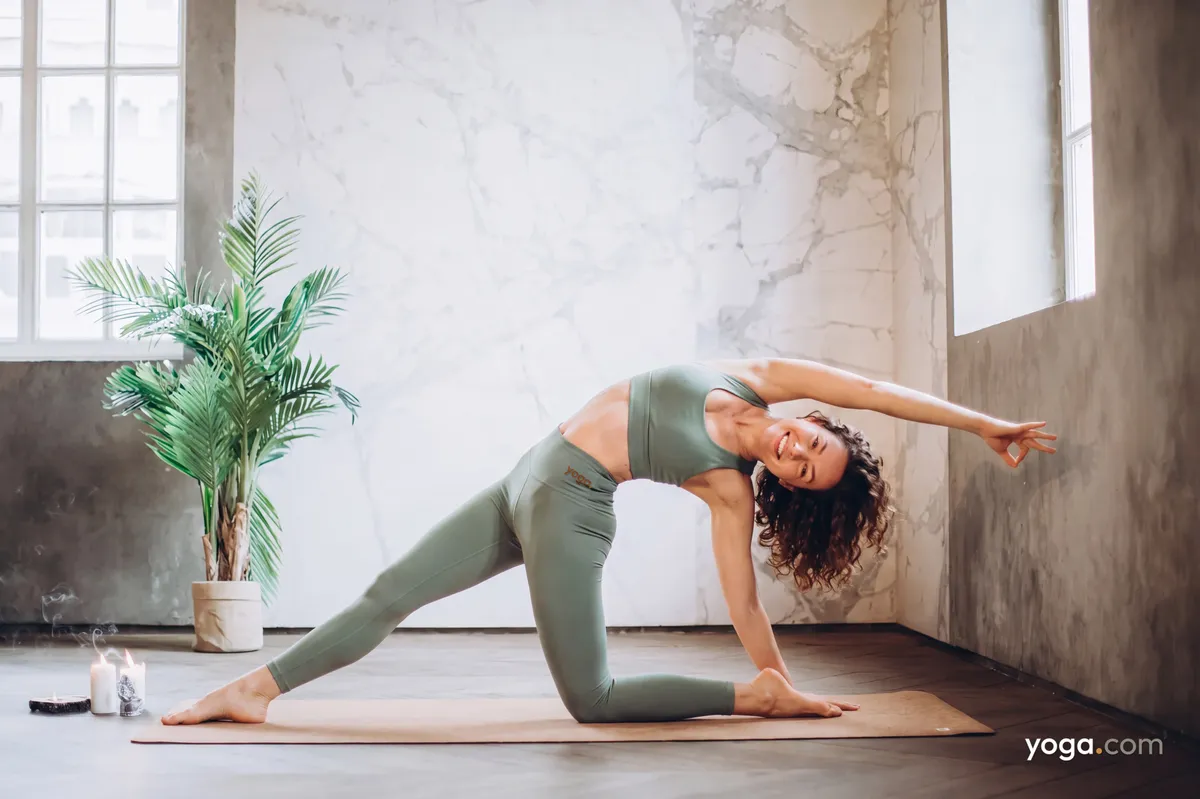
Setting one up takes an afternoon and, depending on the build, $66 to about $280. This guide covers the four decisions that matter: where the mat goes, what your floor requires, which gear tier fits your budget, and how to keep the corner from turning into a laundry rack. Every price below is the manufacturer's list price at the time of writing, and every product is linked in the Sources so you can check for yourself.
Picking the Spot: A Three-Move Test
Stand in the spot you are considering and run three moves:
- Stretch both arms straight out to the sides. Nothing should stop your fingertips.
- Reach both arms overhead. No light fixture, no shelf edge.
- Step one foot back into a full lunge, front knee bent. You should be able to hold it without leaning away from a wall.
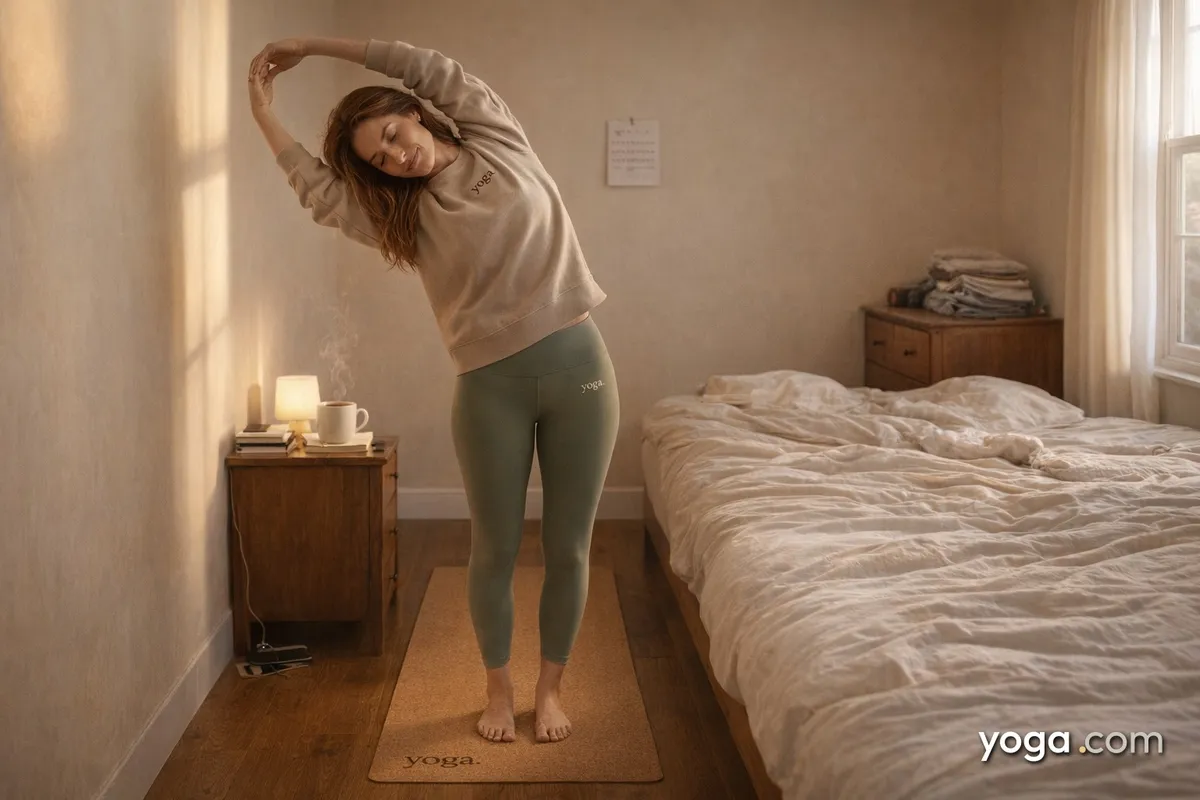
If all three clear, the spot works. In numbers, that is roughly 20 to 25 square feet - about twice the mat's own footprint, or a five-foot square. If a spot fails only the lunge, angle the mat on a diagonal before ruling the corner out.
Four common candidates, each with an honest catch:
- Bedroom corner. Quiet and private, with a door that closes. The catch: early practice there competes directly with the bed.
- End of the living room. Usually the most open floor in the home. The catch: household traffic and the television. It works best if you practice before the room wakes up.
- Cleared basement section. Nobody interrupts you. The floor runs cold in winter, so keep a blanket down there year-round.
- Covered porch. The best air you will get. Weather sets your schedule, so treat it as a fair-season spot with an indoor backup.
One rule outweighs the rest: pick the spot you walk past most often. A corner you see ten times a day gets used. The perfect corner behind a closed door is easy to forget by Thursday.
And the spot only needs to be clear while you practice. A reading chair you slide two feet before starting does not disqualify a good corner. A floor you have to excavate every time does.
Let the Floor Pick the Mat
Hardwood, laminate, and tile are the easy case. A firm mat grips these surfaces and stays put through transitions, which is most of what safety at home comes down to.
Carpet is the hard case. Mats bunch and slide on it, and a mat that shifts under a standing balance pose is a hazard, especially when nobody is around to catch you. Two fixes, depending on how long you expect to live with that carpet:
- Temporary fix: a thin sheet of plywood under a dense, firm mat. It flattens the surface and stops the bunching. It is ugly, it works, and it slides behind a couch when guests come.
- Permanent fix ($209.95): the Gorilla Mats Premium Large Yoga Mat, 7 by 5 feet and 8mm thick, with a circle-pattern bottom built to stay flat on carpet, hardwood, tile, and vinyl without shifting. The trade-offs are real: it costs more than three complete starter builds, and at that size you should plan on leaving it down rather than rolling it up daily. Buy it only if the carpeted room is the room, for years.
Three Builds, With the Math Shown
Each build is complete - mat plus props. The tiers differ mainly in the mat, because a $26 block and a $20 strap are simple objects that either work or do not; there is no premium version worth chasing.
The starter: $65.98
- Gaiam Essentials Yoga Mat, 6mm - $19.98
- Manduka Recycled Foam Yoga Block - $26.00
- Manduka AligN Yoga Strap, 8 feet - $20.00
The block measures 9 by 6 by 4 inches, which gives three working heights depending on which face it stands on: low under a hand in Triangle Pose (Trikonasana), tall under the sit bones in seated folds. The strap extends your reach in forward folds like Paschimottanasana while your hamstrings are still learning the pose. The 8-foot length is the usual pick for taller practitioners; 6 feet suits shorter ones.
The honest gap in this build: one block supports one hand at a time. Plenty of poses want a pair - a block under each hand in a deep lunge, for instance. A second block adds $26.00 and takes the build to $91.98. Start with one anyway; your first month will tell you whether your practice keeps reaching for a second. A folded blanket from the closet stands in for a bolster at this stage, and does the job surprisingly well.
If the Essentials mat is out of stock, or you want a small step up inside Gaiam's line, the Classic Solid Color (5mm, $24.98) and the Premium 2-Color (6mm, $29.98) sit a few dollars higher without changing the math much.
The middle build: $141.98
- Gaiam Performance Dry-Grip Yoga Mat, 5mm - $69.98
- Two Manduka Recycled Foam Yoga Blocks - $52.00
- Manduka AligN Yoga Strap - $20.00
The $50 jump from the starter mat buys one specific thing: a top surface designed to keep traction as your palms get damp. If sliding hands are what pull you out of Downward Dog by minute ten, this is the tier that fixes it. If your practice is slow and mostly seated, the starter mat is honestly enough, and the extra $50 does nothing for you.
This tier also assumes two blocks from day one - the right call if you already know standing poses will be a regular part of your practice.
The buy-once build: $279.95
- JadeYoga Harmony Mat - $99.95
- Two Manduka Recycled Foam Yoga Blocks - $52.00
- Manduka AligN Yoga Strap - $20.00
- Hugger Mugger Standard Yoga Bolster - $108.00
The Harmony is natural rubber tapped from rubber trees, with no PVC or EVA. Its grip holds when you sweat, and at 3/16 inch (just under 5mm) it stays firm enough for balance work. The bolster, 11 by 25 by 6 inches, is what turns the corner into a place for restorative practice: supported reclining poses, legs-up-the-wall variations, the end-of-day sessions that make a home corner earn its keep.
One caution on the bolster: it is the prop most likely to end up decorative. Buy it when your practice starts asking for it - the day you catch yourself stacking couch cushions for support. Sequenced that way, this build is really $171.95 up front and $108.00 a few months later.
If your floor is carpet and you are going the permanent route, add the Gorilla mat and the all-in figure becomes $489.90. That number looks steep next to $65.98, which is exactly why both are laid out here: the corner works the same on either budget. Spend at the level your floor and your sweat demand, and nothing more.
Mat Thickness, Decided in a Minute
- 4 to 5mm: the default. Firm enough that one-legged balance poses stay stable.
- 6mm and up: worth it if your knees or hips complain on a thin mat.
- 8mm and up: cushioned, and noticeably wobbly under standing balance work. Choose it only for a floor-heavy restorative practice, or as part of the carpet fix above.
There is also a fix that beats buying thick: keep a 4-5mm mat for stability and fold a blanket under your knees for kneeling poses. You get cushioning exactly where and when you need it without giving up a stable base everywhere else.
Light, Air, and Where the Phone Goes
Near a window is the best answer for morning practice - daylight changes how a session feels in a way overhead bulbs do not. For evenings or windowless corners, warm, soft lamplight beats a bright ceiling fixture.
Air matters more than decoration, because breathing is half the practice. Crack the window when weather allows; a small, quiet fan covers the rest of the year.
The phone goes in another room. If it serves as your timer or class app, switch it to airplane mode before you step on the mat - one banner notification undoes ten minutes of settling. Beyond that, a single marker object, a plant or a candle, is enough to tell your brain this square of floor has one job. More than one marker and you are decorating, which is a different hobby.
Practicing Alone Changes Which Poses Are Safe
A studio gives you a teacher who spots the drift in your alignment before it becomes a strain. Your corner will not do that, so build the safety margin into your pose choices instead.
The published injury data points the same direction. A review of adverse events associated with yoga practice found that most injuries are muscle strains and sprains, concentrated in the back, neck, and shoulders, and that risk tracks with duration, frequency, the number of techniques attempted, and the practitioner's level of body awareness. Advanced practices carry higher rates of adverse events - Headstand (Sirsasana) is the named example.
The working rules that follow from that:
- Use the corner for repetition of poses your body already knows. Learn new material, and especially inversions, with a qualified teacher watching.
- If you are new to yoga entirely, take at least a few classes before your first solo session.
- If you have an existing health condition or a current injury, talk to your doctor or physical therapist before starting. And be clear-eyed about limits: a home corner is a place to practice, never a substitute for treatment or physical therapy if that is what your back or shoulder actually needs.
The Part That Keeps the Corner From Becoming Storage
Yoga teacher Amy Ippoliti's setup advice ends with the piece most guides skip: leave the mat unrolled when you finish. An unrolled mat, in her words, "will attract you to it and make you want to practice yoga more often." A rolled mat in a closet is a decision you have to make every day; an open mat is an invitation you would have to decline.
Her case for keeping the bar low is worth quoting in full: "A regular practice - even if it's just for five minutes a day - will have huge benefits over time."
A realistic first month looks less impressive than the shopping list. Weeks one and two: five to ten minutes, same time of day, with the mat already out so the only decision is stepping onto it. Weeks three and four: let the good days stretch longer, and let the busy days stay at five minutes instead of shrinking to zero. Missing a single day costs little. The pattern that actually kills home practice is the postponed full hour that never arrives.
The national numbers back the modest approach. In the CDC's 2022 National Health Interview Survey, 80% of people who practice yoga said they do it to restore their overall health - maintenance, in other words, closer in spirit to sleep and meals than to a training block. Judge your corner by the same standard: whether you showed up, for however long. On that measure, $66 spent on a corner you visit daily beats $490 spent on one you admire from the couch.
Sources
- CDC / NCHS Data Brief No. 501 - Yoga Use Among Adults: United States, 2022
- National Library of Medicine (PMC) - Adverse Events Associated with Yoga Practice
- Gaiam Essentials Yoga Mat, 6mm
- Gaiam Premium 2-Color Yoga Mat, 6mm
- Gaiam Performance Dry-Grip Yoga Mat, 5mm
- Gaiam Classic Solid Color Yoga Mat, 5mm
- Manduka Recycled Foam Yoga Block
- Manduka AligN Yoga Strap
- JadeYoga Harmony Mat
- Hugger Mugger Standard Yoga Bolster
- Gorilla Mats Premium Large Yoga Mat, 7 by 5 feet
- Everyday Yoga - How to Set Up a Home Yoga Studio: Tips from Amy Ippoliti