You know the moment. The inbox hits twenty-plus unread, your shoulders are somewhere near your ears, and the idea of pausing — even for sixty seconds — feels laughably indulgent. But small mindfulness pauses during the day aren't a luxury reserved for people who go on retreats. They're one of the most practical tools you have, and research shows that even 10 minutes of mindfulness makes a positive difference. Here's how to actually build that habit — starting today.
Why You Keep Skipping These Pauses (And Why That's Costing You)
Stress at work is not a personal failing — it's a structural problem and it affects a very large number of people. In the United States, an estimated 5–8% of annual healthcare costs are attributable to work-related stressors. In the UK, the overall annual cost of work-related stress to employers exceeds £26 billion. The simple fact is that these numbers show work-related stress is a real and very costly problem, not just something you imagine.
And it is not evenly distributed across all workers. Research from the American Psychological Association suggests workers in manual labor, customer service, sales, and entertainment are more likely than those in desk jobs to report physical fatigue, cognitive weariness, and emotional exhaustion. On top of that, over 30 percent of lower-level employees across all industries had felt fed up with work frequently in the past 30 days. Keep in mind that this means a very large share of workers are already running on empty on any given day.
When you are that depleted, a mindfulness pause feels like the first thing to cut and so you skip it because you feel you do not have the time. But a mindfulness pause is actually the last thing you should cut, because cutting that pause is exactly what makes your depletion worse.
What a Mindfulness Pause Actually Does to Your Body
This is not about clearing your mind or achieving some blissful state. A pause works because of concrete, measurable physiology and the simple fact is that your body responds in ways that can actually be measured. Mindfulness calms the nervous system and reduces the body's stress hormone, cortisol. And you do not need a long session to get there because focused breathing for only a minute can lower stress and improve clarity.
The cortisol connection goes deeper than a single breath, too. UC Davis researchers found that individuals whose mindfulness score increased after a retreat showed a measurable decrease in cortisol — and that a high mindfulness score correlated with a low cortisol score both before and after the retreat. Keep in mind that the more consistently you practice, even briefly, the more your baseline stress response can shift and so your body gradually learns to carry less tension throughout the day.
On top of that, an eight-week mindfulness program has also been shown to reduce stress biomarkers including hair cortisol, as well as perceived stress and anxiety. The simple fact is that consistency, not duration, is what compounds over time and what makes a real difference for your stress levels.
What Counts as a Mindfulness Pause?
A pause does not require a cushion, a candle, or an app. The simple fact is that a pause just requires your attention — deliberately brought to the present moment — for a defined stretch of time and so even a very short stop counts as long as you are doing it on purpose. It can look like:
The common thread in all of these examples is that you are choosing, briefly, to step off autopilot. Keep in mind that the choosing part is what makes the pause a mindfulness pause, because you are the one deciding to bring your attention back to the present moment on purpose.
The Research on Short Pauses at Work
Even brief, informal mindfulness practices have shown meaningful results in demanding work environments. Rodriguez-Vega et al. (2020) found that just 5–10 minutes of guided mindfulness exercises in a hospital setting during the COVID-19 crisis were perceived as helpful by hospital staff for reducing stress. That's one of the most high-pressure environments imaginable — and short pauses still moved the needle.
Formal programs back this up too. In one workplace meditation study, participants used an app offering 45 pre-recorded 10–20 minute guided audio meditations over eight weeks, completing an average of 17 sessions during the intervention period. You don't have to do it perfectly or every single day to benefit.
How to Actually Build the Habit
Attach your pause to something that already happens. Do not try to remember it from thin air — that is how it gets skipped every single time. The simple fact is, if you stack your pause onto an existing cue, you are far more likely to actually do it and keep doing it.
Start with one cue, not five. On top of that, trying to add all five cues at once is one of the most common reasons people give up. Once one cue becomes automatic — usually after a couple of weeks — add another cue to your routine.
What a Pause Can't Do
A 60-second breath break is a powerful stress-management habit. It is not a treatment for clinical anxiety, burnout that won't lift, or depression. If you're experiencing symptoms that are consistently interfering with your daily life, please talk with a doctor or qualified mental-health professional. Mindfulness works beautifully alongside professional support — it just isn't a replacement for it.
Also worth knowing: a short pause is excellent for resetting your mood and sharpening focus. After a truly draining task, though, you may genuinely need a longer break — closer to ten minutes — to fully recover your concentration. Listen to what your body is telling you.
A Few Poses That Double as Pauses
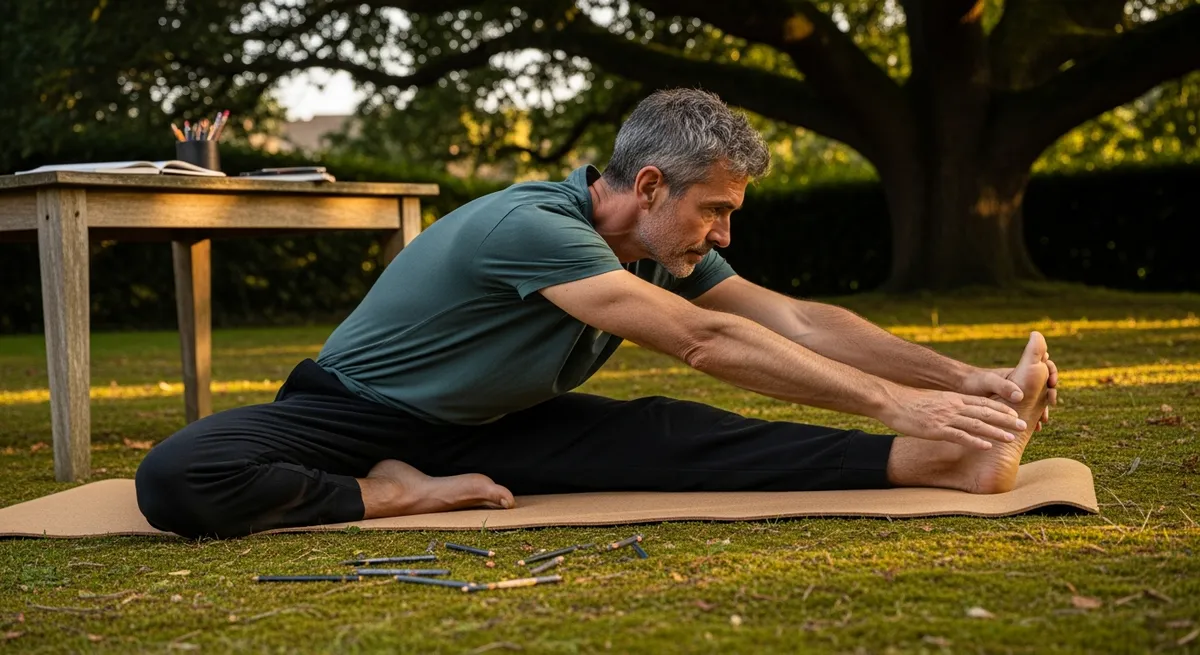
If you have a private space — even a bathroom stall works — a brief yoga shape can deepen the reset. The simple fact is that your body holds a lot of tension during the workday and even a short pose can help you release that tension. Try:
None of these poses require a mat, props, or yoga clothes. The simple fact is that these poses just require a few minutes and the decision to actually take those few minutes for yourself.
The Bottom Line
Small mindfulness pauses during the day do not ask much of you. The simple fact is that a single breath, a moment of stillness, or both hands placed flat on a surface while the noise keeps going can make a real difference. The science behind why these pauses work is solid and well-supported, because cortisol drops, the nervous system settles, and clarity returns when you give your body even a brief rest. Keep in mind that the science is not the hard part here. The only real obstacle is remembering that you are allowed to stop, even briefly, even on the hardest days. On top of that, the hardest days are exactly the days when your mind and body need these small pauses the most. Especially then, you deserve to give yourself that moment.