You've signed up for your first yoga class — and now a quiet little voice is asking: Am I going to do something embarrassing? That feeling is completely normal. The unwritten rules of a yoga studio aren't posted on the wall, but they're easy to learn. This guide walks you through everything you need to know before you roll out your mat, whether you're heading to a studio or logging on from your living room.
Why These "Soft Rules" Actually Matter
Yoga is a shared experience. When you are in a room or a Zoom session with other people who came to breathe, move, and decompress, small acts of consideration make a real difference. The simple fact is that good etiquette is not about being perfect. Good etiquette is about creating the kind of space where everyone, including you, can actually relax and feel comfortable and so the whole group benefits because each person feels respected.
Keep in mind that following these soft rules also signals respect for your teacher. Yoga instruction requires serious preparation and your teacher has put in a lot of work before ever standing in front of a class and so that effort deserves your full consideration. On top of that, some yoga and fitness instructors complete 200 to 500 hours of certified training before they ever lead a class. That level of effort from your teacher deserves a room that truly honors it.
Arrive Early — Not "On Time"
This is the single most important habit you can build, and it is a habit that will make your whole experience better. Most studios, gyms, and community centers ask you to arrive at least 10 minutes before class starts to complete any necessary paperwork. And yoga teachers generally recommend arriving no more than five minutes late — ideally not late at all. The simple fact is that arriving early is one of the best things you can do as a beginner.
A yoga class is built as an arc: a warm-up, a peak, and a wind-down, and each part connects to the next so that the whole class flows together. Walking in mid-sequence disrupts that flow for everyone around you and so it can make your own experience harder as well because you miss the foundation the teacher has already set. Keep in mind that those early minutes before class starts are actually very useful minutes for you. Use those early minutes wisely:
Set Up Your Space Thoughtfully
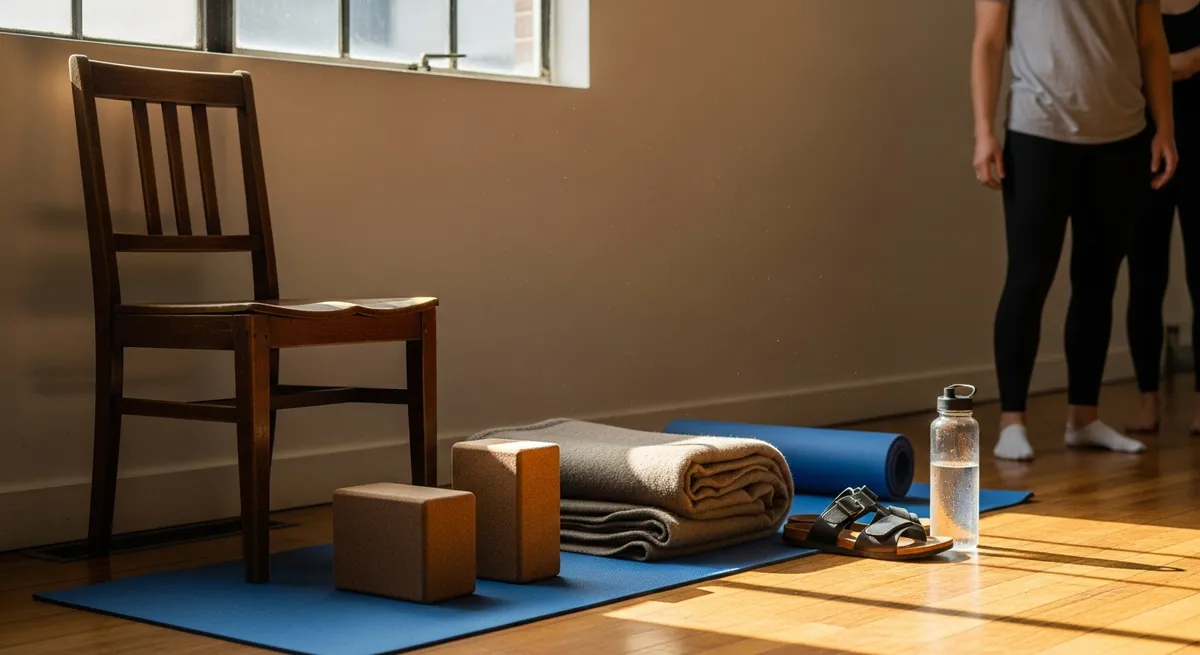
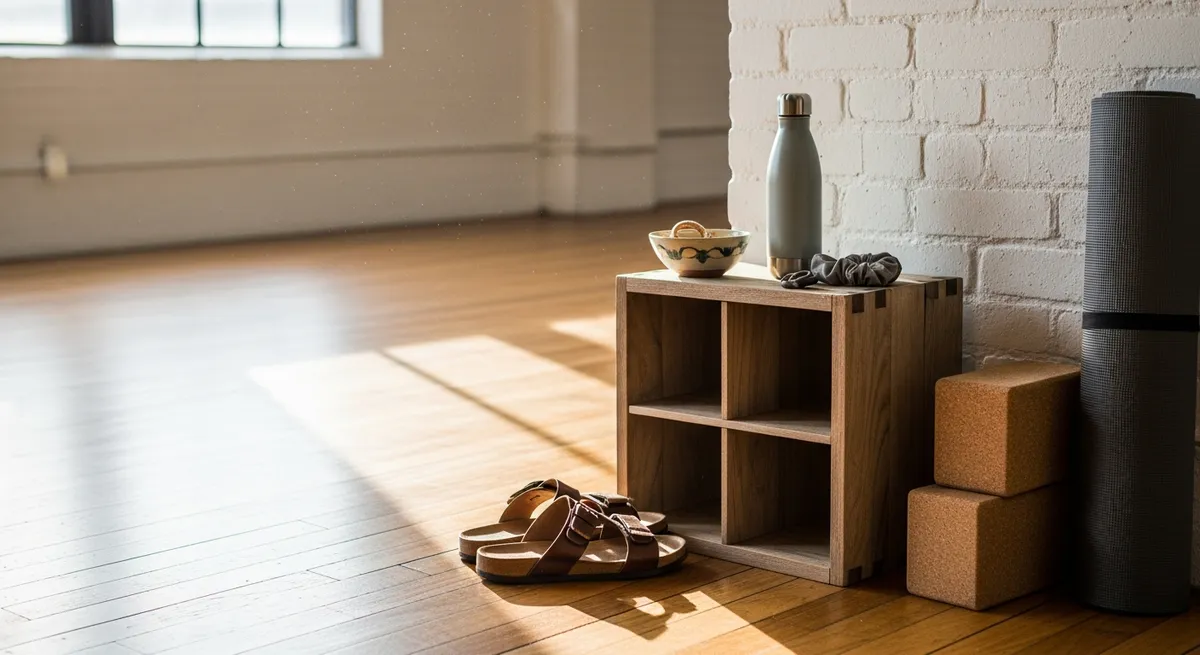
Your mat is your personal bubble for the next hour. The space around it belongs to your neighbors. A common beginner mistake is scattering a bag, water bottle, extra layers, and phone all around the mat's edges — which quietly squeezes out the people next to you.
The fix: Keep belongings minimal and tucked neatly at the top or side of your mat. And yes — silence your phone completely. Not vibrate. Silent.
Talk to Your Teacher Before Class Starts
Your teacher wants to help you, but your teacher can only help you if your teacher knows you need it. The simple fact is that telling your teacher you are a beginner before class starts means your teacher can offer easier variations when poses get challenging and can keep an eye on your alignment without singling you out awkwardly in the middle of class. Keep in mind that this small step makes a real difference to how comfortable your first class feels.
This conversation is also the right moment to ask about hands-on adjustments. Many teachers will gently guide a student's hips or shoulders into better alignment during class, and this can feel unexpected if you are not prepared for it, so it is worth knowing about it ahead of time because it happens in most classes. You have every right to opt out. Most studios now provide a consent card or small token you place at the top of your mat — one side signals "adjustments are welcome," the other says "please don't." If your studio does not use one, a simple "I'd rather not be touched today" before class is completely fine. On top of that, a good teacher will respect your choice without hesitation, so you do not need to feel worried about saying something.
During Class: The Quiet Courtesies
Once class begins, the room becomes a shared quiet space and every person in that room depends on others to keep it that way. The simple fact is that a few basic habits go a long way toward making the class better for you and for everyone around you.
Hygiene: Small Details, Big Impact
Yoga is a close-quarters practice. A few personal hygiene habits protect everyone's comfort:
Online Classes Have Their Own Rules
Virtual yoga has its own version of studio etiquette. The simple fact is that the principles are the same — consideration and presence — but the mechanics look different on a screen and so you need to think about a few extra things before you even press "join."
Before the class starts
During the class
A Quick Pre-Class Checklist
The Bottom Line
Yoga etiquette is not a list of strict rules designed to catch you out or make you feel bad. The simple fact is, yoga etiquette is just the practice of showing up with the same care you bring to your poses — aware of yourself, considerate of others, and willing to learn. You do not need to have everything all figured out on day one, and you do not need to be perfect right away, so keep in mind that every regular student in that room was also a beginner at some point. You just need to show up a little early, say hello to your teacher, and bring an open mind because when you bring an open mind you give yourself the best chance to grow. On top of that, small habits like arriving on time and being considerate of other students will make the whole experience better for everyone in the room. Everything else will follow naturally once you make these simple things a normal part of your practice.