
You've rolled out your mat, you're ready to begin — and then a pose that looked effortless on the instructor suddenly sends a sharp twinge through your lower back. It happens. Yoga is genuinely wonderful for your body and mind, but like any physical practice, it comes with real risks if you dive in without a few ground rules. Here's what you actually need to know before your first class — and in every class after it.
Yoga Injuries Are Real (But Very Preventable)
Yoga has a reputation for being gentle, and often it is. But it's a physical practice, and that means the body is on the line. A study of U.S. emergency department data found 29,590 yoga-related injuries between 2001 and 2014 — with the trunk (46.6%) the most frequently injured region, and sprains or strains (45.0%) the most common diagnosis.
Knowing where the risk lives is the first step to sidesteping it. Most of those injuries are preventable with good alignment, sensible sequencing, and one non-negotiable habit: listening to your body.
Which Poses and Styles Carry the Most Risk
Not all yoga poses are created equal. Research found that hand-, shoulder-, and headstands were associated with the most acute adverse effects, accounting for 29.4% of cases. These are advanced inversions that load the neck, shoulders, and wrists under significant compression — they are not beginner poses, full stop.
Style matters too. Power yoga had the highest injury rate of any style studied, at 1.50 injuries per 1,000 hours of practice — well above the overall average of 0.60 injuries per 1,000 hours. If you're just starting out, a slow-flow Hatha or Yin class is a smarter entry point than a Power or hot-yoga studio.
A note for older beginners
If you're over 65, the risk picture is different. The injury rate was greatest for adults aged 65 and older (57.9 per 100,000) compared with those aged 18–44 (11.9 per 100,000). That's not a reason to avoid yoga — the benefits are real — but it is a reason to start slower, use more props, and work with a qualified teacher from day one. If you have existing health conditions, check with your doctor before beginning.
The Single Biggest Safety Mistake Beginners Make
Practicing alone, from videos, without any corrective feedback. A qualified teacher watches your body in real time — something a screen simply cannot do. An instructor can see that your front knee is drifting past your ankle in Low Lunge (Anjaneyasana), or that you're dumping into your lower back in Downward-Facing Dog (Adho Mukha Svanasana), before those habits become injuries.
For your first several months, prioritize in-person classes over self-guided video practice. Look for a teacher registered with Yoga Alliance (RYT-200 or higher) — that credential confirms a minimum standard of training in anatomy, alignment, and teaching methodology.
Alignment Basics That Protect You in Common Beginner Poses
You don't need to memorize anatomy charts. You just need a few key checkpoints for the poses you'll meet most often.
Standing Forward Fold (Uttanasana)
Low Lunge (Anjaneyasana)
Downward-Facing Dog (Adho Mukha Svanasana)
Child's Pose (Balasana)
How to Tell the Difference Between a Stretch and a Warning Sign
This is probably the most important skill you'll build. A healthy stretch feels like a broad, diffuse pulling sensation across a wide area of muscle — it's uncomfortable in a productive way. A warning sign is sharp, burning, or pinpoint — especially at a joint rather than in the belly of a muscle.
If something feels wrong, stop. Not at the end of the pose. Right then. No class, no instructor, no desire to "keep up" is worth a torn ligament.
Use Props — They're Not Training Wheels
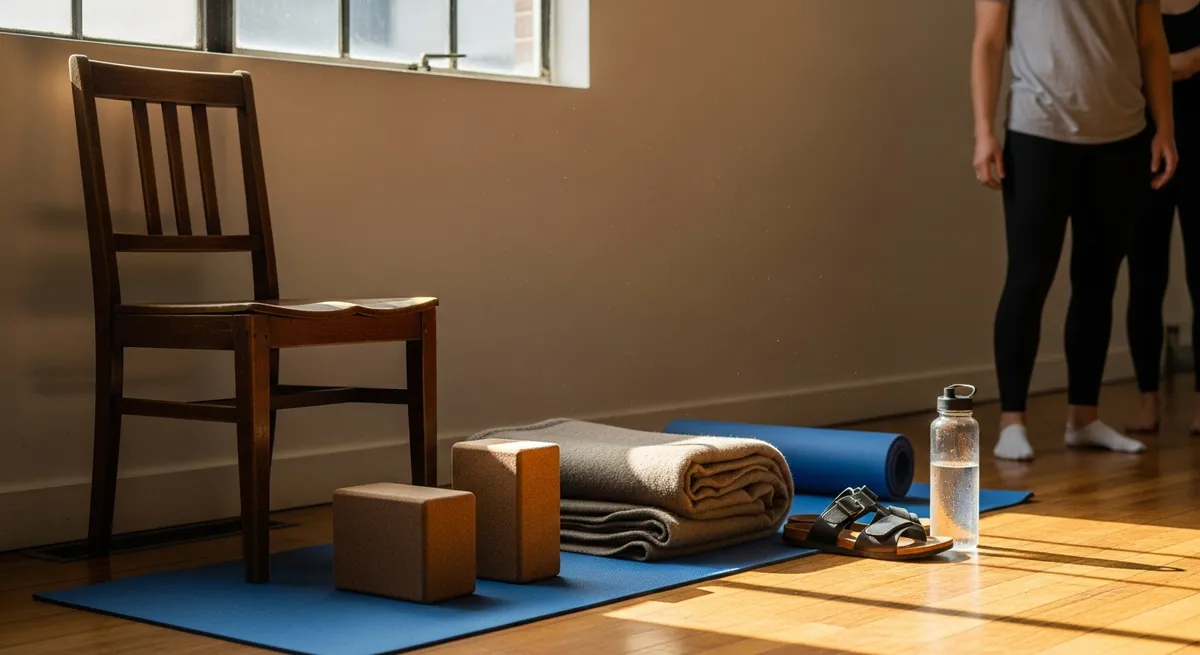
Blocks, straps, blankets, and bolsters exist to make poses accessible and safe and so you should never see them as a sign that you are doing something wrong. The simple fact is that using a prop means you are practicing with good awareness, not that you are falling behind. A block under your hand in Triangle Pose (Trikonasana) lets you maintain a long spine instead of collapsing into the shoulder. A strap around your foot in Seated Forward Fold (Paschimottanasana) means you can actually hinge from the hips rather than rounding your whole back just to grab your feet, and rounding your whole back is exactly the habit that causes injury over time.
Before class, ask your teacher which props to have on hand for your level because different levels need different props and it is better to know in advance. Most studios provide props for free, so grab your props before you spread your mat, not after the sequence has already started. Keep in mind that having your props ready at the beginning means you will not need to interrupt your practice or anyone else's practice to go searching for a block or strap mid-flow.
Warm Up, Cool Down, and Show Up Consistently
Never jump straight into deep stretching on a cold body. Five to ten minutes of gentle joint circles, easy Cat-Cow (Marjaryasana-Bitilasana), and conscious breathing is enough to get blood moving to your muscles and reduce injury risk significantly.
Consistency matters more than intensity. Most beginners notice meaningful changes in flexibility, sleep, and stress levels within two to four weeks of consistent practice — and practicing three or more times per week is associated with significant improvements in flexibility, strength, balance, and overall well-being. Short, regular sessions beat occasional marathon ones every time.
The Bottom Line
Yoga can do a lot for your body and research supports its benefits for back pain, flexibility, balance, and more. But those benefits only come when you practice with awareness and respect for where your body actually is today, not where you think your body should be. The simple fact is that starting with a qualified teacher matters a great deal, and you should skip the advanced inversions until you are genuinely ready, and you should use your props without apology because props are there to help you. Keep in mind that any sharp pain is an immediate stop signal and you need to treat it that way every single time. Your body is the one thing that gets you to the mat each day, so take care of your body. The mat will be there tomorrow.