
Yoga Nidra for Sleep: The Body-Scan Rest That Isn't Quite Sleep
Yoga Nidra for Sleep: The Body-Scan Rest That Isn't Quite Sleep
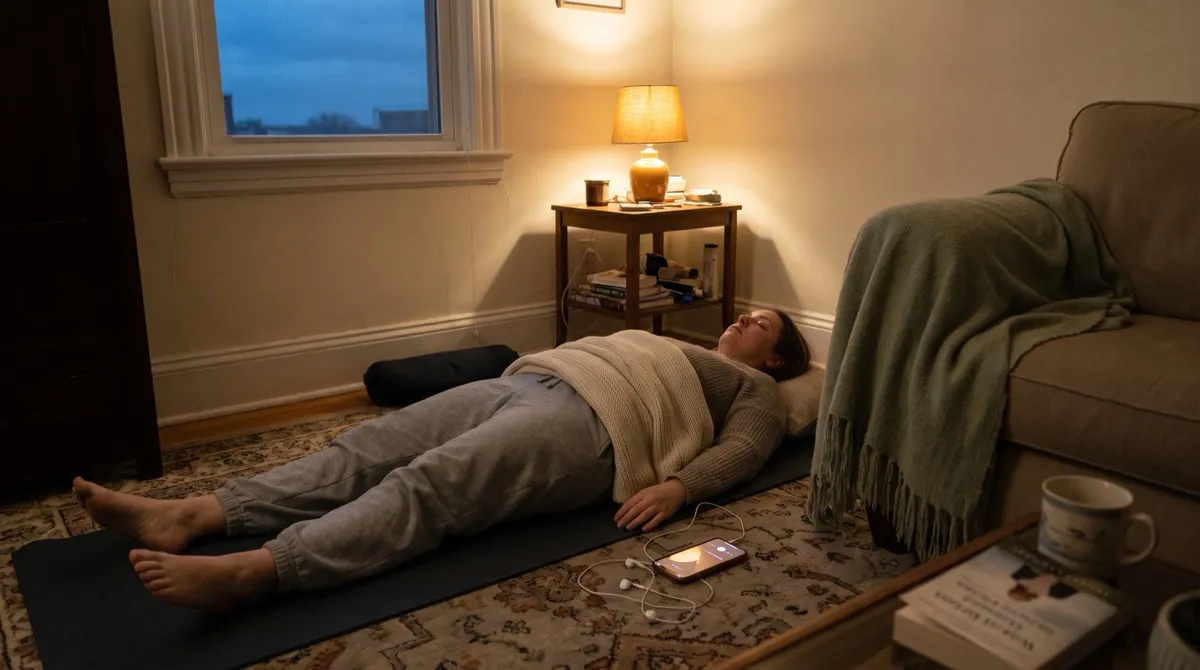
When you first hear the name, "yoga nidra," you might imagine something more along the lines of savasana—the final, rest-and-recovery pose of a yoga class. But yoga nidra is a different kind of rest. Yoga nidra for sleep is a guided meditation practice that focuses on mindfully turning attention inwards to the body, then progressively to different regions, to reach a state akin to deep sleep.
The practice—typically done lying down, wearing comfortable clothing—is a kind of a "rotation of consciousness," moving from one body part to the next, then from body sensation through the breath and into a deeper state of relaxation. The movement, positioning, and "experiencing" of different areas and sensations is done with a guided voice, and it's meant to help you relax deeply enough for your body to feel like it is "resting wakefully." Yoga nidra is described in a peer-reviewed treatment overview as a systematic guided practice that induces a deep state of rest between waking and sleep.1
So is yoga nidra just a long savasana? Not exactly. This process can be done individually or in a group, but either way you follow a guide rather than directing it yourself from memory. The guidance can come from an app, a recording, or a live voice in a session you join with peers. Yoga nidra is usually run in a session lasting 20 to 45 minutes, and you ideally stay present the whole time instead of falling asleep. Yoga nidra is not a replacement for sleep, but it is a way to increase relaxation and reduce arousal, which can help you fall asleep at your regularly scheduled bedtime.2
What Yoga Nidra for Sleep Is, and Isn't
You can think of yoga nidra for sleep as a kind of body scan where you focus on what you are experiencing in the body, what you are feeling, rather than on the mind and the "racing thoughts" many have in the hours before bedtime. And it's a way to deepen your practice of mindfulness, the kind of present-moment awareness that meditation also cultivates.
The evidence for yoga nidra is small but promising. Studies are showing some benefits of the practice, especially for people with insomnia. The best expectations to set are that yoga nidra can help you rest and relax, and that it can help you fall asleep and ease insomnia symptoms.3
How Does Yoga Nidra Work?
After all, "nidra" means "sleep" or "sleep-like state" in Sanskrit. Yoga nidra is a type of guided meditation. A voice—either live or as a pre-recorded track—is guiding you through the different steps of the practice, which typically involves:
- Complete relaxation and focusing on different parts and regions of the body
- Breathing awareness
- Visualization
- Concentration
- Creative visualization
Yoga Nidra Research: What the Evidence Shows
Research on the efficacy of yoga nidra is particularly interesting for sleep issues because the body-scan, guided body-mind relaxation practice is fundamentally different from "mindfulness," which uses a more task-oriented, present-moment awareness practice.
In a randomized controlled trial of yoga nidra vs. CBT-I for chronic insomnia, 21 participants used yoga nidra, and 20 used CBT-I. The participants were assessed with sleep diaries and questionnaires, and polysomnography was used to measure their sleep characteristics. The yoga nidra group improved on subjective total sleep time, sleep efficiency, wake-after-sleep-onset, and sleep quality. On the polysomnography, the yoga nidra group also showed improvements in the N2 and N3 sleep stages—including N3, the deep, slow-wave stage of sleep. Salivary cortisol also fell significantly in the yoga nidra group, from baseline (p=0.041).4
One important caveat to note is that the yoga nidra group received live, in-person sessions to teach the yoga nidra practice, and had to complete sessions with a guided voice. In other words, yoga nidra is a learned skill: guided audio counts as guidance, but live instruction can make the first sessions easier to learn.4 Cortisol is a hormone that drives the body's stress response and rises and falls on a daily (circadian) rhythm, so a drop in it points to lower physiological arousal—the calmer state that makes sleep easier to reach.
A 2025 trial of online yoga nidra meditation found a more modest benefit. Participants were randomized into practice and waitlist groups, and an 11-minute session produced a small but statistically significant lift in subjective well-being over the waitlist—though the effect sizes were small (d ≈ 0.08–0.16). Its cortisol result was an association rather than a clean group-versus-group difference: regular practice was linked to lower total cortisol and a steeper daily (diurnal) cortisol slope.5
Taken together, the practical takeaway is modest but encouraging: for people with insomnia, yoga nidra may improve sleep quality, help with staying asleep longer, and nudge cortisol in the right direction.4
The Caveats of Yoga Nidra
There are only a few randomized controlled trials of yoga nidra for sleep, and they have involved relatively small samples of participants. So the evidence is promising, but the sample sizes are small and more research is needed.3
If you have a diagnosed sleep disorder, yoga nidra is not a substitute for the treatment or therapy your condition needs—talk with your healthcare provider about using it as a complement to your plan. As with meditation and mindfulness practices generally, yoga nidra is considered complementary and is generally safe, but turning attention inward can bring up anxiety or distress for some people, especially anyone with a history of trauma—if that happens, it's fine to stop or to look for trauma-informed guidance.6
How to Get Started With Yoga Nidra
If you are interested in yoga nidra for sleep, and you have decided it might be a good fit for your needs and preferences, you might start by downloading a yoga nidra app, or searching YouTube for a guided meditation or savasana track. There are many available, and many are free. You will also find in-person classes that offer yoga nidra. Make sure you are following a clear, consistent, and authentic practice, and not something that has been adapted or modified in a way that may not be true yoga nidra.
Once you find a practice that feels right to you, try it out a few times. It may take a few sessions to get the hang of it, so don't be discouraged if it doesn't feel natural at first. Yoga nidra is a practice that can be done in a short session at bedtime before you go to sleep, or in a longer session earlier in the day, such as in the mid-afternoon or before dinner.
What to Remember
Yoga nidra for sleep is a complementary practice that can be used as an addition to your sleep routine and care plan. But yoga nidra alone will not be enough to meet the recommended 7 or more hours of nighttime sleep—it's the wind-down, not the sleep itself.2
References
- Moszeik EN, et al. Origin and clinical relevance of yoga nidra. A peer-reviewed overview (PubMed 35496325).
- Watson NF, et al. Recommended amount of sleep for a healthy adult: 7 or more hours. AASM & Sleep Research Society consensus (PubMed 26039963).
- Insomnia. MedlinePlus, U.S. National Library of Medicine (NIH).
- Randomized controlled trial of yoga nidra versus CBT-I in chronic insomnia, with polysomnography and salivary cortisol (PubMed 34825538).
- Randomized controlled trial of an online yoga nidra meditation: subjective well-being and diurnal salivary cortisol, 2025 (PubMed 40373021).
- Meditation and Mindfulness: What You Need To Know. National Center for Complementary and Integrative Health (NCCIH).
This guide is educational and is not medical advice. Yoga nidra is a way to wind down, not a treatment for a sleep disorder. If your insomnia persists, or if you snore loudly, gasp, or stop breathing during sleep, those are signs a sleep problem deserves evaluation by a clinician rather than a bedtime practice.