
Awake at 3 A.M.? Here's What to Actually Do
Waking Up at 3am and Can't Get Back to Sleep?
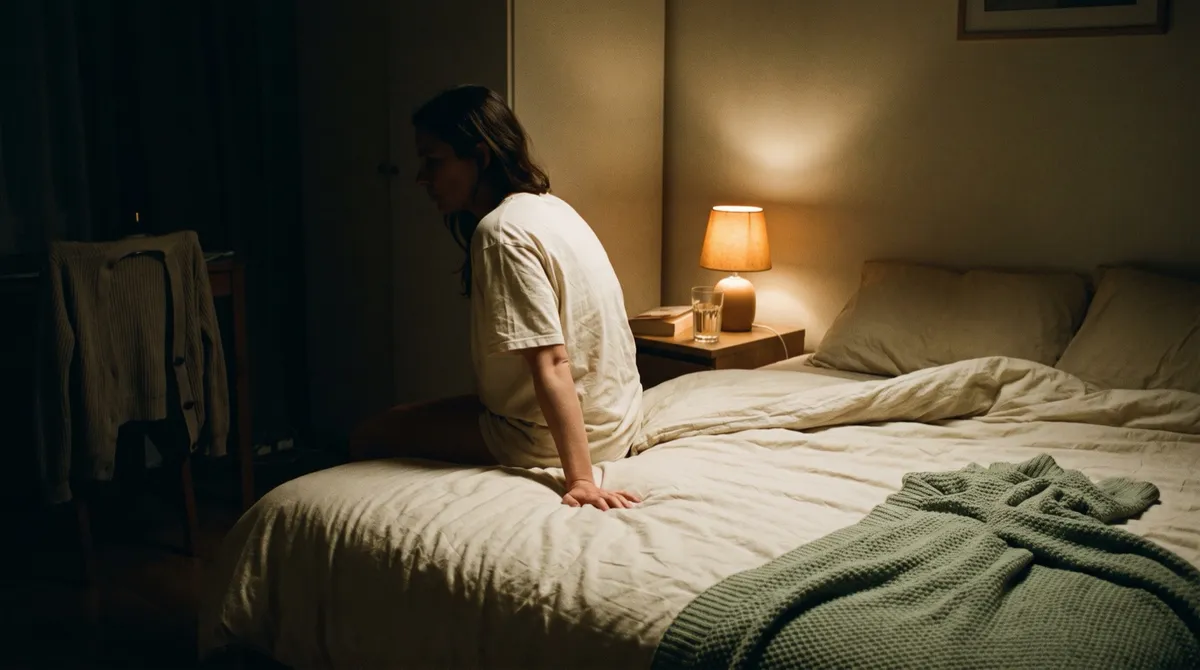
It's 3am and you're wide awake. Your heart is pounding, your mind is racing — and what's worse, you can't stop looking at the clock. It's not just you. A study of the US general population found roughly a third of adults report waking during the night at least three nights a week.1
Why Can't I Sleep When I Wake Up at 3am?
There's no single answer, but several common contributors show up again and again:2
- Stress and cortisol: if you're worried about money, work, or relationships, stress hormones can run high at night.
- Alcohol: a nightcap might help you fall asleep at first, but it can disrupt sleep in the second half of the night.
- Needing to urinate: a full bladder can wake you up.
- Pain: joint pain, back pain, or headaches can keep you up.
- Lighter sleep toward morning: sleep naturally becomes lighter as the night goes on, so awakenings get more likely in the early hours.
But one of the biggest factors is your response to being awake. The more you toss and turn, the more anxious you get, the more you lie there watching the clock, the more likely you are to get stuck in a cycle of insomnia.
How to Fall Back Asleep at 3am
First, a core piece of sleep guidance from CBT-I, the gold-standard insomnia treatment: If you're wired after about 15-20 minutes, get up, keep lights low, do something calm — read under a dim lamp, do light stretching, or listen to quiet audio, avoiding screens and problem-solving tasks — and return only when sleepy.3
That's because lying awake in bed trains your brain to think the bed is a place of frustration and worry rather than a place of rest. So if you have to get up and go to another room, it's not a failure at all — it's the move itself, and it helps you get back to sleep faster and more consistently in the future.
Once you're up, the next step is to downshift. A few minutes of slow breathing, followed by a gentle body scan, can do exactly that. Research shows slow, paced breathing at about 6 breaths per minute can reduce awakenings and improve sleep efficiency,4 and NCCIH lists breathing and relaxation techniques as low-risk tools for reducing the arousal that keeps people awake.5
Close your eyes and take a slow, paced breath (about 6 breaths/minute), letting the inhale and exhale each stretch the full length of your body. Imagine the breath entering and leaving every part of your body as you let go of tension and relax.
Often, you'll find you're feeling calmer after just a few minutes. If you're feeling more relaxed, but you're still awake, a quick scan of your body can help you relax further.
Quickly check in with your face and jaw. Is your jaw clenched? Let it soften. Is your forehead furrowed? Smooth it out. Then work downward — neck and shoulders, upper back and chest, arms and hands, lower back and abdomen, hips and legs, feet — releasing whatever tension you find. Repeat until you feel relaxed. If you've cycled through the process twice without feeling sleepy, stop clock-watching, accept wakefulness without judgment, and focus only on resting your body.
When you feel sleepy, return to your bed. If sleep still doesn't come after another 15-20 minutes there, that's okay — get up again and repeat the cycle until it does.
How to Reduce 3am Wake-Ups
Some of the common causes are worth chasing down. If a full bladder keeps waking you, cut back on fluids in the evening and empty your bladder right before bed. If you notice you wake more after a nightcap, remember that alcohol can help you fall asleep at first but disrupt the second half of the night2 — so keep it away from bedtime. If pain is waking you, try to get on top of it before bedtime.
And if you're waking up for no apparent reason night after night, talk to a health professional. Frequent nighttime waking and trouble getting back to sleep are classic signs of insomnia,6 and the same study of the US general population found that frequent awakenings are associated with medical and psychiatric conditions — they may point to an underlying health issue worth addressing.1
If you've tried the above strategies and you still can't get back to sleep at least three nights a week — and it's been going on for three months or more — see a clinician or book sessions with a CBT-I provider. It's the evidence-based, first-line treatment for chronic insomnia.7
And if you're waking up gasping or choking, or a bed partner reports breathing pauses or loud snoring, you should see a sleep specialist rather than manage with breathing exercises. You may have obstructive sleep apnea, and it's worth getting evaluated.8
But if you're just having an occasional 3am wake, you can rest assured that it's normal. So resist the urge to check your phone or turn on bright lights, and try the CBT-I stimulus control move, some slow breathing, and a body scan to get back to sleep.
References
- Nighttime awakenings in the US general population. PubMed (PMID 18374943). https://pubmed.ncbi.nlm.nih.gov/18374943/
- Why Do I Wake Up at 3 A.M.? Sleep Foundation. https://www.sleepfoundation.org/sleep-faqs/why-do-i-wake-up-at-3am
- Cognitive behavioral therapy for insomnia (CBT-I) — patient guide. Sleep Education (American Academy of Sleep Medicine). https://sleepeducation.org/patients/cognitive-behavioral-therapy/
- Slow, paced breathing before sleep, awakenings, and sleep efficiency. PubMed (PMID 25234581). https://pubmed.ncbi.nlm.nih.gov/25234581/
- Relaxation Techniques: What You Need To Know. NCCIH (NIH). https://www.nccih.nih.gov/health/relaxation-techniques-what-you-need-to-know
- Insomnia. MedlinePlus (NIH). https://medlineplus.gov/insomnia.html
- Chronic insomnia disorder and CBT-I as first-line treatment. PubMed (PMID 27136449). https://pubmed.ncbi.nlm.nih.gov/27136449/
- Sleep Apnea. NHLBI (NIH). https://www.nhlbi.nih.gov/health/sleep-apnea
This article is for education, not medical advice. An occasional 3am wake-up is normal, but persistent insomnia — trouble sleeping at least three nights a week for three months or more — or suspected sleep apnea (loud snoring, gasping, witnessed breathing pauses) deserves evaluation by a qualified clinician.