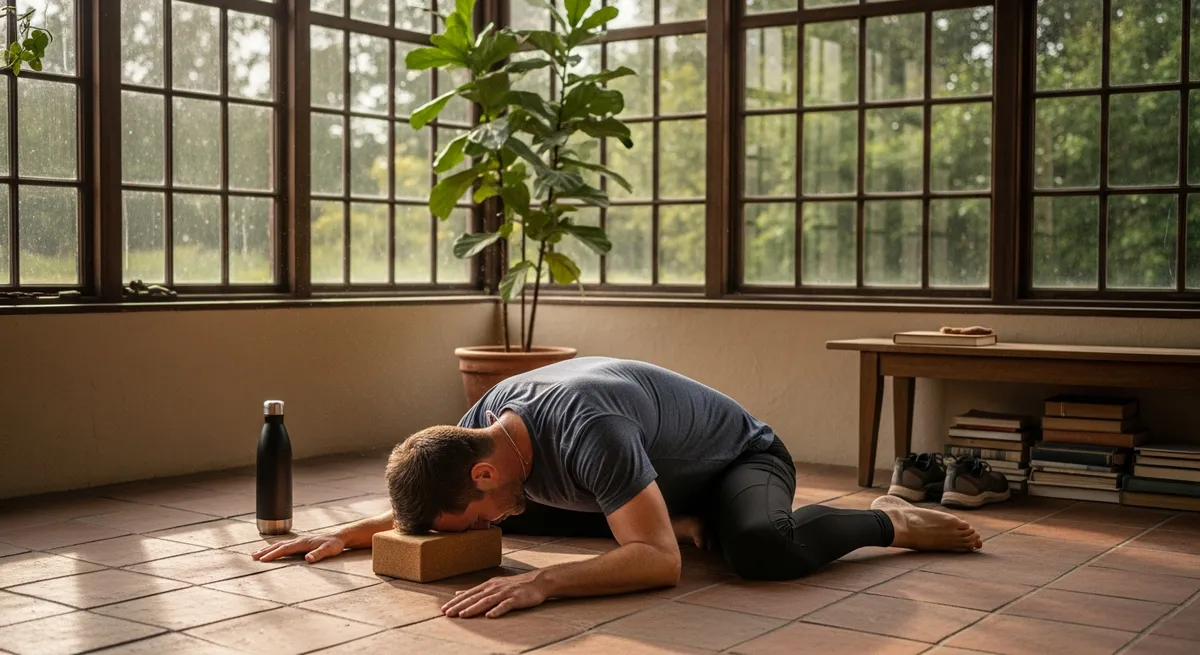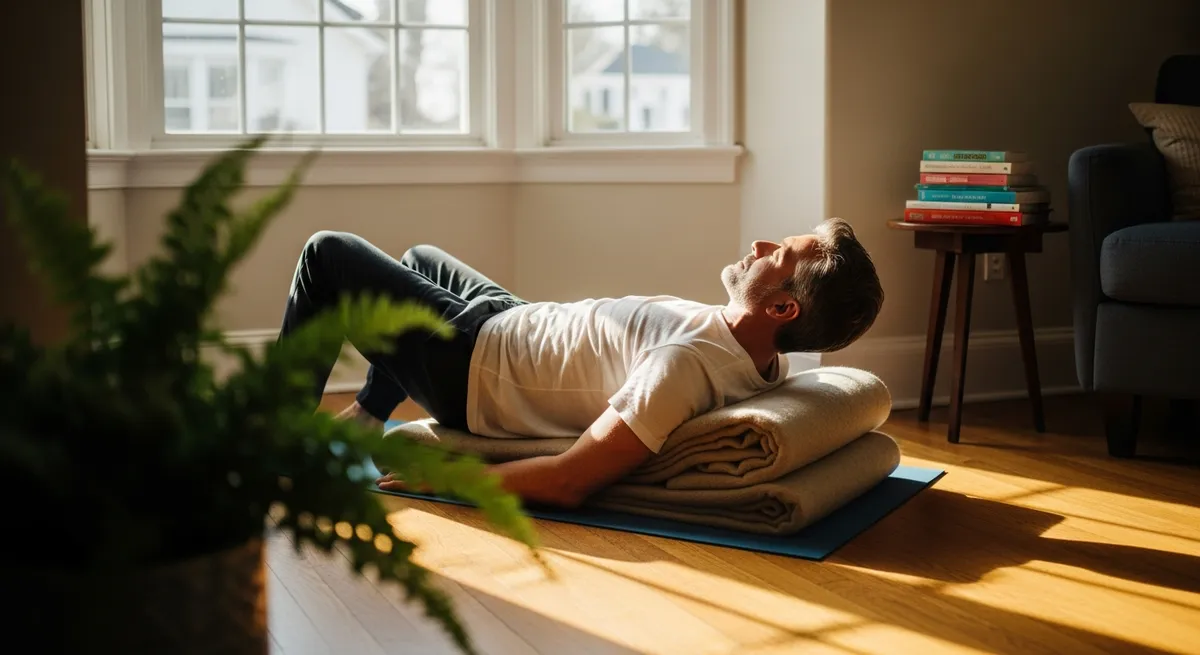

You know that feeling — shoulders creeping toward your ears, a dull ache spreading across your lower back, neck stiff from hours of screen time. If your workday lives at a desk, your body is paying a quiet tax all day long. The good news: a complete desk yoga practice can take five minutes or less, and it targets exactly the places that hurt most.
Why Your Desk Is Hard on Your Body
Sitting still for hours and especially sitting in a chair that does not quite fit your body loads the same muscles and joints repeatedly without giving those muscles and joints a chance to recover. The simple fact is that this kind of repeated loading adds up over time and so it creates real damage to your body. Work-related musculoskeletal disorders are among the most frequently reported causes of lost or restricted work time, and the cost is staggering: American companies could save $20 billion a year in workers' compensation alone by eliminating repetitive stress injuries, with another $100 billion lost to reduced productivity, employee turnover, and other indirect costs.
The underlying issue is simple: your body was built to move, not to hold one position for eight hours. Keep in mind that your body needs regular movement to stay healthy and so holding one posture for a long time is something your body was simply never designed to do. Small, consistent movement breaks — even at your desk — help interrupt that cycle before the cycle becomes serious pain for you.
What a Desk Yoga Practice Actually Targets
A desk yoga sequence focuses on the hips, lower back, shoulders, chest, and wrists — the exact areas that bear the brunt of prolonged sitting and typing. You don't need a mat, a studio, or special clothes. You need your chair and about five minutes.
And yes, many of these poses can be done in 30 seconds or less — making them genuinely realistic on a busy workday.
Five Poses to Try Right Now
Work through these in order, or pick the two or three that speak to where you're holding tension today. The simple fact is that even doing just two or three of these poses can make a real difference for your body.
1. Seated Neck Release
Sit tall and drop your right ear toward your right shoulder. Hold for three slow breaths, then switch sides. This gently stretches the upper trapezius and the muscles along the side of your neck that spend all day holding your head over a screen and so these muscles can become very tight and sore because of that constant strain. One important note: avoid full circular head rolls that take your head far back — that can compress the cervical spine. Keep in mind that you want to keep the movement in front of the midline at all times.
2. Seated Cat-Cow (Seated Bitilasana Marjaryasana)
Place both hands on your knees. On an inhale, lift your chest and gently arch your lower back. On an exhale, round your spine and drop your chin toward your chest. Repeat five times, letting your breath lead the movement. This pose wakes up the entire spine and so your whole spine gets some movement that sitting rarely does for you. Keep in mind that your breath is what guides each repetition.
3. Seated Spinal Twist (Seated Bharadvajasana)
Sit up straight. Place your right hand on your left knee and your left hand on the back of your chair. Inhale to lengthen your spine, then exhale and gently rotate to the left. Hold three to five breaths, then switch sides. Keep your hips square — the rotation comes from the upper back (thoracic spine), which is where your body actually has room to turn. The simple fact is that keeping your hips square is what allows you to get the most benefit from this twist.
4. Eagle Arms (Garudasana Arms)
Extend both arms forward, then cross your right arm under your left. Bend your elbows and try to bring your palms together (or as close as they'll go). Lift your elbows slightly and breathe into your upper back. Hold for five breaths, then switch which arm is on top. On top of that, this pose targets the muscles across your upper back and so you will feel real relief if your shoulders are tight and rounded from desk work.
5. Seated Forward Fold (Seated Uttanasana)
Sit at the edge of your chair with feet flat on the floor. Hinge forward from your hips — not your waist — and let your arms hang toward the floor. Let your head be heavy. If your hamstrings are very tight, cross your arms and rest your arms on your thighs instead. Hold for five slow breaths. You'll feel this pose in your lower back and the backs of your legs and so this is a good pose to save for the end of your practice because it lets your whole body settle and release.
Set Up Your Workspace First
Yoga breaks help most when your workstation isn't actively fighting against you. The goal of ergonomics is to prevent the injuries and discomfort that happen at work — and a few simple adjustments make a real difference. The simple fact is, if your workspace is set up poorly, no amount of stretching will fully fix the problem, so it is worth taking a few minutes to check your setup before anything else.
Make It a Habit, Not a One-Off
The biggest mistake desk yogis make is saving the whole practice for the end of the day. By then, the tension has already built up for hours and your muscles have been tight for a long time so one late-day session cannot undo all of that damage. Spreading short movement breaks throughout the day — morning, mid-morning, after lunch, mid-afternoon — gives your muscles repeated chances to recover rather than one late-day rescue attempt. The simple fact is that spreading your movement breaks out across the day is always going to work better than doing everything at once.
The second most common mistake is rushing through the poses without actually breathing. Keep in mind that the breath is what shifts your nervous system out of stress mode and so the breath is not something you can skip or treat as optional. Slow, full inhales and complete exhales are not optional extras — slow, full inhales and complete exhales are half the benefit. On top of that, if you move through the poses too quickly without breathing properly, your body does not get the recovery signal it needs.
Know When to Seek Extra Help
A short daily practice is a genuinely useful tool. It is not, however, a substitute for professional care when pain is sharp, persistent, or getting worse. If your neck, shoulder, or back pain has been going on for weeks — or is interfering with sleep or daily tasks — please talk to a doctor or physical therapist. Self-care and professional guidance work best together.
The Bottom Line
You don't need a yoga studio, a lunch break, or even a change of clothes. You need five minutes, a little consistency, and the willingness to actually breathe while you do it. Start with two or three poses today, tuck them into natural breaks in your day, and notice how your body feels by Friday. Small, repeated kindnesses to your body add up — and your neck will thank you.