You close your laptop and notice it again — that dull ache across your shoulders, the stiffness climbing up your neck, the low back that never quite lets go. If this sounds familiar, you're not imagining it, and you're not alone. Yoga for desk posture won't just stretch out the sore spots; it can help you understand why they keep coming back — and give you real tools to change that today.
What Hours at a Desk Actually Do to Your Body
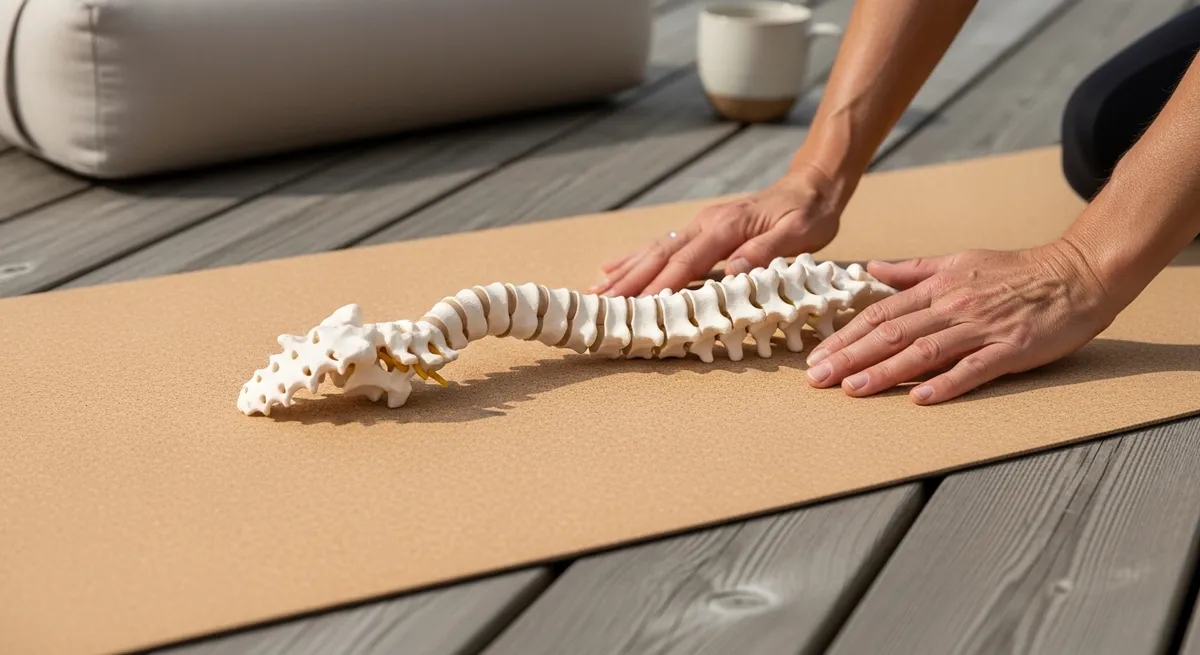
Sitting is not inherently harmful. The problem is the position you hold, for hours at a stretch, day after day. Most of us drift into a familiar shape: chin jutting forward, shoulders rounding, lower back flattening into the chair. Each of those habits puts measurable load on your spine and so the damage builds up slowly over time because your body is absorbing that stress every single workday.
Take your head as an example. In a neutral position, your head weighs roughly 10–12 lb — and your cervical spine handles that load easily when your head is stacked properly. But when your neck shifts forward, the pressure on your posterior vertebrae and muscles increases by more than four times. Keep in mind that this is a significant burden to carry from nine to five, and your neck is doing this work every day you sit at your desk.
And 78% of the population shows deformation of the cervical spine linked to forward head posture — driven by prolonged use of computers, smartphones, and tablets. The simple fact is that your neck was simply not designed for that kind of sustained forward lean, and most people are doing that kind of leaning for many hours every single day.
Meanwhile, the lower back takes its own hit. More than 1 in 4 working adults experience low back pain, and 20% of workers with back pain are told by a health professional that their pain is work-related. On top of that, the problem is serious enough for some workers that between 6 and 10% of affected workers stopped working, changed jobs, or significantly altered their work activities because of low back pain. That means your back pain can affect not just your comfort but your entire working life.
Why Yoga Helps — Specifically
Yoga works on desk posture from two directions at once. The stretching releases muscles that have shortened and tightened — think chest, hip flexors, the front of your shoulders. The holding and strengthening work rebuilds the muscles that have gone passive from underuse — your mid-back, deep neck flexors, core stabilizers.
There's also the mental layer. Yoga builds body awareness. You can't correct a posture you can't feel. Over time, the mindful quality of yoga practice makes you more sensitive to the moment your shoulders start creeping up toward your ears — and that awareness is genuinely useful at a desk.
And the breathing matters too. Just 15 minutes of chair-based yoga postures or guided meditation performed in the office can elicit a relaxation response. That same research found that yoga and meditation significantly reduced perceived stress versus control, and the effect was maintained after the intervention ended — with respiration rate measurably lower during yoga and meditation compared to control. Slower breathing, less tension. It adds up.
Get Your Desk Set Up First
Yoga will help far more if your workstation is not fighting you. The simple fact is that no amount of stretching will fully fix problems that your desk setup is creating every single day. Before you unroll a mat, check these basics.
Think of ergonomics as the foundation because ergonomics is what your body has to deal with for eight or more hours a day and so yoga simply builds on top of that foundation.
Four Poses to Start With Today
You don't need a studio. You don't need an hour. What you need is consistency, and even five to ten minutes every day will shift things over weeks because the body responds to small repeated efforts more than to occasional long sessions.
1. Chin Tuck
Sit tall. Gently draw your head straight back over your shoulders — like making a soft double chin — while keeping your eyes level. Hold for three breaths, release, and repeat five times. This pose targets the deep cervical flexors, the muscles that weaken when your head drifts forward all day and so these muscles need direct attention. The simple fact is that the common mistake here is tipping the chin up or down instead of moving straight back. Fix it by imagining the back of your skull sliding straight back along a flat shelf, and keep that image in mind every single repetition.
2. Seated Cat-Cow (Seated Bitilasana Marjaryasana)
Sit at the edge of your chair, hands on knees. Inhale and arch gently — chest forward, tailbone back. Exhale and round — chin to chest, tailbone under. Move slowly through five rounds. This is a gentle, safe way to rehydrate the spinal discs and wake up the muscles along your spine that have been holding a static position for a long time. Keep in mind that if you have a known disc injury, you should check with your healthcare provider before adding spinal flexion to your routine.
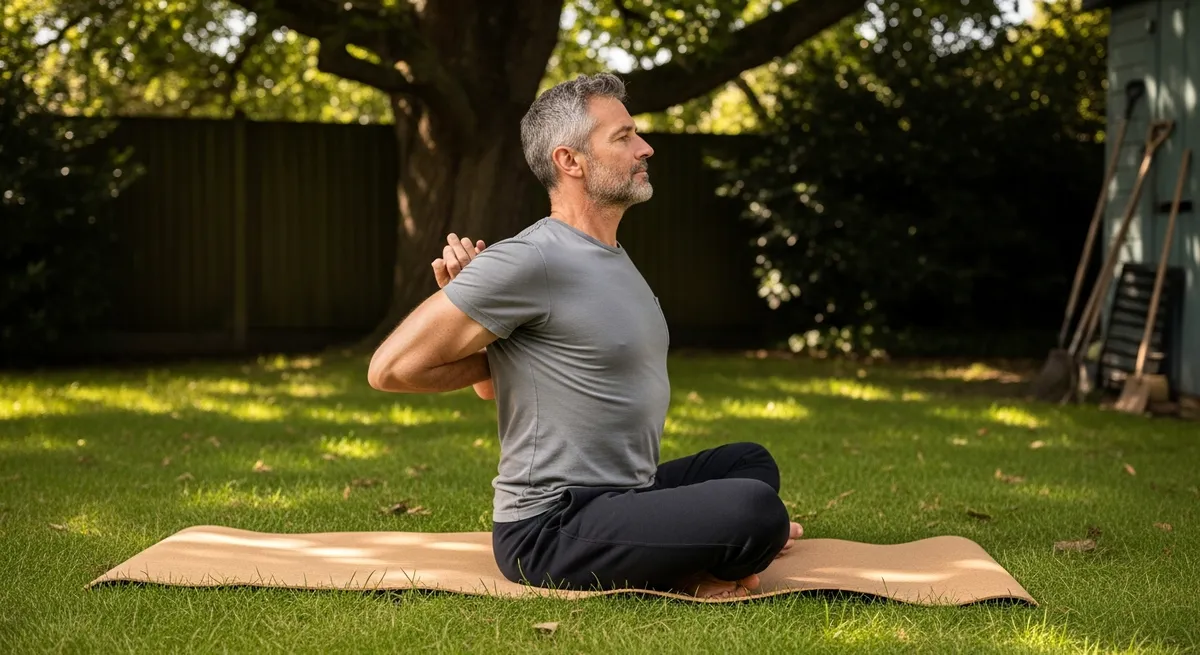
3. Seated Spinal Twist (Seated Bharadvajasana)
Sit tall. On an exhale, rotate your upper body to the right, resting your right hand on the chair back lightly. Hold for four breaths, then switch sides. The twist mobilizes your thoracic spine — the mid-back section that stiffens fastest at a desk — and so this pose is especially useful for people who sit for many hours. Let the movement initiate from your waist and ribs, not your arm. Your hand rests on the chair back; your hand does not crank the twist further than your spine is ready to go.
4. Standing Chest Opener
Stand behind your chair. Place both hands on the top of the chair back, step back until your arms are extended, and let your chest drop gently between your arms so your torso is roughly parallel to the floor. Hold for five slow breaths. On top of that, you will feel this stretch across your pectorals and the front of your shoulders — exactly the area that rounds forward during hours of typing and so exactly the area that needs opening up. Draw your lower belly gently in to protect your lower back from over-arching, and keep that gentle engagement throughout all five breaths.
A Simple Daily Desk-Posture Routine
The simple fact is, that is all you need to do. Keep in mind that a routine you actually follow every day will always beat a heroic plan you follow once in a while. Sustainable habits beat heroic efforts every single time.
A Note on Pain
Yoga is a supportive tool, not a diagnosis or a treatment. Keep in mind that if you have persistent neck pain, radiating symptoms, numbness, or a known spinal condition, you should please consult a qualified healthcare provider before starting a new movement practice. The simple fact is that a healthcare provider can assess your situation properly and so it is always the right first step when your pain is serious. General stiffness from sitting? These poses are a great place for you to begin. Sharp, shooting, or worsening pain? You should get that pain assessed first, because sharp or worsening pain is a signal that your body needs professional attention before you add new movement.
The Bottom Line
Your spine is remarkably adaptable — and so are you. The ache you feel at the end of a long workday isn't inevitable, and it isn't permanent. A well-set-up desk, a handful of targeted poses, and a few minutes of mindful breathing each day can genuinely shift how your body feels over time. Start small, stay consistent, and trust the process. Your future self — sitting tall, shoulders easy, neck free — will thank you.