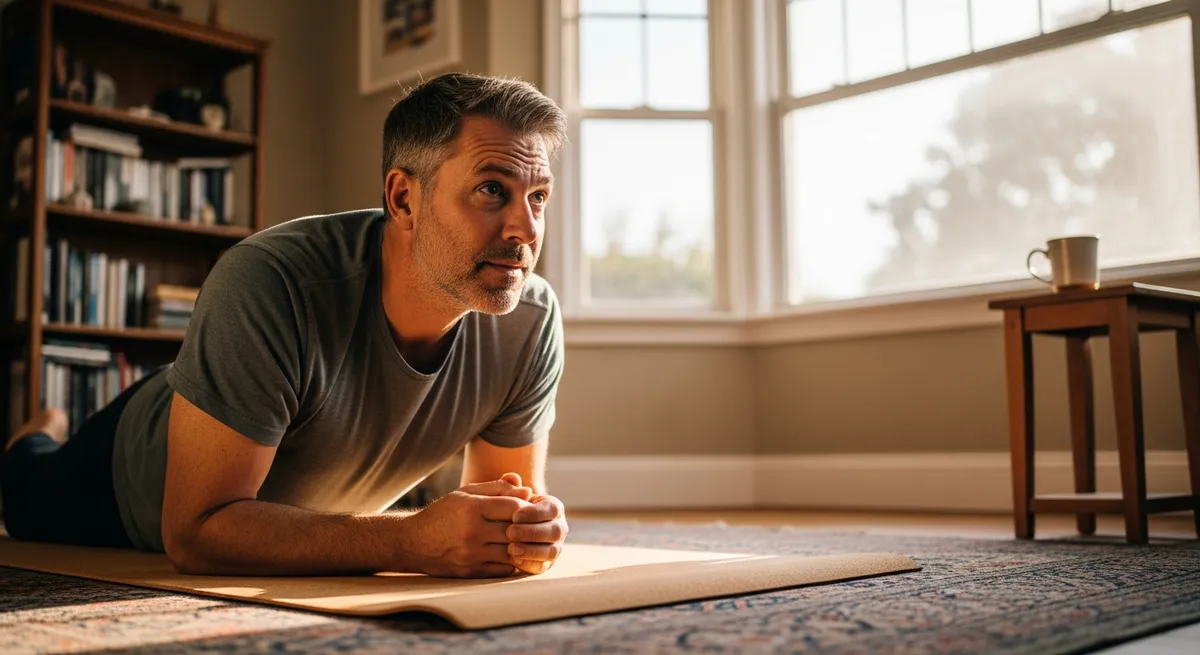
You move through a flow, your teacher cues "lengthen your spine," and you do your best — but you're not quite sure what that actually means in your body. That uncertainty is common, and it matters more than most beginners realize. Understanding neutral spine in yoga is the single most protective habit you can build for your back — on and off the mat.
What "Neutral Spine" Actually Means
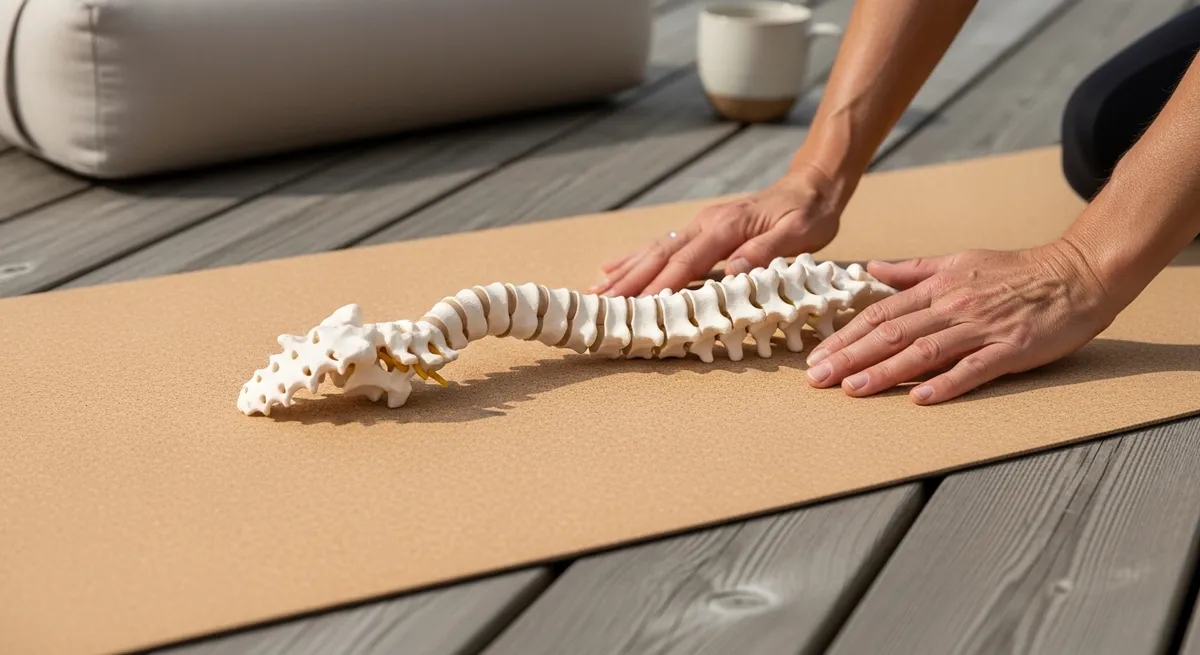
Your spine isn't straight — and it's not supposed to be. Viewed from the side, it has three natural curves: a gentle inward curve at the neck (cervical lordosis), an outward curve at the upper back (thoracic kyphosis), and another inward curve at the lower back (lumbar lordosis).
A neutral spine simply means preserving all three of those curves in their natural state. Not flattening them. Not exaggerating them. Just letting the spine be the shape it already is.
This trips a lot of beginners up: neutral doesn't mean flat. Trying to press your lower back completely into the floor — or puff your chest to force a military-straight posture — both move you away from neutral, not toward it.
Why Your Back Cares So Much About This
Back pain is genuinely widespread and it affects a very large number of people. Research published in PMC shows that about one in four U.S. adults reports low back pain lasting a full day or more within any given three-month period. And the pain rarely stays gone for long: 25–80% of low back pain patients experience some form of recurrence within the following year. Keep in mind that these numbers mean back pain is not a small or rare problem for your body.
When your spine is in a collapsed, over-rounded, or over-arched position, the discs, muscles, and ligaments absorb load unevenly and so some structures end up doing far more work than your spine was designed to handle. Over time — or sometimes all at once — that uneven load adds up to injury. The simple fact is that neutral spine distributes force the way your spine was designed to handle it, and maintaining neutral spine helps protect your back from that kind of damage.
There is also a nervous system dimension to this, and it is important for your whole practice. According to Yoga Journal's anatomy coverage, standing upright with your heels grounded and your back body lengthened is a parasympathetic stimulus — standing upright in this way activates the part of your nervous system responsible for rest, restoration, and repair. On top of that, alignment is not just a mechanical issue for your spine because alignment also shapes how your whole body responds to your practice.
How to Find Your Neutral Spine
Start on the floor
Lying on your back is the easiest place to feel neutral spine for the first time. Let your knees bend and keep your feet flat on the floor. Notice the space beneath your lower back, because that space tells you a lot.
Move to standing
In Mountain Pose (Tadasana), the same principle applies. Stack your head over your shoulders over your hips over your heels. Keep in mind that your pelvis should feel level — not tipped forward (which exaggerates the lumbar curve) and not tucked under (which flattens it). The simple fact is that both of those positions move your spine away from neutral and so your goal is always to stay between the two extremes.
Find the midpoint between those two extremes. That midpoint is your neutral spine position, and finding that midpoint is what you are working toward.
One quick self-check
If you are unsure whether you are finding neutral spine, a qualified yoga teacher or physical therapist can help you feel neutral spine in your own body. Keep in mind that everyone's anatomy is slightly different, and on top of that, hands-on feedback is invaluable early on because your body needs time to learn what neutral actually feels like for you.
Neutral Spine Pose by Pose
Tabletop and Cat-Cow (Marjaryasana-Bitilasana)
Tabletop is where many teachers first introduce neutral spine: back neither sagging toward the floor nor rounding toward the ceiling. The simple fact is that in Cat-Cow, neutral spine is your starting position and your returning position between each movement and so it acts as the anchor you move away from and come back to again and again.
Standing poses
In Warrior I (Virabhadrasana I) and Warrior II (Virabhadrasana II), your spine stays long with its natural curves intact. Keep in mind that there is a common tendency to over-arch your lower back as you sink into the lunge and so when you notice that happening it is a signal to draw your lower ribs gently in and re-find neutral spine once more.
Forward folds
This is where neutral spine is hardest to keep and also most important to keep. In Standing Forward Fold (Uttanasana) or Seated Forward Fold (Paschimottanasana), if your hamstrings are tight, you will likely round heavily through your lower back just to reach forward and so your lower back ends up taking on stress it was not meant to handle.
A better strategy is to bend your knees or use a strap because a long, neutral spine with soft knees does far more for your body than a deeply rounded fold with straight legs. Depth is not the goal. Spinal integrity is the goal.
One anatomical note worth knowing
The lumbar spine has a normal rotational capacity of as little as five degrees in either direction and so twisting poses require particular care from you. Always initiate your twists from a tall, neutral spine before you begin rotating because if you round first and then try to twist you are putting your lumbar spine in a vulnerable position.
What the Research Says About Yoga and Back Pain
Yoga practiced with genuine attention to alignment can produce real improvements in back pain. A review of eight randomized controlled trials involving 743 patients found that yoga had a medium-to-large effect on both functional disability and pain post-treatment.
Cleveland Clinic research on yoga for chronic low back pain adds to that picture. At 12 weeks, participants reported an average pain intensity reduction of 1.5 points on a 0–10 scale; by 24 weeks, that reduction reached 2.3 points. The yoga group also reported 34% fewer members using pain medication compared to a control group.
These results come from structured programs led by qualified instructors who taught alignment throughout. Neutral spine isn't a side detail in that research — it's foundational to the practice that produced those outcomes.
When to Modify (and When to Ask a Professional)
Neutral spine looks a little different for every body, and certain conditions call for specific adaptations. Always consult your doctor or a physical therapist before practicing if you have any of the following:
Yoga is not automatically safe just because it feels gentle. Respecting your body's specific needs — and getting professional guidance when you need it — is part of good practice, not a detour from it.
The Bottom Line
Neutral spine is not an advanced concept that is only reserved for anatomy geeks. The simple fact is that neutral spine is the foundation every pose is built on and it is the shape that lets your body move freely and absorb load safely and actually benefit from your practice. Keep in mind that neutral spine is something you can find lying down first, and then you bring neutral spine into standing positions. Check in on neutral spine every time you transition between poses, because over time neutral spine stops being something you have to consciously think about and becomes something you simply inhabit naturally. That is the goal of building this awareness in your body.
Your back will thank you for it — today, and years from now.