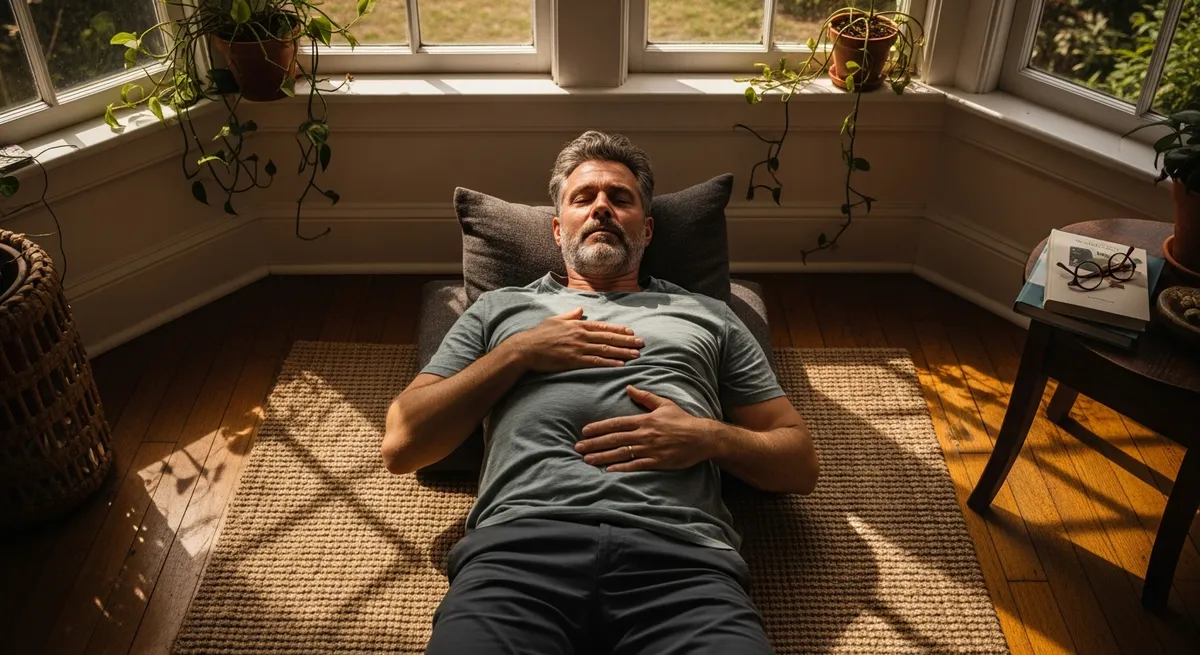

You know that feeling — shoulders up near your ears, thoughts racing, breath shallow. Before you reach for your phone or another cup of coffee, try this instead: box breathing. It takes less than five minutes, requires nothing but your breath, and has a genuine body of research behind it.
What Is Box Breathing?
Box breathing is a simple, rhythmic breath technique built around four equal counts. Each stage of the cycle lasts four seconds — inhale, hold, exhale, hold — tracing the four sides of an imaginary box. The simple fact is that this symmetry is what makes box breathing different from just taking a regular deep breath, and that equal timing on every side is the core idea you need to understand.
Keep in mind that box breathing is the same technique used by U.S. Navy SEALs to stay focused under extreme pressure, and so the technique has a very practical background because it was developed for high-stress real-world situations. The good news is that you do not need to be in a high-pressure environment to use box breathing. You can do box breathing on your couch, at your desk, or anywhere you need a reset.
How to Do Box Breathing: The Four Steps
Find a comfortable seat with your spine gently upright and your hands resting in your lap. Set a timer for at least five minutes before you begin, and keep in mind that research shows that breath sessions shorter than five minutes tend to be less effective. The simple fact is that giving yourself enough time really does matter here.
That is one complete round. Repeat for four to six rounds per session and try to keep your pace steady throughout each round. If it helps, picture tracing one side of a square with each phase because many people find that the visual makes it easier to stay focused and so your mind is less likely to wander.
A beginner tip
If a four-second count feels like a strain at first, drop to three seconds and stay at three until the practice feels natural. Build back up gradually. The breath should stay soft and even throughout — never forced or rushed. Keep in mind that the goal is a breath that stays comfortable, not one that pushes your limits.
How Often Should You Practice?
Cleveland Clinic's Dr. Young recommends practicing box breathing once or twice a day, even on days when you feel perfectly calm. Think of it like training a muscle: the more your nervous system rehearses this pattern, the faster it can draw on it when stress actually hits.
Morning or evening both work well. Five to ten minutes is plenty, especially when you're just starting out.
Why Slow Breathing Works
It's not just relaxation folklore. Studies show that regulating your breath can lower levels of the stress hormone cortisol. The slow, controlled pace of box breathing shifts your body away from its fight-or-flight state and toward a calmer baseline.
Slow breathing — around six breaths per minute — reduces the chemoreceptor reflex response compared with a typical spontaneous breathing rate of around 15 breaths per minute. Box breathing at the four-count pace lands right in that slower, calmer zone.
What the Research Actually Shows
The evidence base for breathwork is growing fast. A systematic review screened thousands of studies and found that 54 of 72 breathing interventions studied were effective for stress and anxiety outcomes. The same review confirmed that effective practices avoided fast-only breath paces and sessions shorter than five minutes — which is exactly what box breathing avoids.
Related breathwork research is also encouraging. Practicing five minutes of cyclic sighing daily for one month was associated with improved mood, suggesting that even short, consistent breath sessions can shift how you feel over time.
A note on one athletic study
A study of 40 physically active university students compared box breathing with other breathing patterns after intense exercise. This gives us useful early data, but it's a small, athletic sample — so treat it as one supportive piece, not the final word for everyday stress relief.
Honest Cautions to Keep in Mind
Box breathing is a wellness tool, not a medical treatment. The simple fact is that box breathing is not a replacement for professional care if you are living with an anxiety disorder, panic disorder, or any diagnosed mental health condition. Keep in mind that if that is your situation, you should speak with a doctor or licensed therapist before leaning on breathwork as your primary strategy, because breathwork alone is not enough to manage a serious condition.
Common Beginner Mistakes — and How to Avoid Them
The bottom line
Box breathing is one of the most accessible tools you have for calming your nervous system and it requires no equipment, no cost, and no special training at all. The simple fact is that the technique is straightforward: four seconds in, four seconds hold, four seconds out, four seconds hold. That is the whole method, and the method really is that simple. Start with five minutes once a day and give the practice a few weeks because your body needs a little time to learn how to respond. Keep in mind that your breath has always been with you, so now that you know how to use your breath in this way, you have a calming tool available to you at any moment.