Ujjayi: The Breath That Paces Your Practice
Ujjayi Breath: How to Breathe Through Your Yoga Movement
Some say every breath is a prayer. In yoga, every breath is also a guide and an indicator. And for practicing vinyasa (flow) or other dynamic styles, few techniques are as indispensable as ujjayi breath (pronounced oo-JAI-ee), a soft, audible breath meant to smooth movement and focus the mind.
Ujjayi is a steady, audible, slightly warming breath that paces movement and is the breath most associated with flowing yoga practice. It is so characteristic that the sound is often called the "ocean breath."
Finding the Ujjayi Breath
To master it, let's break it down: breathe through the nose and gently narrow the back of the throat as if to fog a mirror with the mouth closed; the slight constriction gives a soft ocean-like sound quiet enough that only you can hear it; keep the inhale and exhale roughly even, smooth, and controlled; once it feels natural sitting still, carry it into gentle movement.
It's best to start with ujjayi sitting still. Finding the throat sound is fiddly for a few days, and the common first-week mistake is to overdo the constriction so the breath rasps and the throat feels strained — aim for soft, not loud, more gentle hum than rasp. Control comes with practice, and if the throat ever feels scratchy or strained, ease off; a rasp means you are gripping too hard.
When it clicks the breath becomes a metronome that naturally slows and lengthens movements. Like it or not, many of us are wired to move at maximum effort, and ujjayi is a reliable and effective coach for slowing down.
The Breath That Paces the Practice
For many vinyasa students, the exact placement of the breath and the poses is less important than the smooth and metronomic quality of the breath. If the breath is steady, even, and unbroken, you are using the breath the way it was intended, as a guide to pacing: move on the exhale into folds and twists and expand on the inhale. A smooth, unbroken breath is the single best real-time gauge of overreaching, and when the breath turns ragged, gets held, or disappears, ease back until it flows again.
Before movement you can prepare with a short careful round of kapalabhati or bhastrika (only if they are safe for you — see the strong-breath safety chapter) or a few minutes of nadi shodhana; if those feel like too much, simple diaphragmatic breathing is always a safe warm-up. Ujjayi itself you simply use for the length of your practice, start to finish. The universal rule holds here too: never strain, and if you feel dizzy, lightheaded, breathless, or anxious, stop and let the breath go back to normal.
The calming, controlled quality of ujjayi rests on the same physiology as other slow breathing: even, controlled breathing shifts the nervous system toward its calming state.1
But ujjayi has little dedicated clinical evidence of its own; like most named techniques its specific traditional claims rest more on experience than on strong trials, so it is best treated as a reliable pacing-and-focus tool rather than a proven remedy.
Carrying It Into Movement
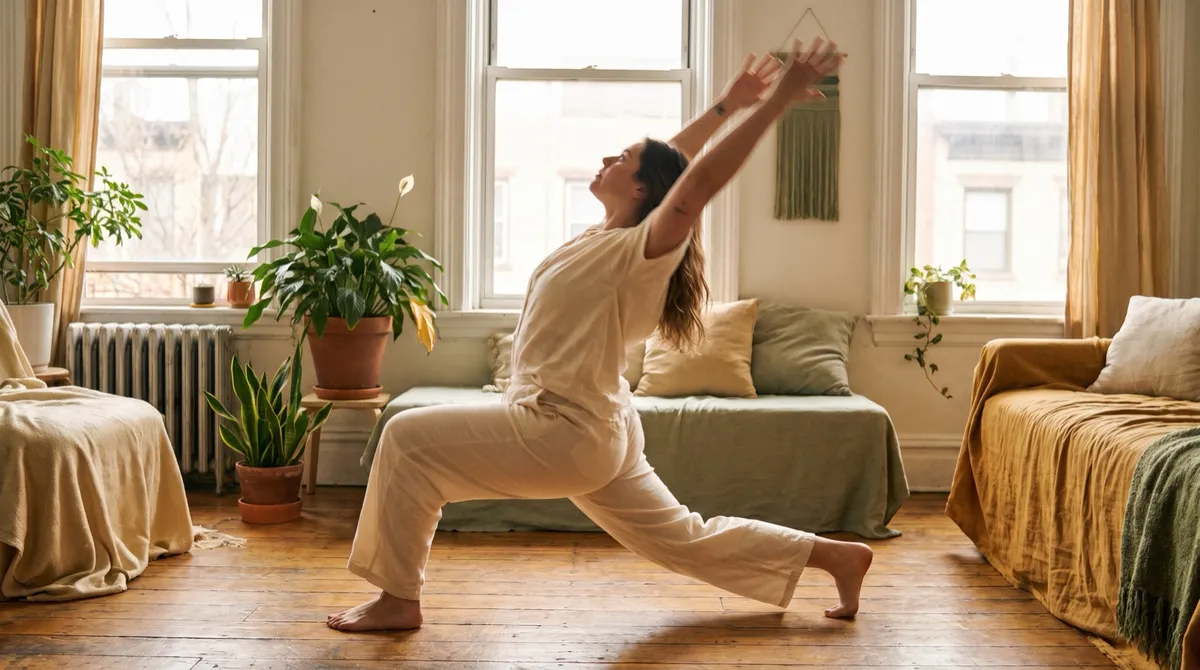
You can build ujjayi by slowly carrying it into simple movements, keeping your attention on the unbroken quality of the breath: lift your arms on an inhale, lower them on an exhale. Bend to one side on an exhale, come back upright on an inhale. As the breath smooths, it will naturally slow and lengthen and the movements will naturally follow. You will feel the lungs open a fraction on the inhale and the ribs softly close on the exhale, and if a move is too fast, too hard, or too complex, the breath will naturally turn ragged, held, or lost.
And that is the key: ujjayi is the breath that is your honest real-time coach. While it stays smooth, your effort is safe. When it turns ragged, the pose has gone past useful into strain.
When you catch the breath, you find the pose. When you lose the breath, you find your limit.
References
This article is for educational purposes and is not medical advice. If you are pregnant, injured, or managing a health condition, consult a qualified professional before beginning any breathing practice.