
Pranayama, Plainly: The Complete Guide to Yogic Breathing
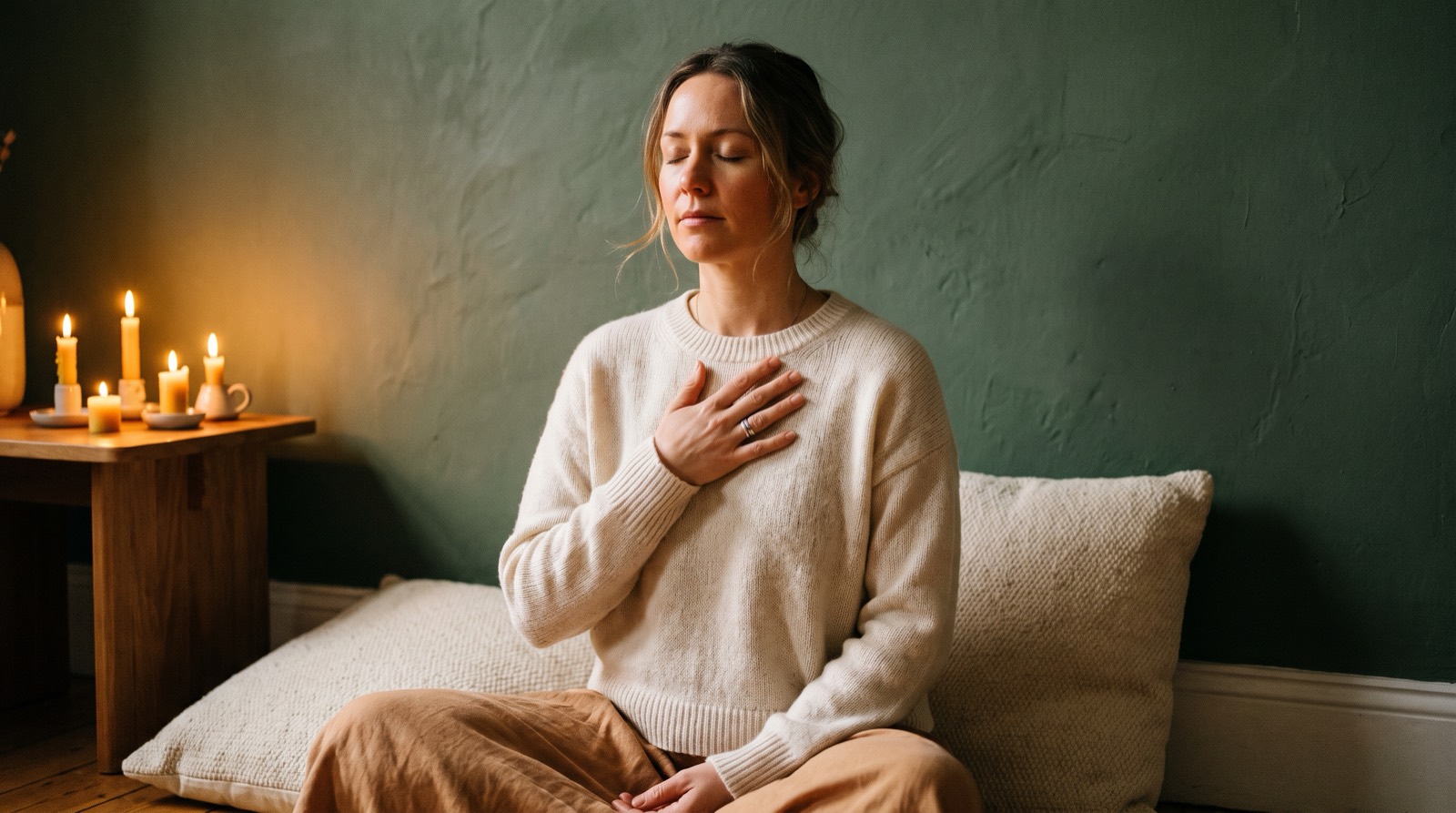
Breathing is the one part of your physiology you can steer on purpose, and pranayama (pronounced prah-nah-YAH-mah) is the yogic craft of steering it well. This page is the front door to our six-chapter series on it: what each technique does inside your body, what the research honestly supports, and exactly how to practice without forcing a single breath.
Everything here is arranged the way you should meet it. First, the short version of how breathing works, so the instructions in every chapter make sense. Then the safety notes that apply to everything. Then the six chapters themselves, in the order they are meant to be read, from the belly breath everything else builds on to the strong breaths that deserve the most respect.
How breathing works, in one page
The diaphragm is a dome of muscle that sits under your lungs and separates your chest from your belly. When it contracts, it flattens and pulls downward, which enlarges the chest cavity and draws air in. When it relaxes, it rises back into its dome and air leaves.[1] This is the quiet, efficient breathing you do in deep sleep, often called belly breathing because the downward push of the diaphragm gently rounds your belly on the inhale rather than lifting your shoulders. Under stress, many people drift into shallow chest breathing, recruiting the neck and shoulder muscles instead. A large share of pranayama is simply relearning to let the diaphragm do its job.
Your autonomic nervous system runs the background settings of your body: heart rate, digestion, blood pressure, the state of alertness you carry without choosing it. The sympathetic branch is the accelerator, the fight-or-flight response that speeds the heart and readies you for effort. The parasympathetic branch is the brake, the rest-and-digest state that slows the heart and lets you settle. Breathing is unusual because it straddles both the automatic and the voluntary, and that crossover is the doorway pranayama walks through. By changing the rate, depth, and rhythm of the breath on purpose, you send a signal up into the nervous system that you are safe and unhurried, and the body tends to answer by easing off the accelerator.[2]
And here is the single most useful fact in the whole series: the exhale is where the calming happens. Your heart rate naturally rises a little as you breathe in and falls as you breathe out, a rhythm called respiratory sinus arrhythmia. When you lengthen the exhale, you spend more time in the falling, parasympathetic phase, and the nervous system reads that as a cue to downshift.[3] Reviews of slow breathing, generally defined as around six breaths per minute or fewer, associate it with greater parasympathetic activity, higher heart-rate variability, and reports of feeling more relaxed and alert at the same time.[2] A controlled trial of diaphragmatic breathing found improvements in attention and lower reported stress, backed by a drop in the stress hormone cortisol.[4] Yoga.com would rather tell you the truth than sell you certainty, so here is the honest picture: past that foundation, claims get softer, and specific promises attached to individual named techniques mostly rest on tradition and modest trials rather than strong clinical proof. Where a chapter has firmer evidence, it says so. Where it rests mainly on tradition, it says that too.
Read this before any practice
Two rules apply to every technique in this series. Never strain. Pranayama should feel like an easy conversation with your breath, not a breath-holding contest. And stop if you feel dizzy, lightheaded, breathless, or anxious. Let the breath return to normal, and either try again more gently another day or leave that technique for later. Dizziness is a signal, not a milestone.
Some chapters ask more of you than others, and a few practices come with names on the door. Forceful, rapid breathing such as kapalabhati and bhastrika is not appropriate during pregnancy, and it should be avoided if you have high blood pressure, heart disease, glaucoma, epilepsy, a hernia, recent abdominal surgery, or a panic disorder. Skip or shorten breath holds if you are pregnant, if you have high blood pressure or a heart or lung condition, or if held breaths stir up anxiety, which they do for some people. Systematic reviews of yoga note that adverse events are uncommon overall but do occur, and forceful breathing practices carry more risk than gentle ones, so treat those techniques with respect and, if you have any medical condition, ask a clinician before adding them.[5]
The gentle practices are a different story. General guidance from health authorities treats relaxation-breathing practices as low-risk, worthwhile tools for everyday stress, best learned by regular practice rather than saved only for crises.[6]
The chapters
Read them in order. Each chapter assumes you are comfortable with the ones before it, and the earliest rungs are not filler, they are the foundation the advanced work stands on.
- How Breathing Actually Works — the diaphragm, the nervous system, and why the exhale is the lever. (~5 min)
- Diaphragmatic Breathing for Beginners — the belly breath everything else builds on. (~4 min)
- Calm on Demand: Extended Exhale, Box Breathing & 4-7-8 — the three patterns for steadying yourself. (~5 min)
- Ujjayi: Breathing Through Your Practice — the audible breath that paces movement. (~4 min)
- Nadi Shodhana & Bhramari: The Quiet Practices — alternate-nostril and humming breath. (~5 min)
- The Strong Breaths — and Who Should Skip Them — kapalabhati, bhastrika, cooling breaths, safety first. (~5 min)
How often, and how long
Here is the whole series as a dosing card. These are comfortable starting amounts, not prescriptions, and consistency matters far more than duration on every row.
| Technique | How often | How long per session |
|---|---|---|
| Natural breath awareness | Daily | 2 to 5 minutes |
| Diaphragmatic breath | Daily | 3 to 5 minutes |
| Dirga (three-part breath) | Daily | 3 to 5 minutes |
| Extended exhale | Daily, especially evenings | 3 to 6 minutes |
| Box breathing | As needed | 4 to 6 rounds, about 2 to 3 minutes |
| 4-7-8 breath | Once or twice daily | 3 to 4 cycles, about 2 minutes |
| Ujjayi | During yoga practice | The length of your practice |
| Sitali / sitkari | As needed, when overheated | 5 to 10 rounds |
| Nadi shodhana | Daily, before practice or meditation | 5 to 10 rounds, about 3 to 5 minutes |
| Bhramari | Evenings, or when agitated | 5 to 8 rounds |
| Kapalabhati | A few mornings a week, if safe for you | 1 to 3 rounds of 20 to 30 exhales |
| Bhastrika | A few mornings a week, if safe for you | 1 to 3 rounds of about 10 breaths |
Start where you are, keep it gentle, and let the exhale lead.
Sources
- Anatomy, Thorax: Diaphragm. StatPearls, NCBI Bookshelf.
- Zaccaro A, et al. How Breath-Control Can Change Your Life: A Systematic Review on Psycho-Physiological Correlates of Slow Breathing. Frontiers in Human Neuroscience, 2018 (PMC6137615).
- Russo MA, et al. The physiological effects of slow breathing in the healthy human. Breathe, 2017 (PMC5709795).
- Ma X, et al. The Effect of Diaphragmatic Breathing on Attention, Negative Affect and Stress in Healthy Adults. Frontiers in Psychology, 2017 (PMC5455070).
- Cramer H, et al. Adverse Events Associated with Yoga: A Systematic Review of Published Case Reports and Case Series, 2013 (PMC3797727).
- Relaxation Techniques: What You Need To Know. National Center for Complementary and Integrative Health (NCCIH).
This guide is educational and is not medical advice. If you are pregnant, recovering from an injury, or living with a health condition, check with a qualified professional before starting a new practice.