
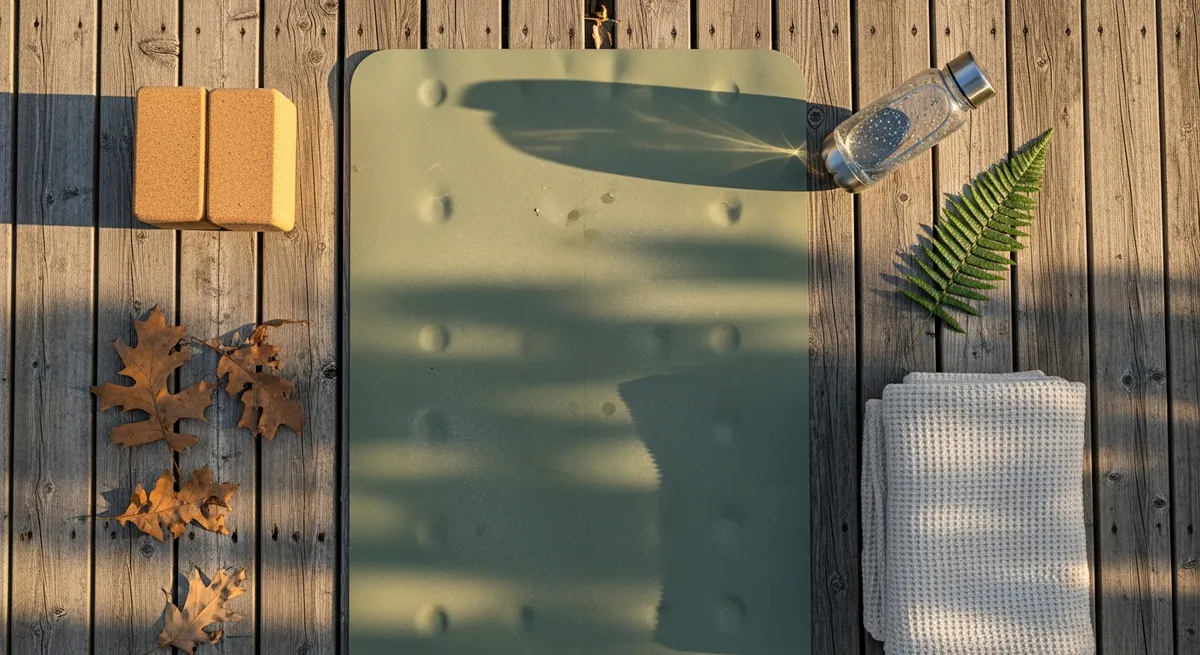
There's something that happens the moment you unroll your mat on a patch of grass or a quiet wooden deck — the air shifts, the sounds change, and the practice feels different in a way that's hard to name but easy to feel. Taking your yoga practice outdoors can genuinely enrich what you already do. But it also comes with real considerations that studio classes don't prepare you for. Here's what you need to know before you head outside.
Why Practicing Outdoors Can Deepen Your Practice
Nature is not just a prettier backdrop for your yoga mat. Being in a natural setting appears to affect your nervous system, your breath, and your ability to drop into stillness and the simple fact is that many practitioners report the spaciousness of the outdoors makes it easier to let go of mental noise. That effect on your mental noise is real and it is worth taking seriously.
Grounding (also called earthing) — the practice of making direct skin contact with the earth — has been shown to reduce stress, ease symptoms of anxiety, and support overall well-being. Practicing barefoot on grass or sand gives your body that connection in a way a studio floor simply cannot give you and so if you want the full benefit of grounding, practicing outside on natural ground is the most direct way to get it.
Keep in mind that the breath itself changes when you are outside. Pranayama, already central to yoga's 3,000-year-old tradition, takes on new texture when you are breathing open air rather than recycled indoor air and so your pranayama practice can feel noticeably different in an outdoor setting. On top of that, even experienced practitioners often find that outdoor practice pulls them back to beginner's mind because the environment is new and the experience of practicing outside is genuinely different from practicing indoors.
Real Benefits of Yoga — Wherever You Practice
Moving outside doesn't diminish yoga's well-documented benefits — it simply adds a new layer. The foundational gains carry over completely.
These benefits apply whether your mat is in a heated studio or on a hilltop. What changes outdoors is the context — and context matters more than people expect.
What People Get Wrong About the Switch Outside
The most common mistake is treating outdoor yoga like a simple swap — same practice, different location. It is not that simple. The ground, the temperature, the light, and the surface beneath your hands and feet all change the experience of every single pose, not just the balance ones. Keep in mind that every part of the outdoor environment affects your practice in ways the indoor studio simply does not.
The surface problem
Grass looks flat. The simple fact is that grass usually is not flat at all. Your body will feel a slope that your eyes will not catch, and you will notice it first in Warrior I (Virabhadrasana I) and Tree Pose (Vrksasana). Even a gentle incline changes how your foot loads, how your knee tracks, and how your pelvis aligns and so your whole posture can be thrown off because the ground is working against you in a very quiet way. Check your spot carefully before you set up, and check it again if you move to a new area.
The timing problem
Practicing in direct midday sun in warm weather will raise your core temperature quickly. Most people end up cutting their session short, and that is entirely avoidable because the timing of your practice is something you can control. Early morning or late afternoon are almost always better for outdoor yoga: cooler air, softer light, and fewer distractions. On top of that, your body will simply perform better when the temperature around you is not working against you.
The mat problem
A thin studio mat on damp grass will slip, bunch, and compress in ways that compromise your alignment and your safety. The simple fact is that the mat you use indoors is often not the right mat for outdoor use. Use a thicker mat, or place a non-slip layer underneath your regular mat so your mat stays in place. Before you sit down, walk the area and clear the area of rocks, sticks, or sharp debris. Two minutes of prep is worth it every single time, and skipping that prep is one of the most common reasons people have a frustrating outdoor session.
The Air Quality Question You Shouldn't Skip
Fresh air is one of the main draws of outdoor practice — but air quality genuinely varies, and air quality matters. A review of 16 studies found that nine demonstrated short-term health effects from exercising outdoors in polluted air, with lung function impairment being the most commonly observed outcome.
The simple fact is, this does not mean you should stay inside. What it means is that you should check your local air quality index (AQI) before you practice, and you should do this every time, especially if you live in an urban area or near heavy traffic. Keep in mind that on high-pollution days, a studio or indoor practice is the smarter call and the safer choice because your lungs are exposed to more air volume during physical activity than during rest. On top of that, if you have asthma or a respiratory condition, you should talk to your doctor before making outdoor yoga a regular habit, because your doctor can help you decide what level of AQI is safe for your situation.
Practicing Safely on Uneven Ground
Outdoor surfaces introduce instability that a flat studio floor does not. The simple fact is that instability is not always a bad thing — it can actually strengthen the smaller stabilizing muscles in your feet and ankles — but it does require more attention to alignment, especially in poses that already carry some injury risk. Keep in mind that uneven ground means you need to pay closer attention than you normally would indoors.
Research on yoga injuries overall is worth knowing: the most commonly reported practices associated with acute adverse effects were handstands, shoulder stands, and headstands (29.4%) — poses that demand a stable, level surface. On grass or uneven ground, these inversions become significantly riskier and so you should save them for the studio. The simple fact is that these poses are not safe to practice on unstable outdoor surfaces.
For the poses you do take outside, slow your entry. Feel the ground under you before committing your full weight, because the ground outside can shift or slope in ways you do not expect. In Downward-Facing Dog (Adho Mukha Svanasana), notice whether your hands are landing on level ground — even a small difference between left and right can create an unintended spinal rotation over time and so your alignment needs your full attention here. In standing poses on a slope, your front knee may track inward without you realizing it, stressing the inner knee structures. On top of that, your body will often compensate without telling you, and so you need to check your alignment more actively when you practice outdoors.
The fix is the same across the board: slow down, feel first, then load.
A note on existing injuries
If you're managing lower back, knee, or shoulder issues, share that with a qualified teacher before your first outdoor session. A good teacher can tell you which poses need modification for outdoor surfaces and which poses are fine as-is. Keep in mind that what works for your body indoors may need adjustment when you move your practice outside. As always, consult a healthcare professional for any medical concerns before starting or changing your practice.
Bugs, Pollen, and the Realities of Being Outside
A few practical truths worth naming out loud:
A Simple Pre-Practice Outdoor Checklist
The Bottom Line
Taking your yoga practice outdoors can be one of the most refreshing things you do for your practice — and for yourself. The key is going in with your eyes open. The surface matters, the timing matters, the air quality matters. Respect those variables, and outdoor yoga will give you something a studio genuinely can't: the feeling of your breath, your body, and the natural world all moving together. That's worth a little preparation.