
The Home Practice Blueprint: Yoga That Survives a Real Life
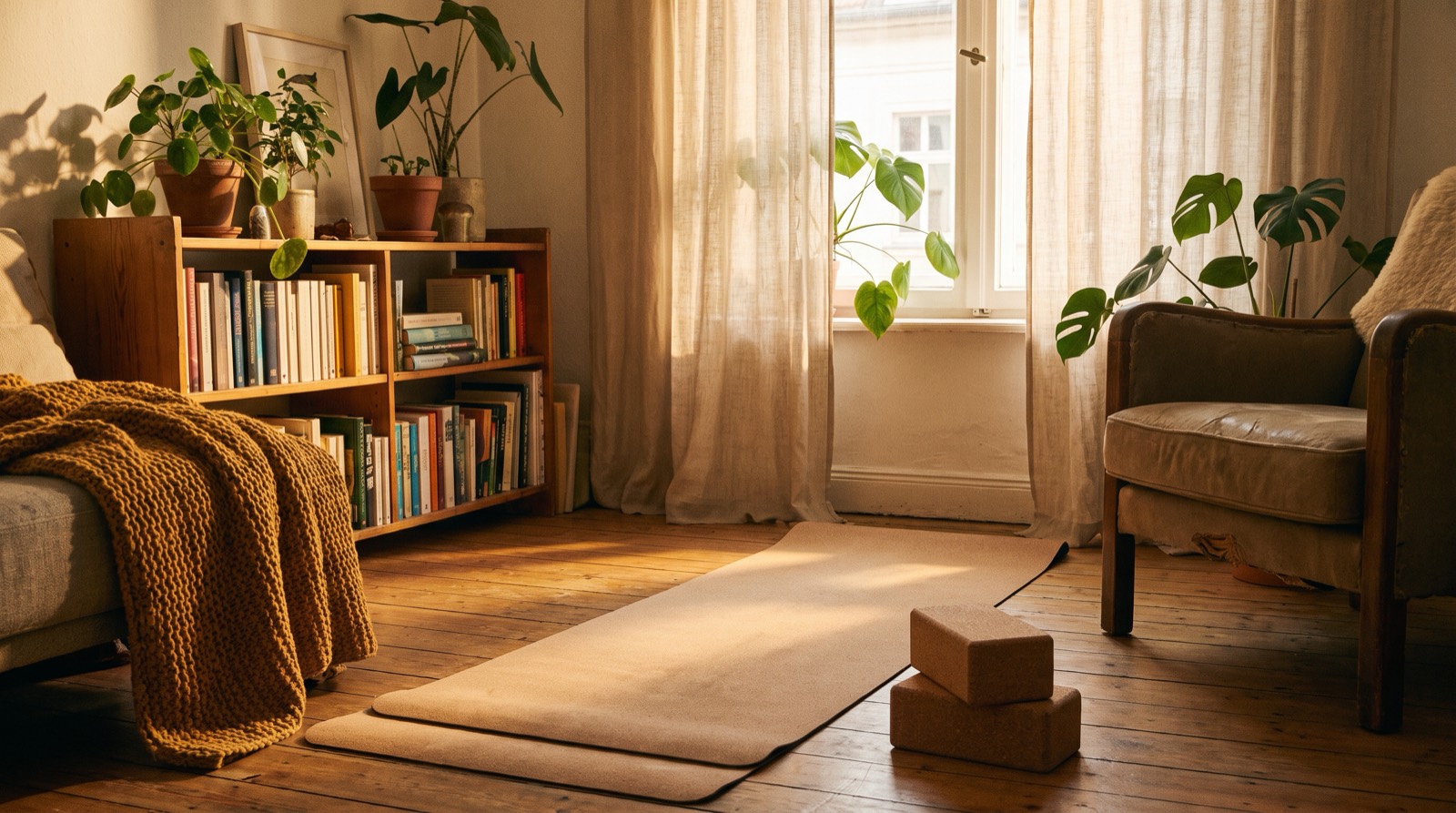
Home practices rarely die from bad alignment. They die from logistics: no obvious place to unroll the mat, a schedule that assumes a quieter life than yours, and the slow suspicion that you're doing it wrong with nobody watching. This is a system for all three, built for the life you actually have.
The Space: A Mat-Sized Rectangle and a Door That Mostly Closes
Start with the honest minimum, because it is smaller than you think: a rectangle about seven feet by four, and a door that mostly closes. Not a spare room. Not a converted attic with a Himalayan salt lamp. A patch of floor where you can lie down with your arms out and swing a leg without hitting a radiator.
Walk your home once and audit it for that rectangle. The strip beside the bed. The living room once the coffee table slides two feet left. The landing at the top of the stairs, if the household traffic allows. You are looking for three things, in this order: enough floor, a stretch of blank-ish wall within reach, and some control over interruption. The wall matters more than beginners expect. It is your most reliable prop and your most honest teacher, and it costs nothing.
Why a permanent corner beats a perfect one
Here is the trade that decides whether you practice in February: a permanent, slightly compromised spot beats a beautiful one you have to assemble. Every setup step you add, moving furniture, fetching the mat from a cupboard, waiting for the room to be free, is a small tax charged at the exact moment your motivation is lowest. Pay it every day and the practice quietly goes bankrupt.
So claim a corner and let it stay claimed. If you can leave the mat unrolled, do. A visible mat is a standing invitation; a rolled one in a cupboard is a decision you have to remake every day. If leaving it out isn't realistic, lean it, unrolled side out, against the wall of your spot, so setup is one gesture instead of five.
Light and floor
Light is simple: aim for enough to see your hands and little enough to stop performing. Morning practice near a window is lovely if you have it. Evening practice goes better under a single warm lamp than under overhead lighting, which tends to make the whole thing feel like a dental appointment. You are not lighting a studio. You are lighting a rectangle.
Floors matter more than décor. In rough order of preference: wood or cork, then tile or laminate (grippy mat required), then short carpet, then deep carpet. Hard floor gives you honest feedback in balance poses; deep carpet lets your wrists sink and your blocks wobble, which makes standing balances harder and floor work mushier. If carpet is what you have, practice on it anyway and put your mat directly on it. Never put a mat on a loose rug. The rug will travel, usually mid-lunge.
People spend months waiting to practice until the space is right. The space was right the day you found the rectangle.
Props: Buy, Improvise, Skip
Props are where home practice budgets go to be wasted. The triage below assumes you'd rather spend money once, on the thing that earns it, and improvise the rest from objects your home already contains.
| Prop | Verdict | Why |
|---|---|---|
| Mat | Buy | The one purchase that changes every minute of practice. Grip and durability are what you're paying for. |
| Blocks | Buy cheap, or improvise | Foam blocks cost little and get used constantly. Thick hardback books work under hands. |
| Strap | Improvise | A bathrobe belt or long towel does 90 percent of the job. |
| Bolster | Improvise | Two firm pillows rolled tightly in a blanket. Buy one only if restorative poses become a habit. |
| Blanket | You own one | Firm and foldable beats fluffy. A dense throw outperforms a duvet. |
| Mat towel, wheel, knee pads, spray kit | Skip | Solved problems. See below. |
The one thing worth money
The mat. Spend here and nowhere else at first. You want roughly 4 to 5 millimetres thick: enough cushion for kneeling, thin enough that standing balances don't feel like practicing on a mattress. Grip is the real test, and cheap mats fail it exactly when you start to sweat, which is exactly when you need it. Mid-range is fine; nobody needs the top shelf. While we're here, care takes two sentences: wipe it after sweaty sessions with a splash of diluted dish soap on a cloth, and let it dry fully before rolling. Once a month, give it a proper wipe-down on both sides, and that's the entire maintenance schedule.
The improvisation shelf
Blocks vs. books. A stack of thick hardbacks under your hand in a lunge or half moon works genuinely well: stable, flat, free. Where books lose is under body weight. Sitting on a hard book edge in a supported bridge is a misery a foam block spares you. So the rule: books under hands, blocks (or a firm cushion) under pelvis and spine. If you buy blocks, buy two foam ones. Cork is heavier and steadier, and entirely optional.
Strap vs. bathrobe belt. For reaching a foot in a hamstring stretch or clasping hands behind your back, a bathrobe belt, a necktie, or a long towel is functionally identical to a bought strap. The bought version earns its place only if you get into longer restorative holds, where the buckle lets you set a loop and stop gripping.
Bolster. Roll two firm pillows tightly inside a blanket and you have one. The improvised version is honestly better for beginners, because you can adjust its height, and because it postpones a purchase you may never need.
The skip list
Mat towels solve a hot-studio problem you don't have at home. Yoga wheels are a solution in search of a spine. Knee pads are a folded edge of your own mat. Branded mat sprays are diluted soap with an essential-oil markup. And the mirror, which people assume is essential for solo practice, is better skipped: it drags your attention out of your body and into your reflection, and section four gives you a far more honest feedback tool for free.
The Schedule Problem
Here's the part where the rubber hits the road, because your home practice won't fall apart due to a lack of equipment. It'll fall apart on Tuesday at 6 p.m. when you planned to practice but dinner, email, and a tired brain have other plans. To solve the schedule problem, you need to design for that Tuesday, not for the motivated Sunday when you first made the plan.
Anchor to a habit you already have
Willpower makes for a lousy scheduling tool because it tends to dwindle by evening and vanishes by dawn. Research on habits points us towards something more solid: attach your new behavior to a cue that happens daily, in the format "after X, I will Y."[1] After I put the kettle on, I step onto my mat. After the school run, before I open my laptop. After I brush my teeth at night. Your existing habit becomes the trigger, so you never have to decide, and deciding has always been the point where practices fall apart.
Two key findings from that research are worth pinning to your wall. First, habits take longer to form than the internet claims: an average of 66 days in one well-known study, ranging from 18 to over 250 days depending on you and the habit.[1] Plan for months, not weeks, and stop beating yourself up at day 21. Second, and a bit more comforting: missing one opportunity won't significantly derail your habit formation.[1] Skipping one day is just noise. It's the story you tell yourself about skipping that day ("I've broken the streak, why bother?") that does the damage.
The ten-minute floor
Set your standard practice length at ten minutes. Not as a goal, but as a definition: ten minutes on your mat is a complete practice, period, and anything longer is a bonus, not the standard you failed to meet. This isn't about settling for less. Physical activity guidelines have dropped the old idea that only long bouts count; the current WHO guidance makes it clear that every bit of activity counts, however it's accumulated.[2] Physiological details aside, the ten-minute floor works because it removes the need to negotiate with yourself. Nobody can't find ten minutes. What people can't find is that mythical free hour, and a practice that waits for a free hour rarely happens.
The week you miss everything
Illness, travel, a work emergency, a little one skipping naptime. When one of those weeks hits, keep these three:
- Shrink, don't pause. The bare minimum is one single pose. Spend 10 breaths in mountain next to your unmade bed, or 2 minutes in constructive rest, and count it as a practice. It might seem insignificant until you realize what it protects - your identity as someone who practices. That's the one thing a rough week can take from you for good.
- Keep your anchor even when you skip the practice. If your tea kettle is your practice cue, stand by it and take three slow breaths on days you can't make it to your mat. The cue stays active, and your habit reboots instantly when life calms down again.
- No catch-up sessions needed. Practices you miss aren't debts to repay. Doubling up on Saturday to make up for the week tells your brain that practice is something you owe, and people tend to avoid their creditors. Just let the week go. Come Monday, it is ten minutes, same as always.
Practicing Safely Without a Teacher's Eyes
Yoga is a low-risk activity as exercise goes, and studies generally find it about as safe as comparable forms of movement.[3] But a home practice removes the person who would otherwise say "back off a little," so you have to install that voice yourself. These are the four tools that do it.
The pain rules
Learn to tell two sensations apart, because your whole solo practice runs on the distinction. The broad, warm, slightly complaining stretch in the belly of a muscle is normal territory. Sharp pain, anything inside a joint, pinching, or any numbness or tingling is a stop signal, immediately and without finishing the rep. Not "ease off gradually." Out of the pose, rest, and approach differently or not at all that day. If a particular movement produces the same sharp signal on three separate occasions, stop self-experimenting and ask a clinician or an experienced teacher about it. Pain that persists after practice, or pain that wakes you at night, belongs to a medical professional, not a video.
Three self-checks that replace a teacher's eyes
- The breath check. Your breath is the most honest teacher in the room. If it has gone short, held, or ragged, you have exceeded today's range, whatever yesterday's range was. Back out until breathing is smooth again; that edge is the pose.
- The joint-stack check. In load-bearing poses, glance at the architecture: in lunges, front knee tracking over the middle of the foot; in down dog, hands spread with weight through the whole hand rather than dumped into the wrist heel; in standing poses, knees soft rather than jammed straight back. Thirty seconds of this per session prevents most of the slow, sneaky strains.
- The symmetry check. Everyone has a favourite side. Once per practice, notice whether the second side got the same time and attention as the first, because at home, nobody makes you do the boring side properly.
Film yourself once a month
This is the highest-value feedback tool in solo practice, and it costs nothing. Once a month, prop your phone against a water glass, film one minute of downward dog and one minute of warrior II from the side, and watch it back once. You are not grading aesthetics. You are looking for surprises: a back that thought it was flat and isn't, a front knee wandering inward, shoulders living up around the ears. The gap between what a pose feels like and what it looks like is exactly the information a teacher provides, and a 60-second video recovers most of it. Monthly is enough; filming every session turns practice into content.
Poses that can wait for a class
A systematic review of published yoga injuries found the case reports clustering around a familiar shortlist: headstand, shoulderstand, lotus and its variations, and forceful breathing practices.[4] None of these are forbidden fruit forever. They are simply poses whose margin for error is thin enough that first attempts deserve supervision. Leave for an in-person class: headstand and shoulderstand (neck loading), full lotus (knee torque), full wheel and deep backbends (spine under load), and arm balances beyond crow, mostly because falling out of them safely is itself a skill someone should teach you. Your home practice loses nothing meaningful by their absence; there are decades of practice in the poses that remain.
Who should check with a clinician first
A few conditions genuinely change the plan, and a short conversation with your doctor beats guesswork. If you're pregnant, have uncontrolled high blood pressure, osteoporosis, a herniated disc, or are recovering from surgery or injury, get clearance and specific guidance before starting, and tell any teacher you do work with.[3] One condition deserves its own sentence: glaucoma. Inverted and head-below-heart positions, including ordinary downward dog, measurably raise pressure inside the eye,[5] so anyone with glaucoma or serious eye conditions should ask an ophthalmologist which poses to modify before practicing them at home.
Three Sessions That Are Already Built
The final failure point of home practice is the blank mat: you showed up, and now you have to choreograph. These three sessions remove that step. Every pose is in our pose directory and every breath practice is in our breath guide, so when a cue below is unclear, the full instructions are one lookup away. Times are approximate; the sequence order is not. And the standing rule for all three: if anything sharpens into pain, skip that pose today and carry on with the rest.
Morning ten: wake the spine
For the stiff first hour of the day. Slow by design, because morning tissues deserve a warm-up, not a performance.
- Constructive rest (1 minute). On your back, knees bent, feet flat. Ten slow breaths while the body reports in.
- Cat–cow (2 minutes). On all fours, eight to ten slow rounds. Let the breath set the tempo, not the other way around.
- Downward dog, pedalling the feet (1 minute). Knees soft, heels don't need to touch. This is a wake-up, not a measurement.
- Low lunge (2 minutes, one each side). Back knee down (fold the mat edge under it), hands on blocks or books.
- Standing forward fold (1 minute). Knees generously bent, torso heavy, head loose.
- Mountain with side bends (1 minute). Reach up, lean gently left and right, three breaths each way.
- Warrior II (1.5 minutes, both sides). One steady, unheroic hold each side.
- Even breathing (30 seconds). Standing still, inhale and exhale to a matched count of four. Then go make the coffee.
Lunch fifteen: undo the desk
Built to be done in work clothes, with no sweating and nothing that leaves marks on your dignity before a 2 p.m. call.
- Seated neck releases (2 minutes). Ear toward shoulder, five breaths each side, hand resting (not pulling) on the head.
- Shoulder rolls and eagle arms (2 minutes). Five slow rolls back, then eagle arms (or simply hug yourself) for five breaths each side.
- Thread the needle (2 minutes). From all fours, one arm sweeps under; five breaths each side for the mid-back that chairs forget.
- Sphinx (2 minutes). Forearms down, chest forward, the gentlest available antidote to flexed-over-a-laptop.
- Figure-four stretch (3 minutes). On your back, ankle over opposite knee. The hips log every hour of sitting; this is the audit.
- Reclined twist (2 minutes). Knees drift one way, gaze the other, one long side each.
- Seated even breathing (2 minutes). Matched inhale and exhale, eyes closed if the office allows, before rejoining the afternoon.
Evening twenty-five: the downshift
The longest session lives in the evening on purpose. There is encouraging evidence here, with a caveat about who was studied: a meta-analysis found that regular yoga practice improved sleep quality in women with existing sleep problems,[6] so if that describes you, the evening slot is earning double. For everyone else it remains a sensible bet rather than a proven one, and this sequence is engineered to end on the floor with the lights low, three steps from bed either way.
- Easy seat with extended exhale (3 minutes). Inhale for four, exhale for six. The long exhale is the evening's thesis; everything after just elaborates.
- Cat–cow into child's pose (3 minutes). Five slow rounds, then rest with the forehead down, arms wherever they're comfortable.
- Low lunge with side reach (4 minutes). Two minutes a side, back knee padded, top arm reaching over.
- Seated forward fold (3 minutes). Sit on a folded blanket, knees bent as much as needed. Aim the chest at the toes and abandon the reach for them.
- Supported bridge (3 minutes). Block or firm cushion under the pelvis (not a hardback; you'll feel why). Skip this one if it bothers your lower back and rest with knees bent instead.
- Reclined twist (3 minutes). Long, lazy, one side then the other.
- Legs up the wall (3 minutes). There's the blank wall from section one, earning its keep. Glaucoma note from above applies; keep the head level with the heart if you've been told to avoid inversions.
- Savasana (3 minutes minimum). Blanket over you, lamp off if you can manage it from the floor. Getting up in a hurry voids the previous 22 minutes, so don't.
That's the whole blueprint: a rectangle you stopped negotiating with, four props (one bought), an anchor instead of an alarm, a ten-minute floor, a monthly minute of video, and three sequences that spare you choreography. None of it is glamorous, which is precisely why it survives contact with a real life. Unroll the mat tonight, leave it there, and let the corner start doing its quiet work.
Sources
- Gardner B, Lally P, Wardle J. Making health habitual: the psychology of "habit-formation" and general practice. British Journal of General Practice (PMC).
- Bull FC, et al. World Health Organization 2020 guidelines on physical activity and sedentary behaviour. British Journal of Sports Medicine (PMC).
- National Center for Complementary and Integrative Health (NIH). Yoga: What You Need To Know.
- Cramer H, et al. Adverse events associated with yoga: a systematic review of published case reports and case series. PLoS ONE (PMC).
- Jasien JV, et al. Intraocular Pressure Rise in Subjects with and without Glaucoma during Four Common Yoga Positions. PLoS ONE (PMC).
- Wang WL, et al. The effect of yoga on sleep quality and insomnia in women with sleep problems: a systematic review and meta-analysis. BMC Psychiatry (PMC).
This guide is educational and is not medical advice. If you are pregnant, recovering from an injury, or living with a health condition, check with a qualified professional before starting a new practice.