
Yoga for Kids: Ages, Games, and How to Keep It Safe
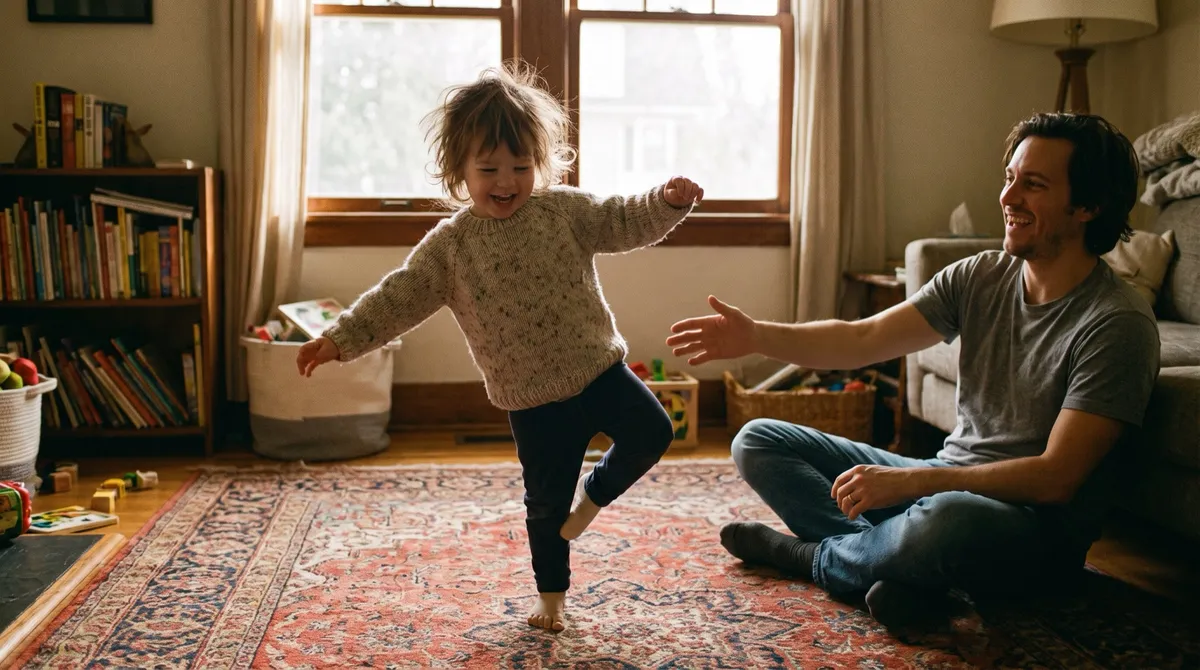
Kids' yoga works when it stops trying to be adult yoga made smaller. This guide gives you the whole toolkit: what changes at each age, twelve poses that fit growing bodies, breathing games that actually land, the boundaries that keep it safe, and an honest read on what the research does and doesn't show. One scope note before anything else: this guide is for children roughly three and up — walking, talking kids who can copy a shape and say how it feels. It is not for babies or toddlers; that's a different practice with its own safety rules, covered in our separate baby yoga guide.
Why Kids' Yoga Is a Different Sport
Adult yoga runs on stillness, long holds, and slow refinement. Children run on none of those things, and that's not a discipline problem — it's the design spec. The American Academy of Pediatrics points out that sitting still is genuinely hard for many kids — exactly why a movement-based practice like yoga makes a good first door into mindfulness: movement first, stillness later.[1]
So the unit of kids' yoga is not the pose held for a minute; it's the game — a shape that lasts four breaths, becomes an animal, gets a sound effect, and moves on. Play is the delivery mechanism; performance is beside the point. The AAP treats yoga as a safe and potentially effective support for children coping with emotional, mental, physical, and behavioral health conditions, and notes even student-athletes use it as cross-training to help prevent overuse injuries.[2]
You're in good company: 8.4% of U.S. children ages 4-17 practiced yoga in the 2017 National Health Interview Survey, and children's yoga use more than doubled between 2012 and 2017.[3][4] One framing note: yoga is a slice of a child's movement diet, not the whole plate. The NHS guideline is that children ages 5-18 should average at least 60 minutes of moderate-to-vigorous activity a day, across a variety that builds movement skills, muscles, and bones.[5] Yoga earns its place inside that variety, not instead of it.
The Hard Boundaries: What Children Skip Entirely
Read this before the poses; it governs every one of them. These are the lines the guide never crosses, each with an honest note on how firm the evidence is.
- No hot yoga. None. No authority addresses hot yoga for children by name, so we won't pretend one exists. What does exist is AAP guidance that children exercising in hot conditions risk heat exhaustion and heat stroke, because sweating may not cool a child enough, especially in high humidity.[6] A heated studio is that environment, engineered on purpose — and the AAP backs its guidance with a formal policy statement on heat stress in exercising children and adolescents.[7] Room temperature, always.
- No headstands, shoulder stands, or anything that loads the neck. The honest version: no pediatric injury statistics specific to inversions exist, so we won't cite any. We skip them anyway, as a plain precaution for a spine that's still growing. A child upside down on the head gains nothing a Downward Dog doesn't already give.
- No deep backbends and no extreme stretching. A precaution, not a finding — no yoga-specific pediatric study on backbends exists. But the AAP lists sprains, strains, growth plate irritation, and stress fractures — all from abnormal stress on growing tendons, joints, and bone — as the most frequent injuries in children.[8] Cranking a growing spine or hamstring to end range is abnormal stress with no upside. Gentle arcs and comfortable stretches only.
- No long holds in working poses. Poses that take effort last a few breaths, not the adult minute-plus — matching both the attention arcs pediatricians describe[1] and the light loading a growing body prefers. Rest shapes are the one exception: lying still in Starfish or folding into Mouse loads nothing, and a comfortable child can stay in those as long as they like.
- No adult-style hands-on adjustments. No injury registry backs this one either; it's a consensus caution among people who teach children, and ours too. An adult pressing a child deeper into a stretch removes the child's ability to feel and report their own limit. Cue with words, demonstration, and games — never with force.
- No competition, no flexibility as achievement. The AAP's own advice is that some poses are harder than others and even flexible kids in good shape should start slowly.[2] Being bendy is not a green light, and it's definitely not a trophy. This matters double for very flexible kids: the NHS notes joint hypermobility syndrome usually affects children and young people, and its main treatment is building muscle strength and fitness so joints are better protected.[9] The bendiest kid in the room may be the one who most needs strength instead of applause. No "party trick" poses, ever.
All this caution for something famously gentle? Low-risk is not no-risk. Yoga is generally a safe activity for healthy people when done properly under qualified instruction, with injuries — mostly sprains and strains — less common than in higher-impact sports.[3] But U.S. emergency departments recorded 29,590 yoga-related injuries across all ages from 2001 to 2014.[10] Supervision and age-appropriate shapes keep your kid on the right side of that math.
Ages and Stages: What Works When
The 3-5 / 6-9 / 10-14 split is everywhere in children's yoga. Honesty first: it's teaching convention, not a published clinical standard, though it lines up loosely with how the AAP bands children's capacity for calm practice — preschoolers a few minutes a day, grade-schoolers 3-10 minutes twice a day, teens 5-45 minutes.[1] Treat them as a starting guess your actual child gets to overrule.
Ages 3-5: Everything Is Pretend
At this age there is no yoga class, only a story with shapes in it. You are a cat, then a tree in the wind, then a mouse hiding in a cave. Rounds last a minute or two; a session is five to ten minutes and ends before anyone wants it to. Imitation beats instruction — do the pose yourself and narrate, don't correct. And it isn't a gimmick format: yoga has been formally studied in preschool-aged children in educational settings.[3] Success looks like giggling, roaring, and asking to do the frog one again.
Ages 6-9: Games, Stories, and Rules They Help Write
Grade-schoolers can follow a sequence if the sequence is an adventure — cross the river (lunges), climb the mountain (chair), surf the wave (Warrior II), set up camp (child's pose). They love partner games, freeze-and-hold challenges of a few breaths, and being the one who leads. This is also the age to hand over the safety language: teach "stop signals" out loud, so they know sharp or pinching feelings mean come out, no permission needed. A session of ten to twenty minutes of movement games works well at this age. Note that's longer than the AAP's guidance for the still kind of practice — for grade-schoolers it suggests 3 to 10 minutes of calm practice at a sitting, up to twice a day[1] — so keep the quiet portions (breathing games, final rest) inside that window and let the moving games carry the rest of the time.
Ages 10-14: Real Practice, Handled Gently
Tweens and young teens can do an honest practice — real alignment cues, breath linked to movement, sessions of twenty to thirty minutes. (For the still, quiet portions, the AAP gives teens a wide calm-practice band of 5 to 45 minutes,[1] so there's plenty of room.) Two things change in how you teach — both about the room, not the poses.
First, a growth spurt can change how a body feels to live in. A kid who folded in half at ten may feel wooden at twelve. Say it out loud — feeling tighter or clumsier during a growth spurt is a phase, not a flaw, and it's never something to stretch through aggressively.
Second, body image walks into the room at this age, so teach around it deliberately. Cue what bodies do ("press the floor away," "reach through your fingers"), never how they look. Skip mirrors, skip comparisons, skip any framing where the deepest stretch wins. To be clear: this is a teaching approach for a sensitive age, not a clinical intervention — nobody has shown yoga prevents body-image problems. For hypermobile teens, the NHS logic applies: strength protects joints, so build muscle around the bend instead of performing the bend.[9]
The Pose Library: Twelve Shapes That Fit Growing Bodies
Every entry follows the same anatomy: plain setup, what it helps, and the stop signals that mean come out now. You won't find age labels on the poses, and that's deliberate: no pediatric authority publishes pose-by-age cutoffs, so we won't invent them. Use the age bands above as your starting guess and your child's comfort as the referee — a coordinated four-year-old may love Rowboat while a lanky nine-year-old wobbles out of Tree, and both are fine. (The whole library assumes a child of about three and up; for babies and toddlers, see the baby yoga guide.) Holds stay short — three to five breaths for any working pose; the two rest shapes at the end, Mouse and Starfish, are the exception and can last as long as they stay comfortable. One rule sits above all: a shape should feel like work or like rest, never like pinching, sharpness, or joint pain. Yoga's good safety record assumes proper form and real supervision[3] — for kids, you are the supervision. Each entry is written to work from words alone; if a shape is hard to picture, do it yourself first and let your child copy you — at every age, imitation beats explanation.
Mountain · the reset button
- Stand with feet hip-width apart, weight even across both feet.
- Grow tall through the top of the head, shoulders easy, arms at the sides.
- Take three slow breaths. For little ones: "be a mountain nothing can push over."
What it helps: body awareness and a calm home base — the reset every game returns to between wilder poses.
Stop signals: almost none — this is the library's safest shape. The one correction: ask for "soft knees," not locked ones. Wiggling means move on.
Tree · the balance game
- Stand on one leg; place the other foot on the ankle or calf — never against the knee.
- Little kids keep toes on the floor like a kickstand.
- Hands together at the chest or grown into branches overhead; sway is allowed.
What it helps: balance, focus, and falling gracefully — wobbling is the exercise, so celebrate the wobble.
Stop signals: a foot jammed against the side of the knee (move it up or down), and crowded rooms — clear crash space, because kids topple with commitment.
Warrior II · the surfer
- Step the feet wide, turn one foot out, bend that knee like riding a surfboard.
- Stretch arms out front and back at shoulder height, eyes over the front hand.
- Three to five breaths, then surf the other way.
What it helps: honest leg strength — the joint-protecting muscle work very bendy kids need most.[9]
Stop signals: the front knee caving inward (cue "knee chases the middle toes") or any complaint from the knee itself rather than the thigh muscles.
Downward Dog · the puppy stretch
- Start on hands and knees, tuck the toes, lift the hips high to make a triangle.
- Knees stay bent as much as needed; heels don't have to touch the floor.
- Bark once if you like; come down after a few breaths.
What it helps: arm and shoulder strength plus a friendly upside-down feeling — all the inversion a child needs, with zero load on the neck.
Stop signals: wrist pain (rest, or drop to forearms) and red-faced, held-breath effort. Kids pop out of this fast; let them.
Cat-Cow · the moody cat
- On hands and knees, breathe out and round the back high like a hissing cat.
- Breathe in and let the belly drop, chest forward, like a cow saying moo.
- Flow between the two, one breath per shape, five rounds.
What it helps: spine mobility and the first taste of matching breath to movement — the skill everything older builds on.
Stop signals: any pinch in the lower back on the belly-drop half. Keep both halves small and comfortable; this is a ripple, not a crank.
Baby Cobra · the little snake
- Lie on the belly, hands flat under the shoulders, legs long.
- Press gently to lift the chest a little — think "hovering," not "climbing."
- Hiss on the way up if it helps. Lower after two or three breaths.
What it helps: back strength and a gentle counter to desk slouching. It stays low on purpose — deep bends are on the skip list as a growing-spine precaution.
Stop signals: lower-back pinching, or arms straining the chest higher. Height is not the goal; the back muscles do the lifting, lightly.
Butterfly · the flapper
- Sit tall, soles of the feet together, knees out to the sides.
- Hold the feet like a book and flap the knees gently — slow flaps, not fast bounces.
- Older kids can hinge forward a little with a long back.
What it helps: comfortable hips after chair-heavy school days and a natural slot for wind-down talk.
Stop signals: anyone — including a helpful grown-up — pressing the knees toward the floor. Never. For hypermobile kids the stretch's edge is not the target; the NHS approach to very mobile joints is strength, not more range.[9]
Frog Squat · the ribbit
- Stand with feet a bit wider than hips, toes turned out slightly.
- Sink into a low squat, hands to the floor or pressed together at the chest.
- Ribbit. Hop once if the floor is soft. Stand and repeat.
What it helps: ankle and hip mobility kids still have and adults pay to recover. Squatting is worth keeping.
Stop signals: knee pain, or heels forced flat when they want to lift — let them lift, or slide a folded towel underneath. Hopping stops on any hard floor.
Rowboat · the core game
- Sit facing your kid (or between two kids), knees bent, feet on the floor.
- Lean back slightly with a long, proud back until the tummy switches on.
- Row an imaginary oar together — add a sea shanty for full effect.
What it helps: core strength through play instead of sit-ups — the library's best partner pose.
Stop signals: a collapsing lower back or a strained, jutting neck. When the boat sinks, the row is over — short rounds beat one long slog.
Happy Baby · the rock-and-roll
- Lie on the back, hug the knees, then hold the outside of each foot.
- Let the knees drift toward the armpits, soles facing the ceiling.
- Rock gently side to side like a happy baby, which requires no acting.
What it helps: easy hip release and reliable giggles; a natural bridge from active poses toward rest.
Stop signals: yanking the feet or jamming the chin to the chest. If the feet are out of reach, hold behind the knees — same pose, zero struggle.
Mouse · Child's Pose, the quiet cave
- Kneel, sit back toward the heels, and fold forward, forehead toward the floor.
- Arms stretch forward or rest back by the feet — the mouse hides in its cave.
- Stay as long as it feels good. This pose is always allowed, mid-game, no questions.
What it helps: self-regulation. Teaching a child "when it's too much, take Mouse" hands them an exit they'll use for life.
Stop signals: complaining knees — widen them or tuck a pillow between hips and heels. If breathing feels squashed, rest folded arms under the forehead.
Starfish · the stillness game
- Lie on the back, arms and legs spread wide like a starfish on a rock.
- Close the eyes if that feels okay; blink at the ceiling if not.
- The game: be so still a crab could walk past without noticing — thirty seconds for little kids, two or three minutes for older ones.
What it helps: the wind-down — the kids' version of final rest. Framing stillness as a game is what makes it land at ages when sitting still is genuinely hard.[1]
Stop signals: none — only an ending. Wiggles mean the timer ran out early today; tomorrow's starfish may hold longer.
Breathing Games: Bunny Breath and Balloon Belly
Two games cover most of what a child needs. Honesty first, because the internet is careless here: no clinical trial has tested "bunny breath" or "balloon belly" by name. What health authorities endorse is the technique underneath — slow, unforced belly breathing. The NHS teaches exactly this for stress and anxiety: breathe deep into the belly without forcing, in through the nose and out through the mouth, counting steadily to five, a few minutes at a time, done regularly.[11] The games are kid packaging around that endorsed core.
Balloon Belly
Hands on the tummy, lying down or sitting. Breathe in slowly through the nose and inflate an imaginary balloon under the hands — feel it rise. Breathe out slowly and let it deflate all the way, no squeezing. Pick the balloon's color together; five balloons make a round. It's the NHS calming technique, translated for a four-year-old.[11]
Bunny Breath
Sit tall like a rabbit sniffing the air: three quick sniffs in through the nose, then one long, slow sigh out through the mouth. Three or four rounds. The game smuggles in the same slow, unforced out-breath the NHS builds its calming exercise around.[11] Use it as the pressure valve: the AAP recommends a few deep breaths at exactly these moments — before tests, hard questions at school, and when big feelings run the show.[1]
Finding a Class or Teacher
Home practice needs nothing but this guide and a bit of floor. If you want a class, the good news is that the hard boundaries above double as your shopping list — a teacher who respects them is worth keeping.
Ask before you book:
- "What training do you have in teaching children specifically?" Dedicated children's-yoga training programs exist; a wonderful adult-yoga teacher is not automatically a good kids' teacher. You want someone who can say concretely how they teach a five-year-old differently from a twelve-year-old.
- "How big is the class, and can I watch one first?" Small groups mean real supervision — and yoga's good safety record assumes exactly that.[3] A teacher confident in their class will happily let you observe.
- "What does a session look like?" The right answer sounds like games, animals, and short holds. If it sounds like a shrunken adult class — long holds, alignment drills, quiet discipline — keep looking.
Walk away if you see: a heated room (children's heat risk carries formal AAP guidance[6]); hands-on adjustments that press children deeper into stretches; any competitive framing — pose contests, flexibility praise, "who can hold longest"; or a teacher who treats a child asking to stop as a problem to fix rather than a signal to respect.
Yoga in the Classroom
If you teach, you're on defensible ground. The AAP encourages teachers to build mindfulness training into lesson plans and points to school-setting studies showing improved attention and behavior; one study it cites, of yoga during PE classes, reduced teens' mood problems and anxiety.[1][2] That same PE study reported higher test scores — one study; don't promise report cards. A 2016 review of 47 published school-yoga studies concluded school-based yoga is "viable and potentially efficacious" for child and adolescent health, while saying plainly that most trials are preliminary, with small samples and weak designs.[12]
Classroom yoga works best as micro-doses: three to five minutes at transitions — after recess, before a test, in the post-lunch slump. Mountain, a round of Cat-Cow at the desks, and ten balloon-belly breaths need no mats. Keep it invitation, not requirement, and don't let the competitive kids turn Tree into a tournament.
Yoga at Bedtime
Keep the claim honest: nobody has proven yoga improves children's sleep — evidence for breathing and meditation around sleep is suggestive, not settled. What's solidly recommended is the container: the AAP advises a consistent, manageable bedtime routine and calm wind-down environment for school-aged kids, with weekend wake-ups within about an hour of usual.[13] It also suggests building deep breathing into the nightly routine to help kids wind down.[1]
A five-minute wind-down that slots in: Butterfly (two minutes of flapping and talking about the day) → Happy Baby (one minute) → Mouse (one minute) → Balloon Belly in bed, lights low. Same order every night; predictability does half the work.
When to Call the Pediatrician
Yoga sits alongside pediatric care, never instead of it. Call, or bring it up at the next visit, when:
- A bone hurts at one exact spot. In a growing child, point tenderness over a bone should be evaluated by a medical provider even without swelling or limited motion — an AAP red flag, because growing bones fail differently than adult ones.[8]
- You suspect hypermobility. Repeated sprains, joint pain and stiffness, dislocations, or poor balance in a very flexible kid are the NHS's listed signs — get them assessed; the plan (strength-building) changes how you'd use yoga.[9]
- A health condition is in play. Any diagnosis — asthma, a heart condition, anxiety under treatment — means checking in before starting and telling the instructor.
- You're tempted to swap yoga for treatment. Don't. NIH's center for complementary health is unambiguous: never replace or delay conventional care or prescribed medications with a complementary practice, and tell the pediatrician about every approach your child uses so care stays coordinated.[14]
What the Research Actually Shows
The straight version, because inflated claims are one search away.
Anxiety: the most promising lane, with caveats. A 2020 systematic review of 27 studies (1,805 children and teens) found roughly 70% showed improvements in anxiety or depression symptoms after yoga, stronger for anxiety than depression — and rated study quality weak to moderate.[15] NIH's complementary-health center puts mindfulness and yoga among the approaches with the best evidence of helping children with symptoms like anxiety and stress, and notes they're low-risk.[14]
Attention: early and small. A randomized waitlist-controlled trial followed 23 preschoolers with elevated ADHD symptoms through six weeks of yoga and measured better attention — faster reaction times, fewer distractibility errors — clearest in kids with the most severe starting symptoms.[16] Twenty-three kids is a pilot, not proof; nothing here says yoga treats ADHD.
School programs: encouraging, not established. Beyond the 2016 review,[12] a 2023 review of 21 school-based randomized-trial papers (children roughly 5-15) called the mental-health evidence "encouraging" while flagging small samples and thin reporting — school yoga as preventive support, not proven treatment.[17]
The professional stance. The AAP's clinical report on mind-body therapies states a growing body of evidence supports their effectiveness and safety — yoga and meditation included — as nonpharmacologic help for concentration, pain, discomfort, and anxiety in children.[18] "Growing" is the operative word: this research goes back decades but stays thin. A 2009 review found only 34 controlled pediatric yoga studies across nearly thirty years, many of low methodological quality.[19]
The honest sell is modest and real: a low-risk, well-liked practice with genuine early evidence for anxiety, stress, and attention — a complement to good pediatric care, movement, and sleep, never a substitute. For a family activity that costs a mat and twenty minutes, modest and real is plenty.
Sources
- American Academy of Pediatrics / HealthyChildren.org — Just Breathe: The Importance of Meditation Breaks for Kids
- American Academy of Pediatrics / HealthyChildren.org — Permission to Unplug: The Health Benefits of Yoga for Kids
- National Center for Complementary and Integrative Health — Yoga: Effectiveness and Safety
- NCCIH — National Survey Reveals Increased Use of Yoga and Meditation Among U.S. Children
- NHS — Physical Activity Guidelines for Children and Young People
- American Academy of Pediatrics / HealthyChildren.org — How to Keep Young Athletes & Active Kids Safe in Hot Weather
- AAP Council on Sports Medicine and Fitness — Policy Statement: Climatic Heat Stress and Exercising Children and Adolescents. Pediatrics, 2011 (Europe PMC)
- American Academy of Pediatrics / HealthyChildren.org — Tips to Prevent Sports Injuries in Children & Teens
- NHS — Joint Hypermobility Syndrome
- Swain TA, McGwin G. Yoga-Related Injuries in the United States From 2001 to 2014. Orthopaedic Journal of Sports Medicine, 2016 (Europe PMC)
- NHS — Breathing Exercises for Stress
- Khalsa SBS, Butzer B. Yoga in School Settings: A Research Review. Annals of the New York Academy of Sciences, 2016 (Europe PMC)
- American Academy of Pediatrics / HealthyChildren.org — Bedtime Routines for School-Aged Children
- NCCIH — Children and the Use of Complementary Health Approaches
- James-Palmer A, et al. Yoga as an Intervention for the Reduction of Symptoms of Anxiety and Depression in Children and Adolescents: A Systematic Review. Frontiers in Pediatrics, 2020 (Europe PMC)
- Cohen SCL, et al. Effects of Yoga on Attention, Impulsivity, and Hyperactivity in Preschool-Aged Children with ADHD Symptoms. Journal of Developmental & Behavioral Pediatrics, 2018 (Europe PMC)
- School-Based Yoga and Children's Mental Health: Review of 21 Randomized-Trial Papers. Clinical Child Psychology and Psychiatry, 2023 (Europe PMC)
- AAP Section on Integrative Medicine — Mind-Body Therapies in Children and Youth. Pediatrics, 2016 (Europe PMC)
- Birdee GS, et al. Clinical Applications of Yoga for the Pediatric Population: A Systematic Review. Academic Pediatrics, 2009 (Europe PMC)
This guide is educational and is not medical advice. Children's bodies, health histories, and needs differ, and no article can account for yours. For any concern — an injury, a health condition, unusual flexibility, or a question about whether a practice fits your child — talk with your pediatrician before starting or continuing.